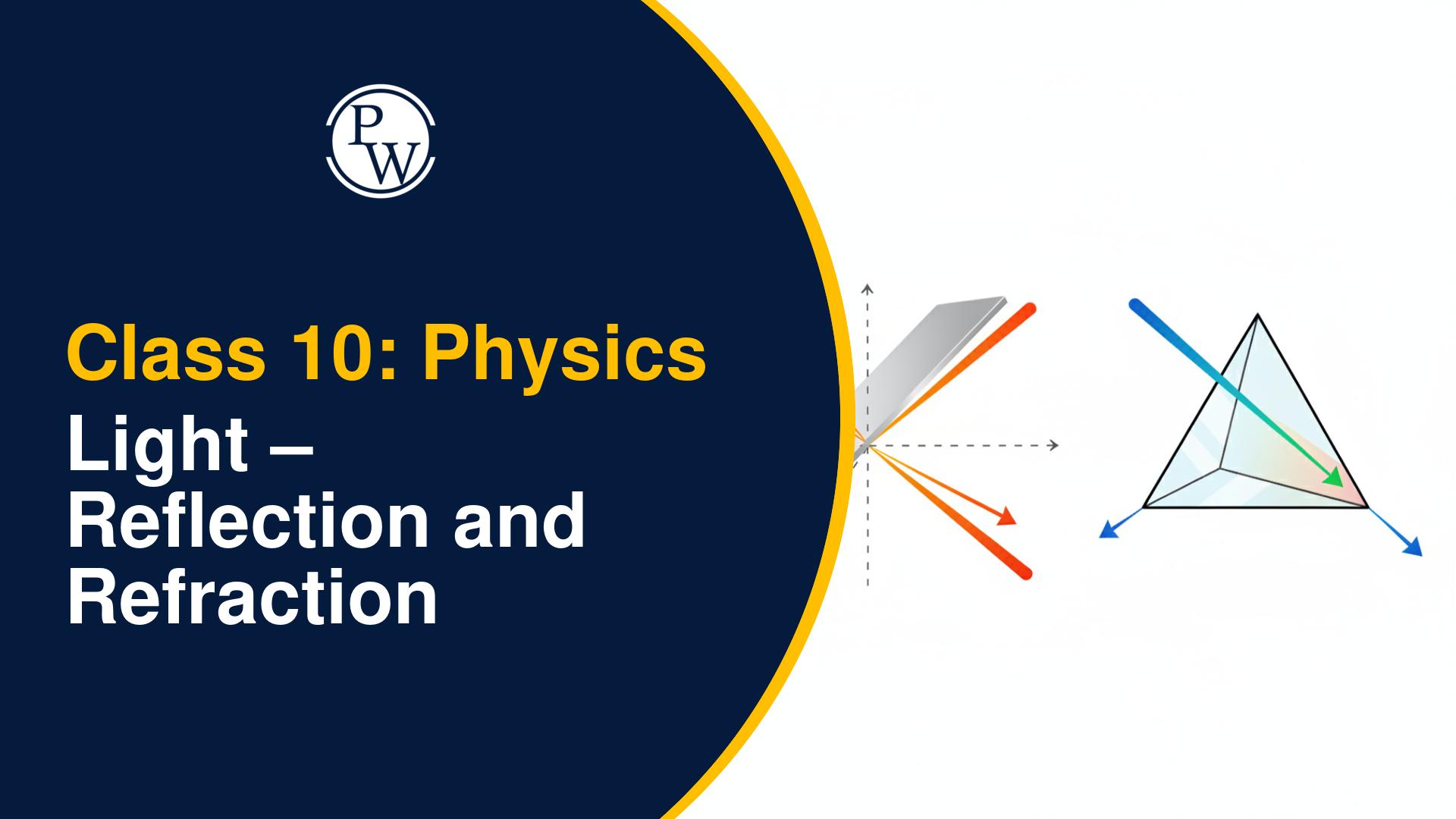
Light Reflection and Refraction Class 10 Notes
Light Reflection and Refraction Class 10 Notes provide a study guide for the CBSE NCERT Science Chapter 10 in Physics. This important chapter defines the fundamental phenomena that govern the behaviour of light, including Reflection and refraction of light.
Mastering these concepts is important for understanding optics, the working of human eyes, and the function of instruments like cameras, microscopes, and telescopes.
Reflection of Light and Spherical Mirrors
Reflection is the phenomenon where light, upon striking an interface between two different media, returns into the medium from which it originated. For a highly polished surface like a mirror, almost all the light is reflected.
Laws of Reflection
The law of reflection always follows two fundamental laws:
| Two Laws of Reflection | |
| Law | Description |
| First Law of Reflection | The incident ray, the reflected ray, and the normal to the surface at the point of incidence all lie in the same plane. |
| Second Law of Reflection | The angle of incidence (∠i) is equal to the angle of reflection (∠r), i.e., ∠i = ∠r. |
Spherical Mirrors: Concave and Convex
Spherical mirrors are reflecting surfaces that are part of a hollow sphere of glass.
A concave mirror is a mirror whose reflecting surface is curved inwards (like the inside of a spoon or a cave). It is also known as a converging mirror because it makes parallel rays of light converge at a single point after reflection.
A convex mirror is a mirror whose reflecting surface is curved outwards. It is known as a diverging mirror because it makes parallel rays of light appear to diverge from a single point after reflection.
Refraction of Light and Snell's Law
Refraction is the phenomenon of the change in direction (bending) of a light ray when it passes obliquely from one transparent medium to another. This happens because the speed of light is different in different media.
Laws of Refraction
Similar to reflection, refraction is also governed by two laws:
- First Law: The incident ray, the refracted ray, and the normal to the interface of the two transparent media at the point of incidence all lie in the same plane.
- Second Law (Snell's Law): The ratio of the sine of the angle of incidence (angle i) to the sine of the angle of refraction (angle r) is constant for a given pair of media. This constant is called the refractive index (n).
sin i / sin r = constant = n₂₁
Here, n₂₁ is the refractive index of the second medium (where the light is refracted) with respect to the first medium (where the light is incident).
The refractive index is also related to the speed of light:
n₂₁ = (Speed of light in medium 1) / (Speed of light in medium 2)
Spherical Lenses and Power of a Lens
A lens is a transparent material bounded by two surfaces, of which one or both surfaces are spherical. A convex lens is thicker at the centre than at the edges. It is a converging lens that focuses light rays. A concave lens is thinner at the centre than at the edges. It is a diverging lens that spreads light rays.


Have questions about your prep?
Our experts can answer all your questions