Tissues, Class 9 Science Notes
Tissues are groups of similar cells that carry out particular functions in plants and animals. They help in growth, repair, protection, and coordination.
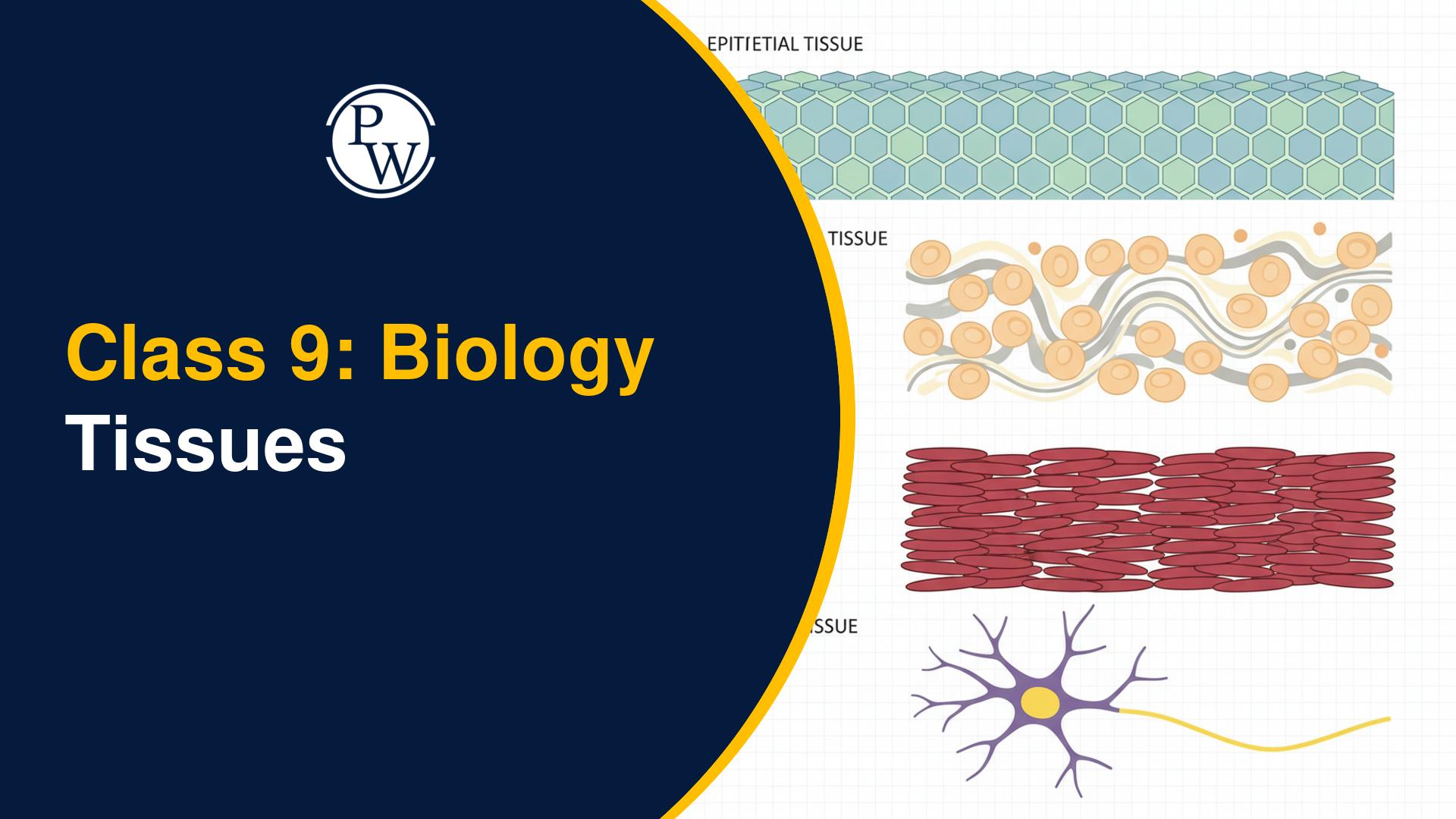
Plant tissues are of two kinds: meristematic and permanent, while animal tissues are epithelial, connective, muscular, and nervous, all combining for survival and efficient functioning.
What Are Tissues?
A tissue is a group of cells having similar structure and performing a specific function. In multicellular organisms, cells combine to form tissues, which then form organs and organ systems.
Levels of Organisation
Levels of organisation describe the way life is structured from simple to complex forms: cells make tissues; tissues make organs; organs form systems that work together to maintain life.
- Cell - The basic structural and functional unit of life.
- Tissue - A group of similar cells performing a particular task.
- Organ - Tissues working together for one function.
- Organ System - Organs that perform similar functions together.
Types of Tissues
There are two main types of tissues found in living organisms based on their structure and function. Plant tissues help in growth and transport, while animal tissues perform protection, movement, and coordination.
Plant Tissues
There are mainly two types of tissues found in living organisms based on their structure and function. In plants, the tissues perform the function of growth and transportation, whereas in animals, tissues take part in protection, movement, and coordination.
1. Meristematic Tissue
These cells are actively dividing, contributing to the growth of plants.
- Apical Meristem - Present at root and shoot tip, promotes length.
- Intercalary Meristem - Present at leaf bases or nodes, promotes regrowth.
- Lateral Meristem - On stem and root sides, increases thickness.
2. Permanent Tissue
These are formed when meristematic cells cease to divide.
- Simple Tissues - Composed of a single kind of cell.
- Parenchyma: Stores food and assists in photosynthesis.
- Collenchyma: Provides flexible support.
- Sclerenchyma: Provides strength and rigidity.
- Complex Tissues - Composed of different kinds of cells.
- Xylem: Transports water and minerals.
- Phloem: Transports food from leaves.
Animal Tissues
Animal tissues are groups of cells that work together to protect the body, support movement, transport materials, and coordinate body functions.
1. Epithelial Tissue
Forms body coverings and linings. It protects and aids in absorption and secretion.
Types: squamous, cuboidal, columnar, and glandular.
2. Connective Tissue
Joins and supports body parts.
Examples include: Bone, cartilage, ligaments, tendons, and blood.
3. Muscular Tissue
It allows movement by contracting and relaxing.
Types: skeletal (voluntary), smooth (involuntary), and cardiac (heart).
4. Nervous Tissue
Composed of neurons that conduct impulses. Controls and coordinates body actions using the cell body, dendrites, and axon.