Matter in Our Surroundings Class 9 Chemistry
Matter in Our Surroundings is one of the first chapters in the Class 9 of Chemistry subject. It helps students to understand what matter is and how it will behave in different forms. The chapter will explain the physical nature of matter, its properties, and the changes that it undergoes. Learning this topic will build a strong base for students to understand Chemistry in higher classes.
Introduction to Matter
Matter in Our Surroundings starts with a simple idea that everything around us is made of matter. Matter is anything that has mass and occupies space. The chair we sit on, the air we breathe, and the water we drink are all examples of matter. Things like love, anger, or happiness do not matter because they do not have mass or occupy space.
Physical Nature of Matter
Matter in Our Surroundings teaches that matter is made up of very tiny particles. These particles are too small to see with the naked eye. The particles have spaces between them, are always moving, and attract each other. This explains many everyday activities. For example, when sugar dissolves in water, the water level does not rise because sugar particles fill the spaces between water molecules.
Characteristics of Particles
According to Matter in Our Surroundings, particles of matter have three main features:
- They have space between them: This allows substances to mix easily.
- They are always moving: This movement is called diffusion.
- They attract each other: The strength of attraction differs in solids, liquids, and gases.
States of Matter
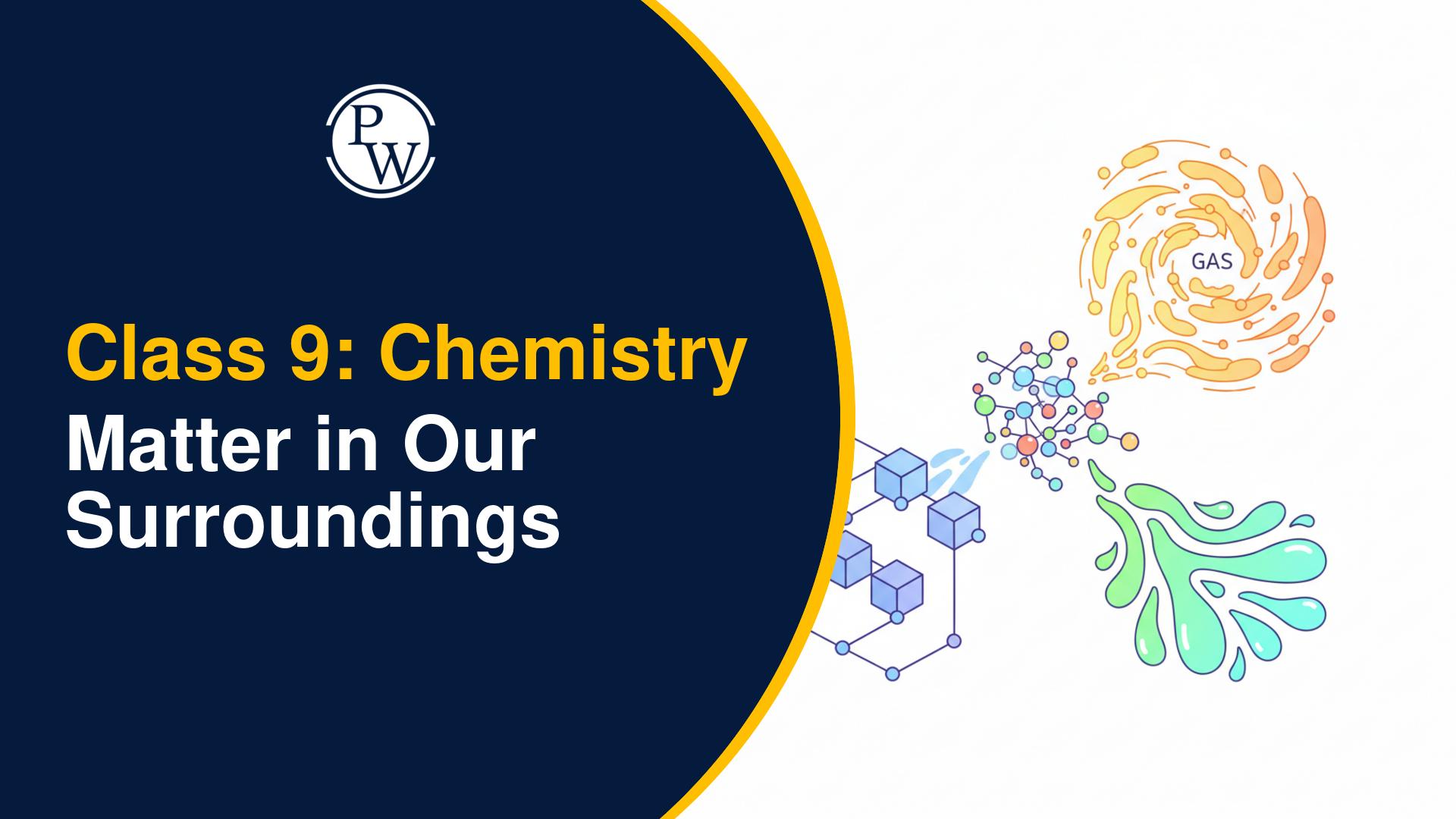
Matter in Our Surroundings explains that matter exists mainly in three states: solid, liquid, and gas.
- Solids have a fixed shape and volume. The particles are closely packed and cannot move freely. Solids are rigid and not easily compressible.
- Liquids have a fixed volume but no fixed shape. They take the shape of the container. The particles are less tightly packed than in solids, and they can move over one another.
- Gases have neither a fixed shape nor a fixed volume. The particles are far apart and move very fast. Gases can be compressed easily.
Change of State
Matter in Our Surroundings also explains that matter can change from one state to another. A solid changes to a liquid on heating (melting), and a liquid changes to a gas (vaporization). Similarly, cooling can turn a gas into a liquid (condensation) or a liquid into a solid (freezing). Some solids, like camphor, change directly into a gas. This process is called sublimation.
Latent Heat and Temperature
Matter in Our Surroundings introduces the concept of latent heat. It is the heat energy needed to change the state of matter without changing its temperature. For example, during melting or boiling, the temperature remains constant even though heat is supplied.
Evaporation
Evaporation is another important part of Matter in Our Surroundings. It happens when a liquid changes into a gas at any temperature below its boiling point. Evaporation causes cooling. For instance, sweat cools our body because it absorbs heat as it evaporates. The rate of evaporation increases with temperature, wind speed, and surface area but decreases with humidity.