Linear Equations in Two Variables Notes Class 9
In mathematics, an equation is used to model real-world situations, such as relationships between costs, distances, or ages. Equations are classified based on the number of variables they contain and the highest power of those variables. While equations with one variable (like 2x+5=10) yield a single solution, those with two variables present a unique challenge and opportunity. These equations are known as linear equations in two variables. They allow us to visualize the algebraic relationship as an infinite set of points forming a straight line.
The General Form
A linear equation in two variables is an equation that can be written in the General Form:
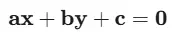
Where:
- x and y are the two variables.
- a, b, and c are real numbers.
-


Solution of a Linear Equation
The solution to a linear equation in two variables is an ordered pair of values x, y that makes the equation a true statement.
- Unlike one-variable equations, a linear equation in two variables has infinitely many solutions.
- For example, for the equation x+y=5, the pairs (3, 2), (0, 5), (6, -1), and many others are all valid solutions.
Graph of a Linear Equation
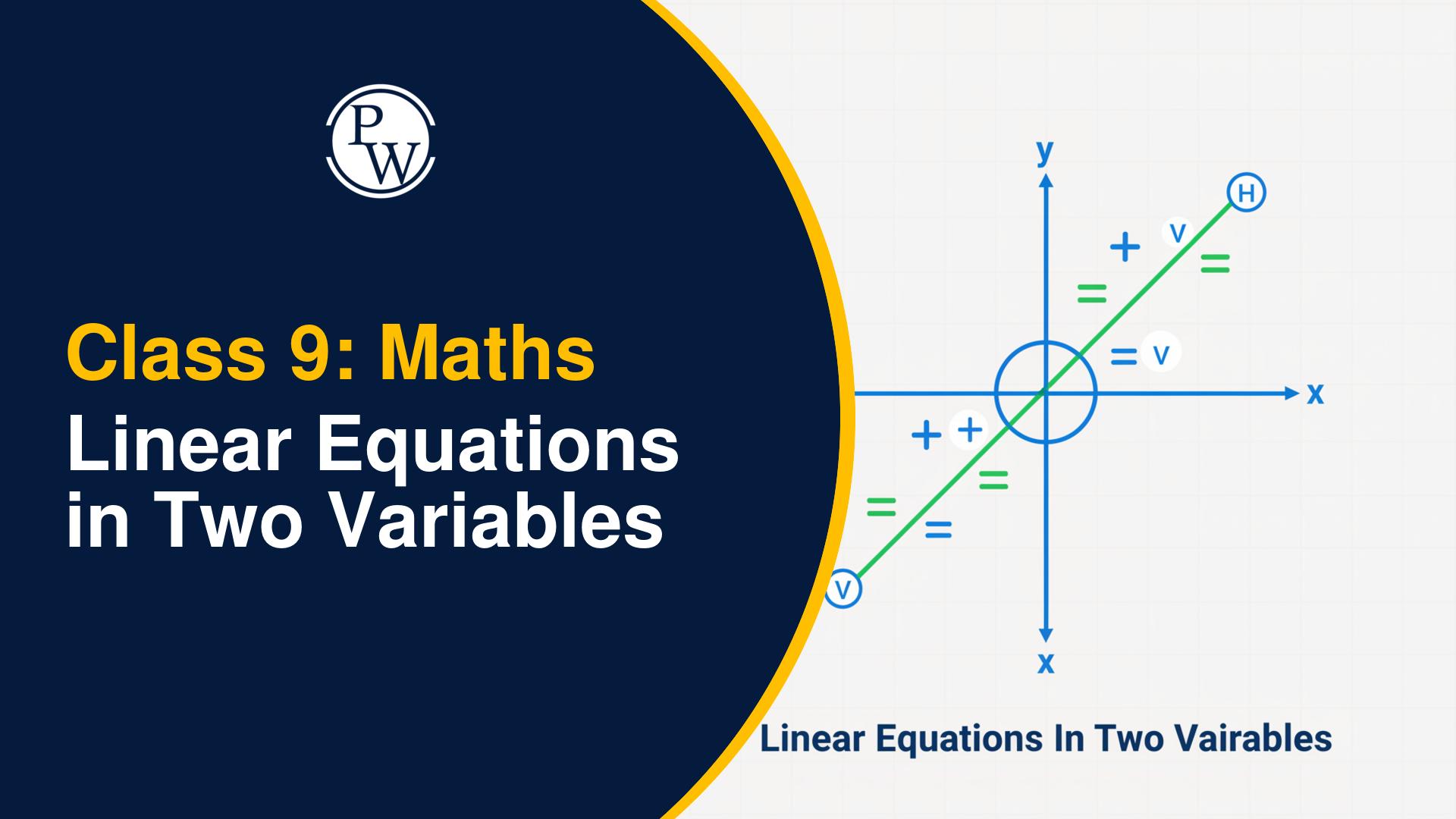
The most visual and defining feature of a linear equation in two variables is its graph. When the infinite solutions of the equation are plotted on the Cartesian coordinate plane, they always lie on a perfectly straight line.
- Drawing the Line: Since a straight line is uniquely determined by just two distinct points, we technically only need to find two solutions to draw the graph. However, it is a recommended practice to find at least three solutions. The third point acts as a check; if all three points lie on the same straight line, the solutions are correct.
- Equations of Axes:
- The equation of the X-axis is y = 0. (Every point on this line has a y-coordinate of 0).
- The equation of the Y-axis is x = 0. (Every point on this line has an x-coordinate of 0).
Converting Statements to Equations
A key application is translating real-world sentences into the ax + by + c = 0 format. This process is used to model problems involving costs, comparisons, or number patterns (such as two-digit number reversals, which use the concept Number = 10y + x).
'The cost of a notebook is twice the cost of a pen.'
- Define Variables: Let x be the cost of the notebook, and let y be the cost of the pen.
- Formulate Equation: x = 2y.
- General Form: 1x + (-2)y + 0 = 0.
Statement: 'The sum of a two-digit number and the number obtained by reversing the order of its digits is 121.'
- Original Number: 10y + x
- Reversed Number: 10x + y
- Formulate Equation: (10y + x) + (10x + y) = 121
- Simplify: 11x + 11y = 121
- Simplified General Form: x + y - 11 = 0 (dividing by 11).