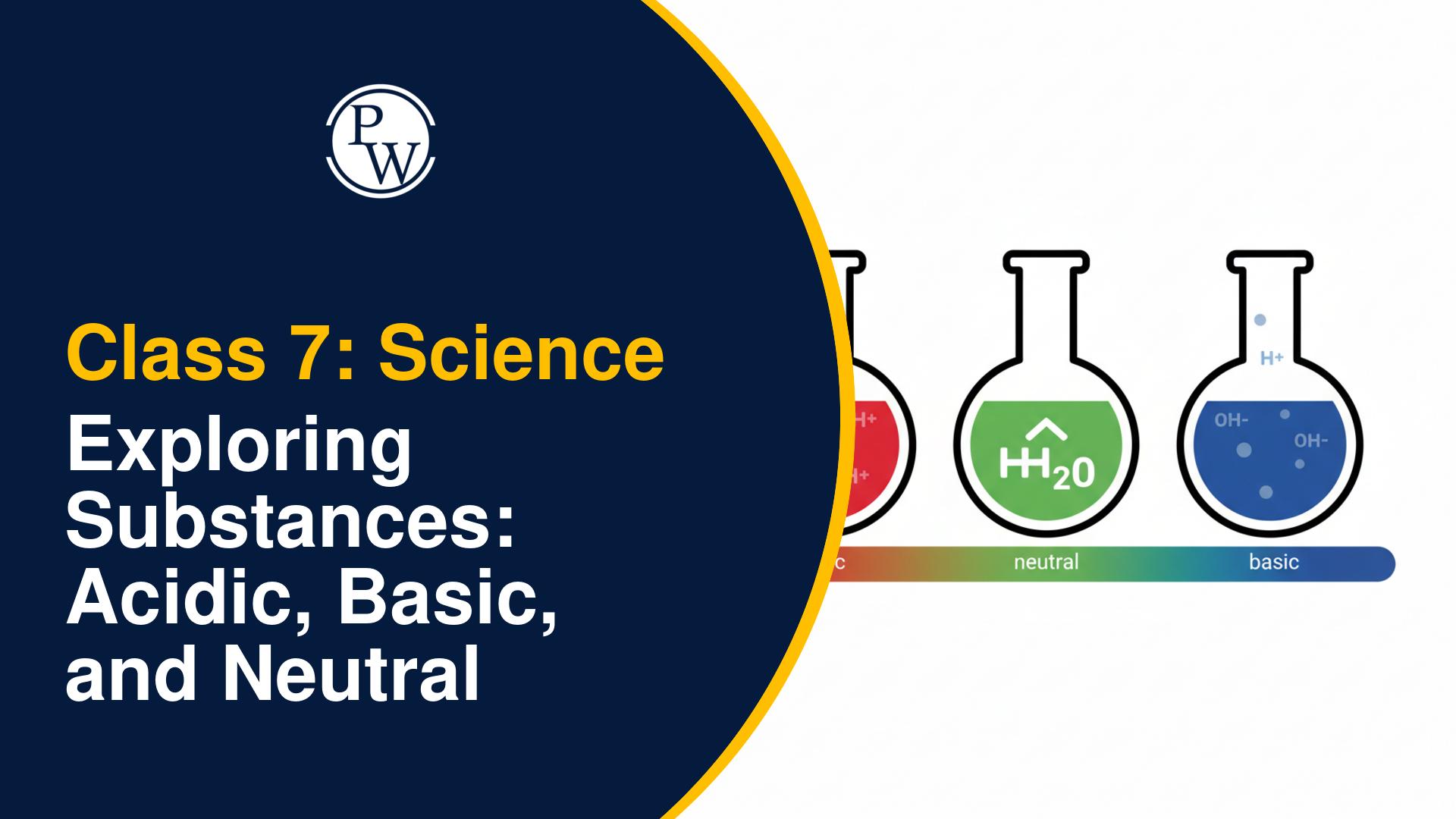
Exploring Substances: Acidic, Basic, and Neutral Class 7 One Shot
Exploring Substances: Acidic, Basic, and Neutral chapter introduces students to common substances in daily life and how they can be categorized as acidic, basic, or neutral. These are differentiated by their taste, chemical nature, and behavior with indicators. Acids and bases surround us, from the food we consume to household items. Understanding their properties is important because of this.
Nature of Acids, Bases, and Neutral Substances
Acids are substances that have a pH of less than 7 and commonly possess a sour taste, such as lemon juice or vinegar.
Bases are substances with a pH greater than 7, usually tasting bitter and having a slippery feel as well; some common bases include baking soda and soap.
Neutral substances are those near pH 7 and do not change the color of indicators; examples include sugar and salt. The pH scale runs from 0 to 14 and is used to correctly classify different substances.
Indicators and Their Role in Testing
Indicators are defined as those substances that give characteristic color or smell changes to indicate whether a substance is acidic, basic, or neutral. They make testing safe and uncomplicated, allowing us to easily differentiate substances without tasting or direct contact.
Natural Indicators
Indicators are those substances that show the acidic, basic, and neutral nature of solutions by changing their color or odour. Some natural indicators used in this chapter are litmus paper, turmeric, red rose, and red cabbage extracts. For example, blue litmus turns red in acids while red litmus turns blue in bases.
Turmeric paper remains yellow in acids and neutral solutions but turns red-brown in bases. The red rose extract turns red in acid and green in base solution.
Synthetic and Olfactory Indicators
Synthetic indicators such as phenolphthalein and methyl orange are man-made and are also used in labs. Olfactory indicators change their smell depending on acidity or alkalinity; onion and vanilla extracts are common examples.
Acid-Base Neutralization and Everyday Uses
Neutralization involves the action of an acid reacting with a base to form a salt, water, and heat-as an exothermic reaction. It is useful in many daily situations, including:
- Baking soda (base) is used to neutralize formic acid from an ant sting to relieve pain.
- Application of lime on acidic soil to prepare the soil for agriculture.
- Neutralizing industrial acidic waste with bases before releasing it into water bodies to protect aquatic life.
- The basic nature of toothpaste neutralizes the acids produced by bacteria in the mouth, hence protecting teeth.
The balanced chemical reaction can be written as:
Acid+Base→Salt+Water+Heat
Acid+Base→Salt+Water+Heat



Have questions about your prep?
Our experts can answer all your questions