





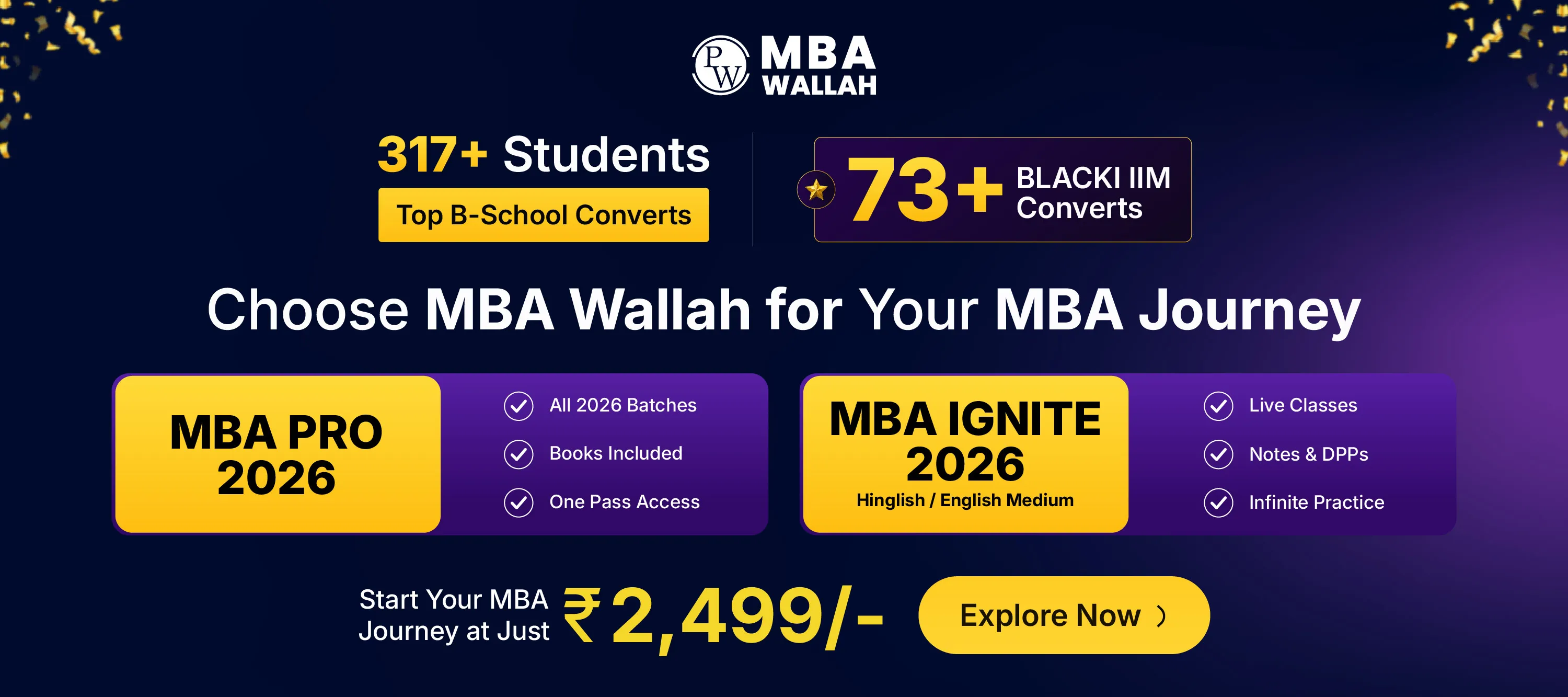



MBA Entrance Exam Preparation 2026 with MBA Wallah


Explore More Information About MBA
The CAT 2026 notification has been officially released, marking the beginning of the admission process for MBA programmes offered by the Indian Institutes of Management (IIMs). Candidates planning to appear for the exam should now begin tracking the registration dates, eligibility criteria, application process, and important deadlines.
PW MBA Wallah supports your MBA preparation with concept-based learning, regular mock tests, practice questions, and guidance from experienced faculty. Whether you are starting your preparation or revising key topics, you can prepare systematically while staying updated with the latest announcements.
CAT 2026 Notification and Latest Updates
The Common Admission Test (CAT) 2026 notification was officially released by IIM Indore on July 26, 2026. Check all the key updates announced, including exam dates, registration schedule, test city allotment, admit card timeline, and eligibility criteria for a more focused preparation.
| Update | Details |
|---|---|
| Exam Date | November 29, 2026 (Sunday), conducted in three sessions |
| Test Duration | 120 minutes total |
| Exam Sections | Section I: Verbal Ability and Reading Comprehension; Section II: Data Interpretation and Logical Reasoning |
| Sectional Timing | Exactly 40 minutes per section; switching between sections is not allowed |
| Registration Window | Opens 10:00 a.m., August 3, 2026 and closes 5:00 p.m., September 15, 2026 |
| City Allotment | After the last date of registration, one of the five preferred cities is allotted, subject to availability; if none of the preferred cities can be allotted, a nearby city is assigned instead |
| Admit Card | Downloadable from November 4, 2026 until November 29, 2026 |
| Official Website | https://iimcat.ac.in |
| Eligibility – Academic Qualification | Candidate must hold a Bachelor's Degree with at least 50% marks or equivalent CGPA (45% for SC, ST, and PwBD candidates), awarded by a recognised University or educational institution |
| Eligibility – Final Year Candidates | Candidates in the final year of their Bachelor's degree, with the required percentage, are also eligible to apply |
| Percentage/CGPA Calculation | Percentage of marks is calculated as per the practice followed by the candidate's University/Institution; where grades/CGPA are awarded, conversion to percentage follows the procedure certified by that University/Institution |
Benefits of Choosing Physics Wallah for MBA Coaching | CAT & GMAT
MBA Wallah helps you prepare smartly for CAT, GMAT, and other MBA exams in India with focused learning, strong practice, and reliable guidance.
Why students choose Physics Wallah:
- Clear syllabus coverage
Learn exactly what comes under the MBA entrance exam syllabus so your preparation stays focused and efficient. - Exam-aligned preparation
Study and practise based on real CAT and GMAT exam patterns, not generic aptitude content. - Strong practice volume
Access 80 chapter-wise tests, 20 full-length mocks, and 4,500+ practice questions to improve speed and accuracy. - Daily consistency support
Build discipline with 1,000+ free daily quiz questions for regular revision and practice. - Experienced faculty guidance
Learn from faculty with 15 to 24 years of teaching experience across Quant, DILR, and VARC. - Flexible learning access
Revise anytime with 5,500+ live and recorded lectures, suited for different study schedules.

MBA Entrance Preparation Led by Experienced Faculty
MBA Wallah’s Online CAT entrance preparation is led by experienced faculty specialising in Quant, DILR, and VARC, ensuring focused, exam-aligned guidance for CAT, OMETs, and GMAT aspirants.
CAT & OMETs Faculty
| Faculty Name | Section | Experience |
| Rahul Bathla Sir | Quantitative Aptitude | 15+ Years |
| Vinit Kakriya Sir | Quantitative Aptitude | 15+ Years |
| Gourav Gupta Sir | Data Interpretation & Logical Reasoning (DILR) | 18+ Years |
| Amit Surana Sir | Data Interpretation & Logical Reasoning (DILR) | 15+ Years |
| Juhi Narula Ma’am | Verbal Ability & Reading Comprehension (VARC) | 15+ Years |
| Vikrant Kathuriya Sir | Verbal Ability & Reading Comprehension (VARC) | 24+ Years |
GMAT Faculty
| Faculty Name | Section | Experience |
| Rahul Bathla Sir | Quantitative Aptitude | 15+ Years |
| Juhi Narula Ma’am | Verbal Ability & Reading Comprehension (VARC) | 15+ Years |
| Vikrant Kathuriya Sir | Verbal Ability & Reading Comprehension (VARC) | 24+ Years |
CAT & OMETs Batches by MBA Wallah
| Batch Name | Focus | Start – End |
| MBA Fastrack 2026 (CAT + OMETs) | Fast Paced Batch for CAT & OMETs 2026 Aspirants | 08 Aug 2026 - 31 March 2027 |
| MBA IGNITE 2026 (CAT + OMETs) | Targeted Batch for CAT & OMETs 2026 Aspirants | 02 Jun 2026 - 30 Apr 2027 |
| MBA ELITE WEEKEND 2026 (CAT + OMETs) | Weekend Prep Program for CAT & OMET Aspirants | 09 May 2026 - 30 Apr 2027 |
| MBA Pro 2026 (CAT + OMETs) | Targeted Batch for CAT & OMETs 2026 Along with advanced resources and personalized mentorship | 13 Oct 2025 - 31 Mar 2027 |
| MBA PIONEER 2026 (CAT + OMETs) | Students targeting CAT & OMETs 2026 | 15 Dec 2025 - 31 Mar 2027 |
| MBA ELITE 2026 (CAT + OMETs) | For Elite Preparation of CAT & OMETs 2026 | 16 Feb 2026 - 31 Mar 2027 |
GMAT Batches by Physics Wallah
| Batch Name | Focus | Start – End |
| GMAT STELLAR 5.0 2026 | Targeted batch for GMAT 2026 aspirants | 28 July 2026 - 03 November 2026 |
| GMAT PRACTICE BOOSTER 2026 | Practice-focused batch for GMAT 2026 aspirants | 27 June 2026 - 23 July 2026 |
| GMAT STELLAR PRO 2026 | Advanced preparation batch for GMAT 2026 aspirants | 11 February 2026 - 17 April 2026 |
| GMAT DI Practice Booster 2026 | Data Insights practice-focused batch for GMAT 2026 aspirants | 05 August 2026 - 31 August 2026 |
| GMAT ACCELERATOR 2026 | Accelerated preparation batch for GMAT 2026 aspirants | 23 May 2026 - 23 June 2026 |
| GMAT FOUNDATION 2026 | Foundation batch for GMAT 2026 aspirants | 6 February 2026 - 18 March 2026 |
| GMAT Powerplay 2026 | Targeted batch for GMAT 2026 aspirants | 18 Dec 2025 – 31 Mar 2027 |
| GMAT Stellar 7.0 (2025–26) | Full-scale structured GMAT preparation | 3 Nov 2025 – 30 Sep 2026 |
| GMAT Stellar 6.0 (2025–26) | Comprehensive GMAT preparation for 2026 intakes | 4 Sept 2025 – 30 Sep 2026 |
| GMAT Power Series 2026 | Targeted GMAT preparation batch for 2026 | 4 Jun 2025 – 31 Mar 2026 |
Choose the Right CAT Batch for Your Preparation
Getting your CAT 2026 preparation right starts with the right resources. PW offers a complete range of free and paid CAT batches designed for every stage of preparation, along with subject-wise playlists covering VARC, DILR, and Quants to help you build concepts and practice strategically ahead of the exam.
Free CAT Batches
| Batch | Link |
|---|---|
| CAT Practice Booster 2026 (English) | CAT Practice Booster 2026 (ENGLISH) |
| MBA Power Booster 2026 | MBA POWER BOOSTER 2026 |
| CAT Premier League 2026 | CAT PREMIER LEAGUE 2026 |
| CAT Core Concepts 2026 (English) | CAT Core Concepts 2026 (ENGLISH) |
| CAT Free Test Series 2026 | CAT Free Test Series 2026 |
| CAT Abhyaas 2026 | CAT ABHYAAS 2026 |
| CAT Concept Builder (English) | CAT CONCEPT BUILDER (English) |
| MBA Starter Kit 2026 | MBA STARTER KIT 2026 |
| MBA Foundation 2026 | MBA FOUNDATION 2026 |
| CAT Fundamentals 2026 | CAT FUNDAMENTALS 2026 |
Paid CAT Batches
| Batch | Link |
|---|---|
| MBA Ignite 2026 (CAT + OMETs) | MBA IGNITE 2026 (CAT + OMETs) |
| MBA Elite Weekend 2026 (CAT + OMETs) | MBA ELITE WEEKEND 2026 (CAT + OMETs) |
| MBA Pioneer 2026 (CAT + OMETs) (English) | MBA PIONEER 2026 (CAT + OMETs) (ENGLISH) |
| MBA Elite 2026 (CAT + OMETs) | MBA ELITE 2026 (CAT + OMETs) |
| MBA Pioneer 2026 (CAT + OMETs) | MBA PIONEER 2026 (CAT + OMETs) |
CAT Subject-wise Playlists
| Playlist | Link |
|---|---|
| AEON Essays Playlist for CAT 2026 | AEON Essays Playlist for CAT 2026 |
| CAT 2026 LRDI | CAT 2026 LRDI |
| CAT 2026 Quants | CAT 2026 Quants |
| CAT 2026 VARC | CAT 2026 VARC |
| Logical Reasoning | CAT 2026 | Logical Reasoning | CAT 2026 |
| DATA INTERPRETATION | CAT 2026 | DATA INTERPRETATION | CAT 2026 |
| Algebra for CAT 2026 | Algebra for CAT 2026 |
| VARC 2026 | MBA FOUNDATION | VARC 2026 | MBA FOUNDATION |
| QUANTS 2026 || MBA FOUNDATION | QUANTS 2026 || MBA FOUNDATION |
| Arithmetic Quants | MBA Foundation 2026 | Arithmetic Quants | MBA Foundation 2026 |
| LRDI || MBA PRE FOUNDATION | LRDI || MBA PRE FOUNDATION |
| VARC || MBA PRE FOUNDATION | VARC || MBA PRE FOUNDATION |
| ALGEBRA QUANTS || MBA PRE FOUNDATION | ALGEBRA QUANTS || MBA PRE FOUNDATION |
| Quants One Shot | Quants One Shot |
| LRDI ONE SHOT | LRDI ONE SHOT |
Choose the Right GMAT Batch for Your Preparation
You can also access a dedicated set of PW study resources and topic-wise playlists covering Verbal, Quant, and Data Insights. Whether you're just starting out or looking to sharpen specific sections, these resources are designed to support your GMAT 2026 preparation from the basics to advanced problem-solving.
Free GMAT Batches
| Batch | Link |
|---|---|
| GMAT Accelerator 2026 | GMAT ACCELERATOR 2026 |
| GMAT Foundation 2026 | GMAT FOUNDATION 2026 |
| GMAT Comprehensive Guide 2026 | GMAT COMPREHENSIVE GUIDE 2026 |
| GMAT Powerplay 2026 | GMAT POWERPLAY 2026 |
Paid GMAT Batches
| Batch | Link |
|---|---|
| GMAT Stellar Pro 2026 | GMAT STELLAR PRO 2026 |
| GMAT Stellar 2.0 2026 | GMAT STELLAR 2.0 2026 |
| GMAT Stellar 3.0 2026 | GMAT STELLAR 3.0 2026 |
GMAT Subject-wise Playlists
| Playlist | Link |
|---|---|
| GMAT 2026 VARC PREPARATION | GMAT 2026 VARC PREPARATION |
| Percentage | Free Lec | Free GMAT Prep | Percentage | Free Lec | Free GMAT Prep |
| Probability | Free Lecture | Probability | Free Lecture |
| HCF & LCM | Free Lec | Free GMAT Prep | HCF & LCM | Free Lec | Free GMAT Prep |
| Sets & Matrix | Sets & Matrix |
| DI | Multi Source Reasoning | DI | Multi Source Reasoning |
| DI | GRAPHICAL INTERPRETATION | DI | GRAPHICAL INTERPRETATION |
| DI | TWO PART ANALYSIS | DI | TWO PART ANALYSIS |
| DI | TABLE ANALYSIS | DI | TABLE ANALYSIS |
| DI | DATA SUFFICIENCY | DI | DATA SUFFICIENCY |
| Data Sufficiency Question | Data Sufficiency Question |
| GMAT DI | GMAT DI |
| GMAT VARC Foundation | GMAT VARC Foundation |
| GMAT Quants Foundation | GMAT Quants Foundation |
With the CAT 2026 notification now released and registration opening soon, you have a clear runway to prepare strategically for the exam. PW's free and paid study resources, paired with dedicated subject-wise playlists, offer a well-rounded path; from building foundational concepts to sharpening exam-day strategy, helping you stay on track through registration, preparation, and the final exam day.
MBA Entrance Exam Preparation FAQs
How much time is needed to prepare for the CAT exam?
Preparation time depends on your basics. If Quant fundamentals are strong, 3 to 4 months of focused study may be enough. If Quant is weak, most students need around 9 to 10 months for concept building and regular practice.
What percentile is required to get calls from IIMs?
There is no single cut-off for all candidates. Percentile requirements depend on the IIM, category, academics, and work experience. Top IIMs usually call candidates above 98–99 percentile, while strong profiles may receive calls at slightly lower scores.
Are Class 10 and 12 marks important for IIM admission?
Yes. Most IIMs consider Class 10 and 12 marks during shortlisting. Academic scores usually carry around 10% weightage in the composite score, though the exact percentage differs across institutes.
Is work experience mandatory for getting into IIMs?
No, work experience is not mandatory. Freshers also get selected every year. However, many IIMs give extra weightage to relevant work experience, which can improve shortlisting and final selection chances.
When should I start preparing for CAT if I am in college or working?
College students usually start in the second-last or final year of graduation. Working professionals often begin preparation 8 to 12 months before the exam, depending on available study time and comfort with basic concepts.
How many mock tests should I take before the CAT exam?
Most serious aspirants attempt 30 to 50 full-length mock tests before CAT. What matters more is detailed analysis after each mock to improve accuracy, time management, and section-wise strategy.
Is online coaching from PW enough to crack CAT?
Yes, many students prepare fully through PW’s online CAT batches. With live evening classes, recorded lectures, regular mocks, and doubt support, students can manage preparation along with college or full-time jobs if they stay consistent.
What exactly is an MBA and what do you study in the programme?
An MBA, or Master of Business Administration, is a postgraduate degree that builds strong business and leadership skills across areas such as finance, marketing, operations, strategy, and people management. It prepares you to understand how organisations work and how to make informed business decisions.
Why do so many professionals choose to pursue an MBA today?
Many professionals choose an MBA to accelerate their career growth, move into leadership roles, and gain a broader understanding of how businesses operate. It also helps develop strategic thinking, problem-solving ability, and professional confidence.
Is an MBA worth the investment in terms of fees, placements, and long-term salary growth?
An MBA can be a worthwhile investment, especially when pursued from a reputed institution, as it often opens access to better roles, stronger placement opportunities, and higher long-term earning potential. The return depends on the institute, specialisation, and individual performance.
Which MBA specialisation should you choose based on your career goals?
The right specialisation depends on your interests and career ambitions, whether that is finance, marketing, business analytics, operations, human resources, technology management, or consulting. Choosing a specialisation aligned with industry demand and your strengths improves long-term career prospects.
What is the complete admission process for getting into a top MBA college in India?
Admission typically starts with qualifying in a national entrance exam, followed by shortlisting for further evaluation stages such as written assessments, group discussions, and personal interviews conducted by individual colleges.
How should you plan your MBA entrance exam preparation for consistent improvement?
A balanced preparation plan includes understanding the exam pattern, building strong fundamentals, practising regularly, taking mock tests, and analysing mistakes to improve accuracy and speed over time.
Is online MBA coaching better than offline classroom coaching for entrance exam preparation?
Online coaching offers flexibility, wider access to faculty, and the ability to learn at your own pace, while offline coaching provides in-person interaction and structured classroom discipline. The better option depends on your schedule, learning style, and personal preferences.
Which are the top MBA colleges in India for 2026?
As per the latest India Rankings 2025 for Management, some of the top MBA colleges in India include:
-
Indian Institute of Management Ahmedabad
-
Indian Institute of Management Bangalore
-
Indian Institute of Management Kozhikode
-
Indian Institute of Technology Delhi (DMS IIT Delhi)
-
Indian Institute of Management Lucknow
-
Indian Institute of Management Mumbai
-
Indian Institute of Management Calcutta
-
Indian Institute of Management Indore
-
Management Development Institute (MDI), Gurugram
-
XLRI – Xavier School of Management, Jamshedpur
What Students Are Saying







Get Free Counselling Today
and Clear up all your Doubts
 Live & recorded classes available at easeDashboard for progress trackingMillions of practice questions at your fingertips




