
CBSE Releases Major Advisory Before Board Exams 2026: Students Must Know
CBSE has issued a key advisory for Board Exams 2026 starting 17 February. Students must reach centres before 10:00 AM as entry will close strictly. Due to possible traffic and security restrictions, candidates are advised to leave early, visit centres in advance, and plan travel carefully to avoid missing the exam.


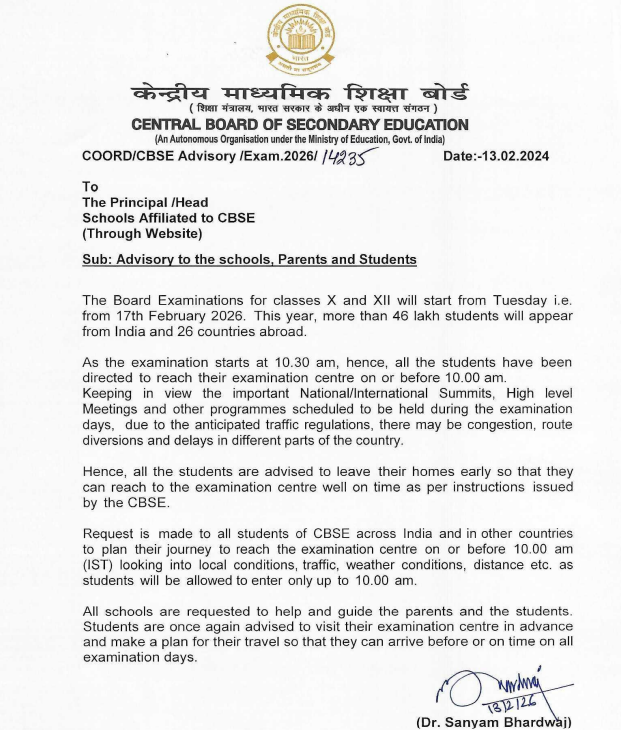
Just days before the start of the Class 10 and Class 12 Board Exams 2026, CBSE has issued an important nationwide advisory for schools, parents, and students. The exams will begin 17 February 2026, and more than 46 lakh candidates across India and 26 countries abroad will participate.
Unlike routine notifications, this advisory focuses on arrival timing, travel planning, and strict entry rules. The board has clearly indicated that reaching late — even by a minute — can lead to denial of entry. This makes logistical preparation almost as important as academic preparation.
Reporting Time Is Now a Critical Rule — Not a Suggestion
The examination will start at 10:30 AM, but CBSE has emphasised that students must reach their centres on or before 10:00 AM.
The reason is simple: verification procedures, seating arrangement, and biometric processes require buffer time. Once the gates close at 10:00 AM, entry will not be allowed under any circumstances.
This means students should not calculate travel time based on normal daily commute assumptions. The board is effectively treating reporting time as a mandatory eligibility condition for writing the paper.
Why CBSE Warned Students to Leave Early This Year
The board has highlighted unusual nationwide factors that may affect travel:
-
National and international summits
-
VIP movement and security restrictions
-
Traffic diversions across major cities
-
Possible congestion around examination centres
-
Local weather disruptions
Because these are unpredictable and location-specific, CBSE has advised students to keep a safety margin in travel planning rather than aiming to arrive “just on time.”
In practical terms, a route that normally takes 25 minutes may take 60–90 minutes on exam day.
Visiting the Exam Centre in Advance Is Now Essential
CBSE has strongly recommended that students physically visit their examination centre before the exam day. This is not a formality — it helps avoid last-moment confusion.
Students should verify:
-
Exact building location
-
Gate entry point
-
Parking or drop-off area
-
Traffic pattern at the same time of day
Many students lose valuable time searching for the correct block or gate despite reaching the area. A prior visit eliminates this risk.
Role of Parents: Travel Planning Matters More Than Last-Minute Speed
Parents are expected to actively help students plan logistics instead of relying on routine schedules. The board specifically advises arranging transportation early and not depending on unpredictable public transport timing.
Dropping a student off early and waiting nearby is safer than arriving close to the deadline. The advisory essentially treats late arrival as a preventable mistake rather than an acceptable delay.
Instructions Issued to Schools
CBSE has directed affiliated schools to guide both parents and students regarding the strict entry policy. Schools must ensure students clearly understand that the reporting deadline is final and non-negotiable.
They are also expected to help students identify their centres and encourage advanced travel planning so exam day confusion can be avoided.
What This Advisory Actually Signals
This notice indicates a stricter exam discipline framework for 2026. With millions appearing simultaneously, even small delays at gates can disrupt the entire schedule. Therefore, CBSE is prioritising punctuality and orderly entry over flexibility.
In simple terms, Preparation alone will not help if a candidate fails to reach the centre on time.
Practical Strategy Students Should Follow
Students should plan to reach the examination centre at least 45–60 minutes before reporting time. Keeping buffer time protects against unexpected delays such as traffic blocks, vehicle breakdowns, route diversions, or security checks.
Carry multiple printouts of the admit card and valid identification, keep stationery ready the night before, and avoid experimenting with new travel routes on exam morning.


Have questions about your prep?
Our experts can answer all your questions