






ABO Blood Group And Rhesus System
 Abhishek Kumar25 Oct, 2023
Share
ABO Blood Group And Rhesus System : A blood group is defined as the entire blood group system that is made up of red blood cell (RBC) antigens. Blood group: a division of the blood based on genetic variations (polymorphisms) in the antigens on the erythrocytes' (red blood cells') surfaces. A collection of linked or allelic genes found on the same chromosome work together to regulate the specificity of RBC antigens. The International Society of Blood Transfusion has found and documented 33 different blood group systems that correspond to more than 300 distinct RBC antigens. The ABO, MNS, Rhesus (Rh), Lutheran (LU), Kell (KEL), Lewis (LE), Duffy (FY), and Kidd (Jk) systems are a few of the most significant blood type systems.
ABO Blood Group
American biologist Karl Landsteiner , who was born in Austria, made the discovery of the human ABO blood types in 1901 . Landsteiner discovered that antigens and antibodies in the blood cause red cells of one kind to clump together when they are mixed with red cells of a different type. Based on how they interacted with one another, he was able to identify three groups: A , B , and O . A year later, a different research team discovered a fourth group, AB . The ABO blood group system, which was first identified in 1901, is thought to be the most significant in terms of transfusion therapies and organ transplants among the 33 systems. There are two co-dominant A and B alleles, one recessive O allele, and three major alleles that make up the ABO blood group system. A single gene located on the terminal segment of chromosome 9's long arm regulates each of the ABO system's three alleles.
Both of these enzymes work by adding N-acetylgalactosamine and D-galactose to an H-antigen, which is a precursor side chain that will subsequently be transformed into either the A or B antigen, despite the fact that the glycosyltransferases that both the A and B alleles encode for differ slightly. The O allele, in contrast to the co-dominant alleles, does not encode for any transferase enzyme, resulting in the expression of the H-antigen in its unaltered form in these carriers.
ABO Blood Group Types
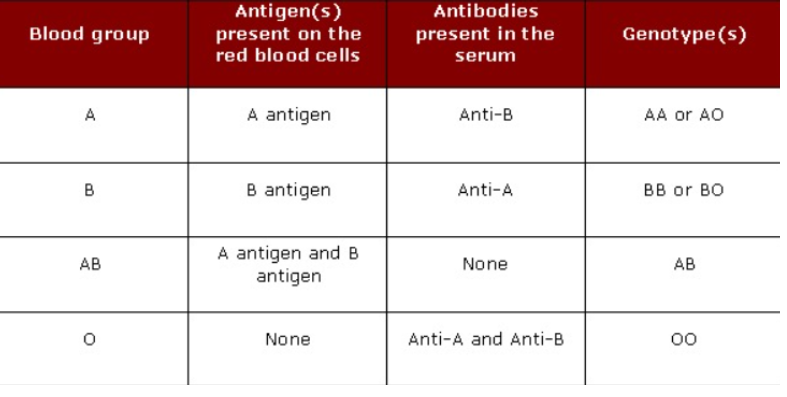
- An individual's blood type is defined by the combination of three ABO blood system alleles, which can result in four distinct main phenotypes.
- The presence or lack of A and/or B antigens on the surface of RBCs defines the four different blood types, which are A, B, AB, and O.
- For instance, those with blood type A will have anti-B antibodies in their plasma as well as A antigens on the surface of their RBCs.
- Similar to this, those with the B blood type will have anti-A antibodies in their plasma as well as B antigens on the surface of their RBCs.
- O blood type carriers contain both anti-A and anti-B antibodies in their plasma, despite the fact that neither A nor B antigens are found on the surface of their RBCs.
- People with the AB blood type will not have any antibodies against either antigen in their plasma because both the A and B antigens are present on the surface of their RBCs.
- ABO antigens are widely expressed on the surfaces of numerous cells and tissues throughout the body, as well as in a variety of body fluids, in addition to their expression on the surface of RBCs.
- For instance, epithelial cells, sensory neurons, platelets, and the endothelium that lines blood vessels all contain ABO antigens.
- The RBO system has thus been investigated for its role in the etiology of many cardiovascular, neoplastic, and other health diseases, in addition to its importance for transfusion and transplantation therapy.
Rhesus (Rh) System
- The Rh blood group system is regarded as the second most significant blood group system after the ABO system.
- There are 50 distinct blood type antigens that make up the Rh system, five of which are thought to be important for maintaining human health.
- The presence or absence of the Rh factor, an immunogenic D-antigen, determines a person's Rh status.
- As a result, Rh-positive individuals will have the D-antigen on the surface of their RBCs, whereas Rh-negative individuals will not.
- Rh-negative people will typically not have anti-Rh antibodies present in their plasma, in contrast to the ABO blood type system, where antibodies against the alternative antigens are present in the plasma.
- Anti-Rh antibodies will, nevertheless, circulate if a Rh-negative person's circulatory system has been exposed to D-positive RBCs.
- Anti-D IgG will be administered as a prophylactic medication to pregnant Rh-negative women who have given birth to a Rh-positive child in order to stop the anti-D antibodies from crossing the placenta and injuring the infant.












 Live & recorded classes available at easeDashboard for progress trackingMillions of practice questions at your fingertips

