ICSE Class 10 Maths Selina Solutions Chapter 11 Geometric Progressions
 Neha Tanna17 Feb, 2026
ICSE Class 10 Maths Selina Solutions Chapter 11: A Geometric Progression (G.P.) is a sequence in which every term is obtained by multiplying or dividing the previous term by a constant number called the common ratio.
Since the ICSE Maths Board Exam 2026 is approaching on 2 March 2026, Chapter 11 Geometric Progressions is extremely important for last-minute revision.
This chapter includes its general term, features, and the total number of terms in a G.P. If students are having trouble with the problems in this ICSE Class 10 Maths Selina Solutions Chapter 11, they can consult Selina Solutions for Class 10 Mathematics, which have been provided by our knowledgeable teachers here.
ICSE Class 10 Maths Selina Solutions Chapter 11 Overview
1. Find which of the following sequence form a G.P.:
(i) 8, 24, 72, 216, ………
(ii) 1/8, 1/24, 1/72, 1/216, ………
(iii) 9, 12, 16, 24, ………
Solution:
(i) Given sequence: 8, 24, 72, 216, ……… Since, 24/8 = 3, 72/24 = 3, 216/72 = 3 ⇒ 24/8 = 72/24 = 216/72 = ……….. = 3 Therefore 8, 24, 72, 216, ……… is a G.P. with a common ratio 3. (ii) Given sequence: 1/8, 1/24, 1/72, 1/216, ……… Since, (1/24)/ (1/8) = 1/3, (1/72)/ (1/24) = 1/3, (1/216)/ (1/72) = 1/3 ⇒ (1/24)/ (1/8) = (1/72)/ (1/24) = (1/216)/ (1/72) = ……….. = 1/3 Therefore 1/8, 1/24, 1/72, 1/216, ……… is a G.P. with a common ratio 1/3. (iii) Given sequence: 9, 12, 16, 24, ……… Since, 12/9 = 4/3; 16/12 = 4/3; 24/16 = 3/2 12/9 = 16/12 ≠ 24/16 Therefore, 9, 12, 16, 24 …… is not a G.P.2. Find the 9 th term of the series: 1, 4, 16, 64, …..
Solution:
It’s seen that, the first term is (a) = 1 And, common ratio(r) = 4/1 = 4 We know that, the general term is t n = ar n – 1 Thus, t 9 = (1)(4) 9 – 1 = 4 8 = 655363. Find the seventh term of the G.P: 1, √3, 3, 3 √3, …..
Solution:
It’s seen that, the first term is (a) = 1 And, common ratio(r) = √3/1 = √3 We know that, the general term is t n = ar n – 1 Thus, t 7 = (1)(√3) 7 – 1 = (√3) 6 = 274. Find the 8 th term of the sequence:

Solution:
The given sequence can be rewritten as, 3/4, 3/2, 3, ….. It’s seen that, the first term is (a) = 3/4 And, common ratio(r) = (3/2)/ (3/4) = 2 We know that, the general term is t n = ar n – 1 Thus, t 8 = (3/4)(2) 8 – 1 = (3/4)(2) 7 = 3 x 2 5 = 3 x 32 = 965. Find the 10 th term of the G.P. :
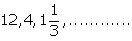
Solution:
The given sequence can be rewritten as, 12, 4, 4/3, ….. It’s seen that, the first term is (a) = 12 And, common ratio(r) = (4)/ (12) = 1/3 We know that, the general term is t n = ar n – 1 Thus, t 10 = (12)(1/3) 10 – 1 = (12)(1/3) 9 = 12 x 1/(19683) = 4/ 65616. Find the nth term of the series:
1, 2, 4, 8, ……..
Solution:
It’s seen that, the first term is (a) = 1 And, common ratio(r) = 2/ 1 = 2 We know that, the general term is t n = ar n – 1 Thus, t n = (1)(2) n – 1 = 2 n – 1ICSE Class 10 Maths Selina Solutions Chapter 11 Exercise 11B
1. Which term of the G.P. :
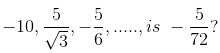
Solution:
In the given G.P. First term, a = -10 Common ratio, r = (5/√3)/ (-10) = 1/(-2√3) We know that, the general term is t n = ar n – 1 So, t n = (-10)( 1/(-2√3)) n – 1 = -5/72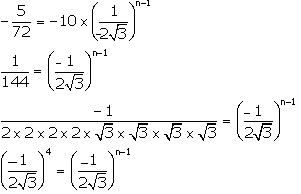 Now, equating the exponents we have n – 1 = 4 n = 5 Thus, the 5 th of the given G.P. is -5/72
2. The fifth term of a G.P. is 81 and its second term is 24. Find the geometric progression.
Solution:
Given, t 5 = 81 and t 2 = 24 We know that, the general term is t n = ar n – 1 So, t 5 = ar 5 – 1 = ar 4 = 81 …. (1) And, t 2 = ar 2 – 1 = ar 1 = 24 …. (2) Dividing (1) by (2), we have ar 4 / ar = 81/ 24 r 3 = 27/ 8 r = 3/2 Using r in (2), we get a(3/2) = 24 a = 16 Hence, the G.P. is G.P. = a, ar, ar 2 , ar 3 …… = 16, 16 x (3/2), 16 x (3/2) 2 , 16 x (3/2) 3 = 16, 24, 36, 54, ……3. Fourth and seventh terms of a G.P. are 1/18 and -1/486 respectively. Find the G.P.
Solution:
Given, t 4 = 1/18 and t 7 = -1/486 We know that, the general term is t n = ar n – 1 So, t 4 = ar 4 – 1 = ar 3 = 1/18 …. (1) And, t 7 = ar 7 – 1 = ar 6 = -1/486 …. (2) Dividing (2) by (1), we have ar 6 / ar 3 = (-1/486)/ (1/18) r 3 = -1/27 r = -1/3 Using r in (1), we get a(-1/3) 3 = 1/18 a = -27/ 18 = -3/2 Hence, the G.P. is G.P. = a, ar, ar 2 , ar 3 …… = -3/2, -3/2(-1/3), -3/2(-1/3) 2 , -3/2(-1/3) 3 , …… = -3/2, 1/2, -1/6, 1/18, …..4. If the first and the third terms of a G.P are 2 and 8 respectively, find its second term.
Solution:
Given, t 1 = 2 and t 3 = 8 We know that, the general term is t n = ar n – 1 So, t 1 = ar 1 – 1 = a = 2 …. (1) And, t 3 = ar 3 – 1 = ar 2 = 8 …. (2) Dividing (2) by (1), we have ar 2 / a = 8/ 2 r 2 = 4 r = ± 2 Hence, the 2 nd term of the G.P. is When a = 2 and r = 2 is 2(2) = 4 Or when a = 2 and r = -2 is 2(-2) = -45. The product of 3 rd and 8 th terms of a G.P. is 243. If its 4 th term is 3, find its 7 th term
Solution:
Given, Product of 3 rd and 8 th terms of a G.P. is 243 The general term of a G.P. with first term a and common ratio r is given by, t n = ar n – 1 So, t 3 x t 8 = ar 3 – 1 x ar 8 – 1 = ar 2 x ar 7 = a 2 r 9 = 243 Also given, t 4 = ar 4 – 1 = ar 3 = 3 Now, a 2 r 9 = (ar 3 ) ar 6 = 243 Substituting the value of ar 3 in the above equation, we get, (3) ar 6 = 243 ar 6 = 81 ar 7 – 1 = 81 = t 7 Thus, the 7 th term of the G.P is 81.ICSE Class 10 Maths Selina Solutions Chapter 11 Exercise 11C
1. Find the seventh term from the end of the series: √2, 2, 2√2, …… , 32
Solution:
Given series: √2, 2, 2√2, …… , 32 Here, a = √2 r = 2/ √2 = √2 And, the last term (l) = 32 l = t n = ar n – 1 = 32 (√2)( √2) n – 1 = 32 (√2) n = 32 (√2) n = (2) 5 = (√2) 10 Equating the exponents, we have n = 10 So, the 7 th term from the end is (10 – 7 + 1) th term. i.e. 4 th term of the G.P Hence, t 4 = (√2)(√2) 4 – 1 = (√2)(√2) 3 = (√2) x 2√2 = 42. Find the third term from the end of the G.P.
2/27, 2/9, 2/3, ……., 162
Solution:
Given series: 2/27, 2/9, 2/3, ……., 162 Here, a = 2/27 r = (2/9) / (2/27) r = 3 And, the last term (l) = 162 l = t n = ar n – 1 = 162 (2/27) (3) n – 1 = 162 (3) n – 1 = 162 x (27/2) (3) n – 1 = 2187 (3) n – 1 = (3) 7 n – 1 = 7 n = 7+1 n = 8 So, the third term from the end is (8 – 3 + 1) th term i.e 6 th term of the G.P. = t 6 Hence, t 6 = ar 6-1 t 6 = (2/27) (3) 6-1 t 6 = (2/27) (3) 5 t 6 = 2 x 3 2 t 6 = 183. Find the G.P. 1/27, 1/9, 1/3, ……, 81; find the product of fourth term from the beginning and the fourth term from the end.
Solution:
Given G.P. 1/27, 1/9, 1/3, ……, 81 Here, a = 1/27, common ratio (r) = (1/9)/ (1/27) = 3 and l = 81 We know that, l = t n = ar n – 1 = 81 (1/27)(3) n – 1 = 81 3 n – 1 = 81 x 27 = 2187 3 n – 1 = 3 7 n – 1 = 7 n = 8 Hence, there are 8 terms in the given G.P. Now, 4 th term from the beginning is t 4 and the 4 th term from the end is (8 – 4 + 1) = 5 th term (t 5 ) Thus, the product of t 4 and t 5 = ar 4 – 1 x ar 5 – 1 = ar 3 x ar 4 = a 2 r 7 = (1/27) 2 (3) 7 = 34. If for a G.P., p th , q th and r th terms are a, b and c respectively; prove that:
(q – r) log a + (r – p) log b + (p – q) log c = 0
Solution:
Let’s take the first term of the G.P. be A and its common ratio be R. Then, p th term = a ⇒ AR p – 1 = a q th term = b ⇒ AR q – 1 = b r th term = c ⇒ AR r – 1 = c Now,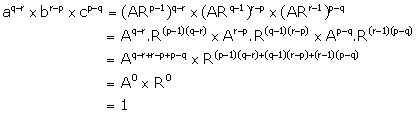 On taking log on both the sides, we get log( a q-r x b r-p x c p-q ) = log 1 ⇒ (q – r)log a + (r – p)log b + (p – q)log c = 0 – Hence Proved
ICSE Class 10 Maths Selina Solutions Chapter 11 Exercise 11D
1. Find the sum of G.P.:
(i) 1 + 3 + 9 + 27 + ………. to 12 terms
(ii) 0.3 + 0.03 + 0.003 + 0.0003 +….. to 8 terms.
(iii) 1 – 1/2 + 1/4 – 1/8 + …….. to 9 terms
(iv) 1 – 1/3 + 1/3 2 – 1/3 3 + ……… to n terms
(v) 
(vi) 
Solution:
(i) Given G.P: 1 + 3 + 9 + 27 + ………. to 12 terms Here, a = 1 and r = 3/1 = 3 (r > 1) Number of terms, n = 12 Hence, S n = a(r n – 1)/ r – 1 ⇒ S 12 = (1)((3) 12 – 1)/ 3 – 1 = (3 12 – 1)/ 2 = (531441 – 1)/ 2 = 531440/2 = 265720 (ii) Given G.P: 0.3 + 0.03 + 0.003 + 0.0003 +….. to 8 terms Here, a = 0.3 and r = 0.03/0.3 = 0.1 (r < 1) Number of terms, n = 8 Hence, S n = a(1 – r n )/ 1 – r ⇒ S 8 = (0.3)(1 – 0.1 8 )/ (1 – 0.1) = 0.3(1 – 0.1 8 )/ 0.9 = (1 – 0.1 8 )/ 3 = 1/3(1 – (1/10) 8 ) (iii) Given G.P: 1 – 1/2 + 1/4 – 1/8 + …….. to 9 terms Here, a = 1 and r = (-1/2)/ 1 = -1/2 (| r | < 1) Number of terms, n = 9 Hence, S n = a(1 – r n )/ 1 – r ⇒ S 9 = (1)(1 – (-1/2) 9 )/ (1 – (-1/2)) = (1 + (1/2) 9 )/ (3/2) = 2/3 x ( 1 + 1/512 ) = 2/3 x (513/512) = 171/ 256 (iv) Given G.P: 1 – 1/3 + 1/3 2 – 1/3 3 + ……… to n terms Here, a = 1 and r = (-1/3)/ 1 = -1/3 (| r | < 1) Number of terms is n Hence,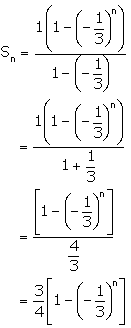 S n = a(1 – r n )/ 1 – r (v) Given G.P:

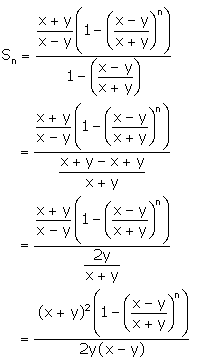 (vi) Given G.P:

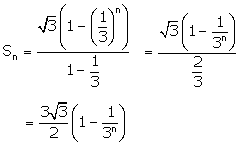
2. How many terms of the geometric progression 1 + 4 + 16 + 64 + …….. must be added to get sum equal to 5461?
Solution:
Given G.P: 1 + 4 + 16 + 64 + …….. Here, a = 1 and r = 4/1 = 4 (r > 1) And, S n = 5461 We know that, S n = a(r n – 1)/ r – 1 ⇒ S n = (1)((4) n – 1)/ 4 – 1 = (4 n – 1)/3 5461 = (4 n – 1)/3 16383 = 4 n – 1 4 n = 16384 4 n = 4 7 n = 7 Therefore, 7 terms of the G.P must be added to get a sum of 5461.3. The first term of a G.P. is 27 and its 8 th term is 1/81. Find the sum of its first 10 terms.
Solution:
Given, First term (a) of a G.P = 27 And, 8 th term = t 8 = ar 8 – 1 = 1/81 (27)r 7 = 1/81 r 7 = 1/(81 x 27) r 7 = (1/3) 7 r = 1/3 (r <1) S n = a(1 – r n )/ 1 – r Now, Sum of first 10 terms = S 10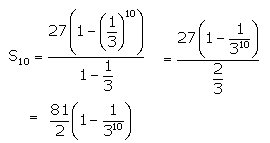
4. A boy spends Rs.10 on first day, Rs.20 on second day, Rs.40 on third day and so on. Find how much, in all, will he spend in 12 days?
Solution:
Given, Amount spent on 1 st day = Rs 10 Amount spent on 2 nd day = Rs 20 And amount spent on 3 rd day = Rs 40 It’s seen that, 10, 20, 40, …… forms a G.P with first term, a = 10 and common ratio, r = 20/10 = 2 (r > 1) The number of days, n = 12 Hence, the sum of money spend in 12 days is the sum of 12 terms of the G.P. S n = a(r n – 1)/ r – 1 S 12 = (10)(2 12 – 1)/ 2 – 1 = 10 (2 12 – 1) = 10 (4096 – 1) = 10 x 4095 = 40950 Therefore, the amount spent by him in 12 days is Rs 409505. The 4 th term and the 7 th term of a G.P. are 1/27 and 1/729 respectively. Find the sum of n terms of the G.P.
Solution:
Given, t 4 = 1/27 and t 7 = 1/729 We know that, t n = ar n – 1 So, t 4 = ar 4 – 1 = ar 3 = 1/27 …. (1) t 7 = ar 7 – 1 = ar 6 = 1/729 …. (2) Dividing (2) by (1) we get, ar 6 / ar 3 = (1/729)/ (1/27) r 3 = (1/3) 3 r = 1/3 (r < 1) In (1) a x 1/27 = 1/27 a = 1 Hence, S n = a(1 – r n )/ 1 – r S n = (1 – (1/3) n )/ 1 – (1/3) = (1 – (1/3) n )/ (2/3) = 3/2 (1 – (1/3) n )6. A geometric progression has common ratio = 3 and last term = 486. If the sum of its terms is 728; find its first term.
Solution:
Given, For a G.P., r = 3, l = 486 and S n = 728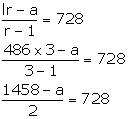 1458 – a = 728 x 2 = 1456 Thus, a = 2
7. Find the sum of G.P.: 3, 6, 12, …., 1536.
Solution:
Given G.P: 3, 6, 12, …., 1536 Here, a = 3, l = 1536 and r = 6/3 = 2 So, The sum of terms = (lr – a)/ (r – 1) = (1536 x 2 – 3)/ (2 – 1) = 3072 – 3 = 30698. How many terms of the series 2 + 6 + 18 + ….. must be taken to make the sum equal to 728?
Solution:
Given G.P: 2 + 6 + 18 + ….. Here, a = 2 and r = 6/2 = 3 Also given, S n = 728 S n = a(r n – 1)/ r – 1 728 = (2)(3 n – 1)/ 3 – 1 = 3 n – 1 729 = 3 n 3 6 = 3 n n = 6 Therefore, 6 terms must be taken to make the sum equal to 728.9. In a G.P., the ratio between the sum of first three terms and that of the first six terms is 125: 152.
Find its common ratio.
Solution:
Given,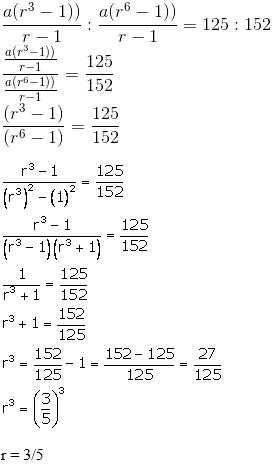
Common Mistakes to Avoid in Chapter 11 Geometric Progressions
While preparing for the ICSE Class 10 Maths exam on 2 March 2026 (Monday), students must be careful about these common errors in Geometric Progressions:
1. Using the Wrong Formula
Students often confuse:

2. Ignoring the Sign of the Common Ratio
If the common ratio is negative (e.g., -1/2), signs alternate. Missing this leads to incorrect answers.
3. Calculation Errors in Powers
Mistakes in evaluating powers are common. Double-check exponent calculations.
4. Skipping Steps
ICSE follows strict step marking. Writing only the final answer may lead to loss of marks even if the result is correct.
5. Not Identifying the First Term Correctly
Sometimes sequences are rewritten incorrectly. Always clearly identify First term (a) and Common ratio (r)
ICSE Class 10 Maths Selina Solutions Chapter 11 FAQs
Is maths easy in class 10 ICSE?
What is GP in math class 10?
Can I pass ICSE if I fail in maths?
Are ICSE boards hard?