







Physics Wallah brings Class 10 Science Chapter 12 Electricity Most Important Questions to make this chapter more logical and less confusing. Instead of getting stuck in formulas, you start seeing how current flows, how circuits behave, and how different factors affect resistance and potential difference.
PW CBSE Class 10 Sample Paper Science provides latest pattern sample papers, competency-based questions, and detailed solutions for board exams.
Through these questions, you revise key ideas like Ohm’s law, electric current, series and parallel circuits, heating effects of current, and important numericals. The focus is on building strong conceptual clarity along with calculation practice. Regular solving helps you get comfortable with circuit-based questions and improves accuracy, speed, and confidence for CBSE board exams.
PW CBSE 10th QCB Science offers chapterwise solved questions, competency-based practice, diagrams, and exam-focused preparation for Science.

Electricity Class 10 Most Important Questions With Answers
Revise important topics like resistance, series and parallel circuits, electrical energy, power calculations, and applications of electric current. Solving Electricity Important Questions Class 10 improves your numerical skills, conceptual clarity, and exam accuracy.
Multiple Choice Question [1 Mark]
This section includes Class 10 Electricity important multiple-choice questions, each carrying 1 mark, designed to test your foundational understanding of Electricity concepts. These questions are essential for quick recall and strengthening your grasp of the basics.
1. Which of the following does not represent electrical power in a circuit?
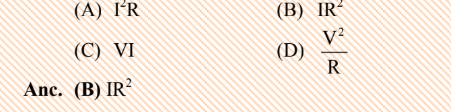
2. An electric bulb is rated 220 V and 100 W. When it is operated on 110 V, the power consumed will be _____.
(A) 75 W
(B) 100 W
(C) 50 W
(D) 25 W
Anc. (D) 25 W
4. If the current ‘I’ through a resistor is increased by 100% (assuming that the temperature remains unchanged), the approximate increase in power dissipated will be
(A) 400 %
(B) 200 %
(C) 300 %
(D) 100 %
Ans. (C) 300 %
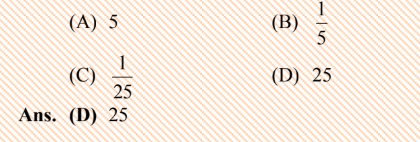
5. A piece of wire of resistance R is cut into five equal parts. These parts are then arranged in parallel. If the equivalent resistance of this combination is R’, then the ratio R/R′ is _____.
6. The correct representation of the series combination of cells (Figure) obtaining maximum potential is
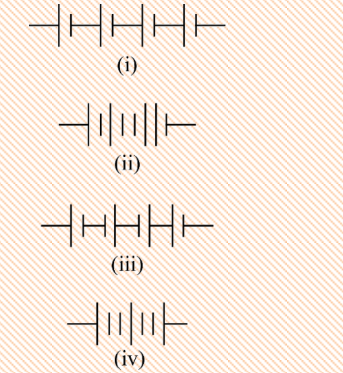
(A) (i)
(B) (ii)
(C) (iii)
(D) (iv)
Ans. (A)
7. Two pieces of conducting wire of the same material and of equal lengths and the equal diameters are first connected in series and then changed to parallel in a circuit across the same potential difference. The ratio of heat produced in both series and parallel combinations would be_____.
(A) 1:2
(B) 4:1
(C) 1:4
(D) 2:1
Ans. (C) 1 : 4
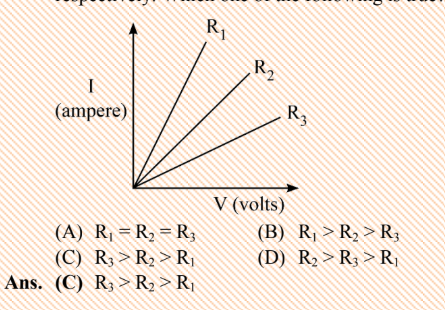
8. A person carries out an experiment and thus plots the V-I graph of three taken samples of nichrome wire with different resistances R1, R2 and R3, respectively. Which one of the following is true?
9. Two resistors of resistance 2 Ω and 4 Ω, when connected to a battery, will have
(A) the same potential difference across them when connected in series
(B) same current flowing through them when connected in series
(C) same current flowing through them when connected in parallel
(D) different potential difference when connected in parallel
Ans. (B) same current flowing through them when connected in series
Multiple Choice Question [3 Mark]
This section contains important questions of electricity class 10, each carrying 3 marks, designed to test your analytical and problem-solving skills . These questions often require a deeper understanding and application of concepts.
10. What does an electric circuit mean?
Answer: An electric circuit is a closed, continuous path through which electric current flows. It typically includes a cell, wires (conductors), a switch, and a load.
11. How is the resistivity of alloys compared with that of pure metals from which they are formed?
Answer: Alloys generally have higher resistivity than the pure metals that make them.
12. How does the use of a fuse wire protect electrical appliances?
Answer: A fuse wire has higher resistance than the main wiring. When excessive current flows due to a fault, the fuse wire heats up and melts, breaking the circuit. This stops the current and protects appliances from damage.
13. Why are copper wires used as connecting wires?
Answer: Copper is used because it has low electrical resistivity, is a very good conductor of electricity, is ductile, and is relatively inexpensive.
14. Define the SI unit of current.
Answer: The SI unit of current is the ampere. One ampere is the current when one coulomb of charge flows through a conductor in one second.
15. How can three resistors of 2 Ω, 3 Ω, and 6 Ω be connected to get:
(a) 4 Ω?
16. Ammeter burns out when connected in parallel. Give reasons.
Answer: An ammeter has very low resistance. When connected in parallel, a large current flows through it, causing it to overheat and burn out or get short-circuited.
17. Should the resistance of an ammeter be low or high? Give reason(s).
Answer: The resistance of an ammeter should be as low as possible ( ideally zero) so it does not change or reduce the current flowing in the circuit.
18. Why does the connecting rod of an electric heater not glow, but the heating element does?
Answer: The connecting rod has very low resistance, so it does not produce much heat. The heating element has high resistance, so it produces more heat and glows when current flows.
19. The power of a lamp is 60 W. Find the energy in joules consumed by it in 1 s.
Answer:
Power, P = 60 W
Time, t = 1 s
Energy = P × t = 60 × 1 = 60 J
20. A wire of resistivity δ is stretched to double its length. What will be its new resistivity?
Answer:
Resistivity depends only on the material of the wire, not its shape or size.
So even when the length is doubled, the resistivity remains the same (δ).
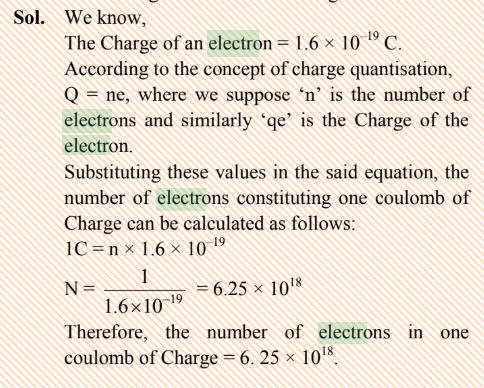
21. Calculate the total number of electrons constituting one coulomb of charge.
Answer:
22. How much current will an electric iron draw from a 220 V source if its resistance is 55 Ω? Calculate its wattage.
Answer:
V = 220 V, R = 55 Ω
Using Ohm’s law:
I = V/R = 220/55 = 4 A
Power (P) = V × I = 220 × 4 = 880 W
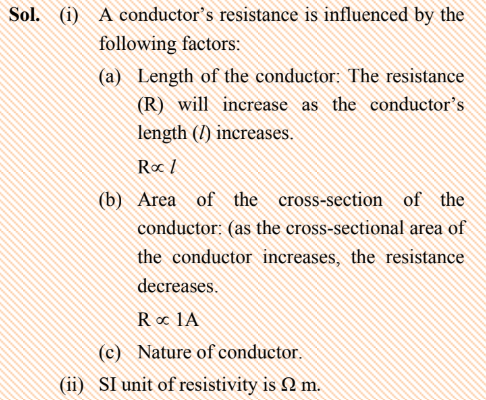
23. (i) List three factors on which resistance of a conductor depends.
(ii) Write the SI unit of resistivity.
24. Name a device that helps to maintain a potential difference across a conductor.
Sol. One of the devices that aid in maintaining a potential difference across a conductor is a battery, which can consist of one or more electric cells.
25. What is the resistance of an ammeter?
Sol. An ammeter’s resistance generally is very minimal, and in an ideal ammeter, it is zero.
26. What is the resistance of a voltmeter?
Sol. The resistance of a voltmeter is ideally infinite resistance.
27. What is the commercial unit of electrical energy? Represent it in terms of joules.
Sol. The commercial unit of electrical energy is kilowatt hour
1 kWh = 1 kW × 1 h
= 1000 W × 60 × 60 s
= 3.6 × 10⁶ J
28. Explain two disadvantages of series arrangement for a household circuit.
Sol. The two drawbacks of series circuits for household wiring are:
• If one electrical appliance in a series circuit stops functioning for any reason, the entire circuit will break, and all other electrical appliances will also stop functioning.
• Because there is only one switch for every electrical device in a series circuit, they cannot be turned on or off independently.
29. What is meant by the saying that the potential difference between two points is 1 V?
Sol. The potential difference between two points is 1V when 1 J of work is done to move a 1 C of charge from one location to the other.
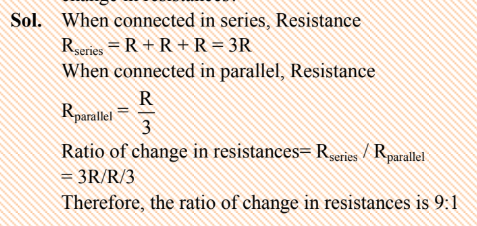
30. Three equal resistances are connected in series and then in parallel. What will be the ratio of their change in resistance?
Sol. When connected in series, Resistance
31. State Ohm’s law? How can it be verified experimentally? Does it hold good under all conditions? Comment.
Sol. According to Ohm’s law, the potential difference (voltage) across an ideal conductor is proportional to the current flowing through it at a given temperature.
I.e. V/I = R
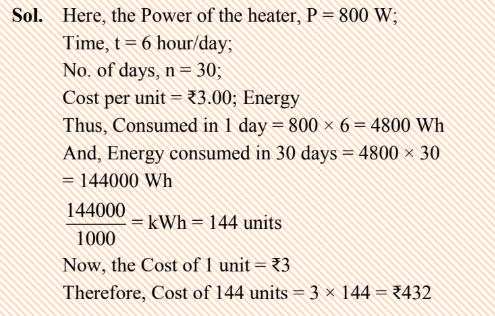
32. If an electric heater rated 800 W operates 6h/day. Find the Cost of energy to operate it for 30 days at ₹3.00 per unit of consumption.
33. What is the electrical resistivity of a given material? What is its unit? (Discuss an experiment to study the factors on which the resistance of conducting wire depends).
Sol. Resistivity is an inherent property of a conductor that resists the flow of electric current. The resistivity of each material is unique. The SI unit of resistance is Ω m.
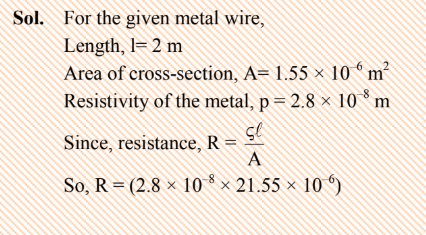
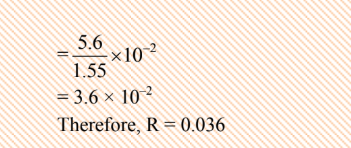
34. Calculate the resistance of a given metal wire of length 2m and area of cross-section 1.55 × 10⁶ m2 if the resistivity of the metal is taken to be 2.8 × 10⁻⁸ Ωm.
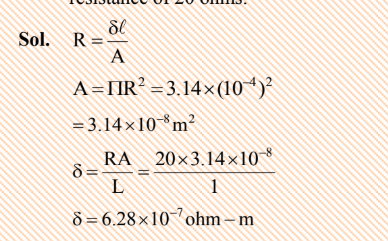
35. Calculate the estimated resistivity of the material of a wire of length 1 m, radius 0.01 cm and resistance of 20 ohms.
36. Why are the coils of electric toasters and irons made of an alloy rather than any pure metal? Give reason(s).
Sol. Due to its high resistivity, an alloy has a substantially higher melting point than a pure metal. Alloys are resistant to melting when temperatures are high. As a result, alloys are utilised in heating devices like electric toasters and irons.
37. Which has more resistance, 100 W bulb or 60 W bulb?

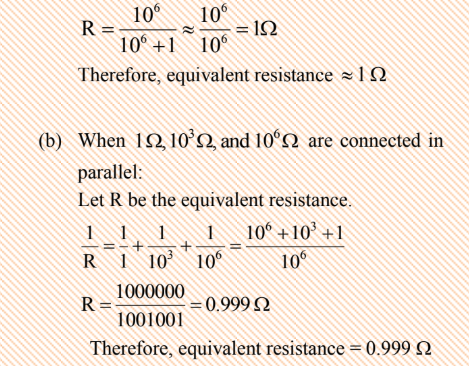
38. Find the equivalent resistance when the following are connected in parallel
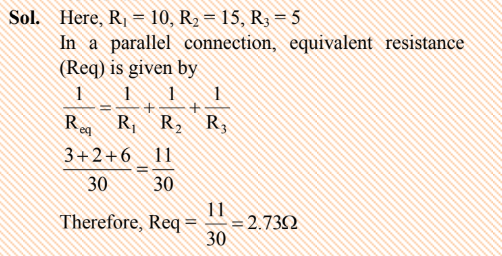
39. Three resistors of 10 Ω, 15 Ω and 5 Ω are connected in parallel. Find their equivalent resistance.
40. Explain the use of an electric fuse. What type of material is used for fuse wire and why?
Sol. Electric fuses guard against the very high electric current by blocking it from flowing into circuits and appliances. It is composed of a wire formed of a metal or alloy with an appropriate melting point, such as lead, copper, iron, or aluminium. The temperature of the fuse wire rises if a current more than the allowed amount runs through the circuit. The fuse wire melts, as a result, breaking the circuit.
41. How many 176 Ω resistors (in parallel) are required to carry 5 A on a 220 V line?
Sol. Let ‘x’ be the number of resistors required. The equivalent resistance of the resistor R in the parallel combination is given by
PW Class 10 Science Chapter 11 Electricity PDF
PW provides a downloadable PDF featuring important questions and their solutions for CBSE Class 10 Science Chapter 11 Electricity, which is attached below. You can use this resource for offline study, quick revision, and board exam preparation.
PW Class 10 Science Chapter 11 Electricity PDF
Study without using the internet
CBSE Important Questions for Class 10 Science Chapter 11 FAQs
What topics are most important in Chapter 11 Electricity?
Are numericals important for the Class 10 Electricity chapter?
How can I score well in the Electricity chapter?
What type of questions are usually asked from Electricity?







Get Free Counselling Today
and Clear up all your Doubts
 Live & recorded classes available at easeDashboard for progress trackingLakhs of practice questions

