NCERT Solutions for Class 9 Science Chapter 9: Atomic Foundations of Matter
 Neha Tanna17 Nov, 2026


Understanding how atoms combine to form molecules and compounds can be challenging when you study chemical reactions and bonding. You may also find it difficult to apply the laws of chemical combination, write chemical formulae, calculate molecular masses and understand how electrons are transferred or shared between atoms.
NCERT Solutions for Class 9 Science Chapter 9, Atomic Foundations of Matter, provide answers to selected textbook activities, in-text questions, exercises and additional sections. These solutions explain important concepts through simple steps, numerical examples and diagrams to help you practise different question types.
NCERT Class 9 Science Chapter 9 Solutions
Practise the following questions to revise the chapter's concepts and understand how atoms combine to form molecules and compounds.
Activity Based Questions
Q. If you tear a piece of paper into 100 tiny bits, will the total mass of the bits be different from the original paper?
Ans. No, the total mass will remain the same. Tearing a piece of paper into 100 tiny bits is a physical change because only the size and shape of the paper change. No matter is added or removed during the process, so the total mass of all the bits together remains equal to the mass of the original paper.
Q. Why was it necessary to fix the balloon to the mouth of the flask in Set-up II (refer NCERT Fig. 9.3 (a) and (b))?
Ans. To create a closed system by preventing the gas produced (carbon dioxide) from escaping, ensuring all products are accounted for.
Q. Why is it important to record the total mass of the reactants before mixing them?
Ans. Recording the initial mass helps in comparing it with the final mass after the reaction to verify whether mass is conserved.
NCERT In-text Questions
Q. Oxygen is sometimes represented as O and sometimes as O₂. What is the difference between these symbols?
Ans. O represents a single oxygen atom, while O₂ represents a molecule of two oxygen atoms bonded together.
Q. Nitrogen has five valence electrons. Draw the structure of the nitrogen molecule (N₂).
Ans. To form a stable nitrogen molecule (N₂), two nitrogen atoms share three pairs of electrons to complete their octets. This results in a triple bond. The nitrogen molecule can be represented as N≡N.
Original figure: Formation of a nitrogen molecule (source PDF, page 85).
Q. The atomic number of fluorine is 9. Explain the formation of the fluorine molecule (F₂).
Ans. The atomic number of fluorine is 9. Its electronic configuration is 2, 7. Fluorine has 7 electrons in its outermost shell. Since fluorine has seven valence electrons, it needs one more electron to complete its octet. Thus, two fluorine atoms share one electron each. Each fluorine atom contributes one electron to form a shared pair. Because only one pair of electrons is shared, a single bond is formed between the two atoms (F–F).
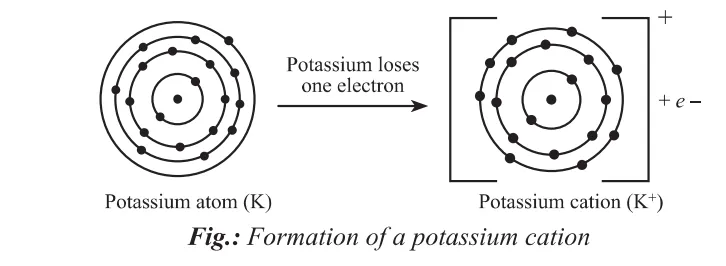
NCERT Exercise
Q. A particular element (A) has one electron in its third shell. There is another element (B) with six electrons in its second shell.
(i) How many electrons does A tend to give or take to become stable?
(ii) What kind of ion would it form?
(iii) How many electrons does B tend to give or take to become stable?
(iv) What kind of ion would it form?
(v) If A and B were to combine, what kind of bond would be formed?
(vi) What would be the formula of the compound thus formed?
Ans. Element A has 1 electron in the third shell. For there to be a third shell, the first two must be full (2, 8). So, the configuration is (2, 8, 1). This is Sodium (Na).
Element B has 6 electrons in its second shell. The first shell must be full (2). So, the configuration is (2, 6). This is Oxygen (O).
(i) Element A tends to lose 1 electron to become stable.
(ii) It forms a positive ion (cation), A⁺.
(iii) Element B tends to gain 2 electrons to become stable.
(iv) It forms a negative ion (anion), B²⁻.
(v) An ionic (electrovalent) bond would be formed.
(vi) The formula of the compound formed would be A₂B, i.e. Na₂O.
Q. An element X has six electrons in its outer shell and forms a diatomic molecule.
(i) Why would that be so?
(ii) What kind of bond would it form?
(iii) Draw the structure of the molecule it would form.
(iv) A certain other element Y has two electrons in its second shell. Draw the structure of the molecule that X would form with Y.
Ans. (i) Element X forms a diatomic molecule because it needs two more electrons to complete its octet.
(ii) It forms a covalent bond by sharing electrons.
(iii) In the X₂ molecule, two atoms share two pairs of electrons.
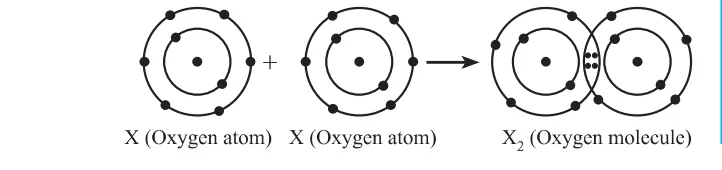
(iv) Element Y (Valency 2) wants to lose 2 electrons. Element X (Valency 2) wants to gain 2 electrons. When they combine, Y transfers its 2 valence electrons to X, forming an ionic bond. The resulting compound has the formula YX.
Q. Which of the following, in Fig. 9.18, correctly represents Cl⁻ (Atomic number of chlorine = 17)?
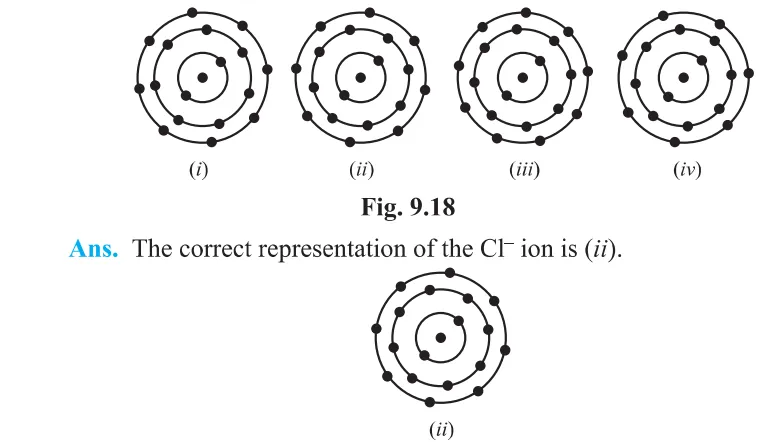
Ans. The correct representation of the Cl⁻ ion is (ii). It shows the correct distribution of 18 electrons (2, 8, 8), representing a stable chloride ion that has gained one electron to complete its third shell.
Q. 5.3 g of sodium carbonate and 6.0 g of acetic acid react to produce 2.2 g of carbon dioxide, 0.9 g of water and 8.2 g of sodium acetate. Verify whether the law of conservation of mass is valid.
Ans. Total mass of reactants = 5.3 g + 6.0 g = 11.3 g. Total mass of products = 8.2 g + 2.2 g + 0.9 g = 11.3 g. Since the total mass of reactants (11.3 g) is exactly equal to the total mass of products (11.3 g), the data is in agreement with the law of conservation of mass, which states that mass can neither be created nor destroyed in a chemical reaction.
Q. The species ²⁷Al, ⁸⁰Br⁻ and ²⁰¹Hg²⁺ have 13, 35 and 80 protons, respectively. How many electrons and neutrons do they have?
Ans. 1. Aluminium (²⁷Al): Protons = 13; Neutrons = 27 − 13 = 14; Electrons = 13, since it is a neutral atom. 2. Bromide ion (⁸⁰Br⁻): Protons = 35; Neutrons = 80 − 35 = 45; Electrons = 35 + 1 = 36 electrons. 3. Mercury ion (²⁰¹Hg²⁺): Protons = 80; Neutrons = 201 − 80 = 121; Electrons = 80 − 2 = 78 electrons.
The Journey Beyond
Q. Design and perform an experiment to show and compare that water always contains hydrogen and oxygen in the same ratio by mass, regardless of its source.
Ans. Aim: To demonstrate that water, irrespective of its source (river water, rainwater, tap water, distilled water, etc.), contains hydrogen and oxygen in the same ratio.
Materials Required: Water samples from different sources, beaker, two graphite electrodes, two test tubes, dilute sulphuric acid, battery (DC power supply), connecting wires, and a measuring cylinder.
Procedure: (i) Take equal volumes (e.g. 100 mL) of distilled water, tap water, river water, and rainwater in four separate containers.
(ii) Set up an electrolysis apparatus with two electrodes connected to a battery.
(iii) Add a few drops of dilute sulphuric acid to each sample to improve conductivity.
(iv) Pass electric current through each water sample.
(v) Collect the gases evolved at the two electrodes in separate test tubes and measure their volumes.
(vi) Record the volumes of hydrogen and oxygen obtained from each water sample.
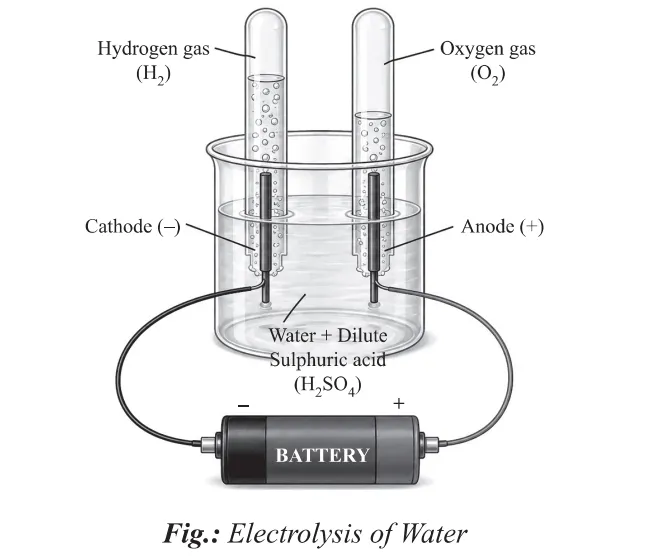
Observation: In every sample, the volume of hydrogen gas collected is twice the volume of oxygen gas.
The ratio of hydrogen to oxygen by volume is always 2:1.
Conclusion: Thus, water always contains hydrogen and oxygen in a fixed ratio, regardless of its source.
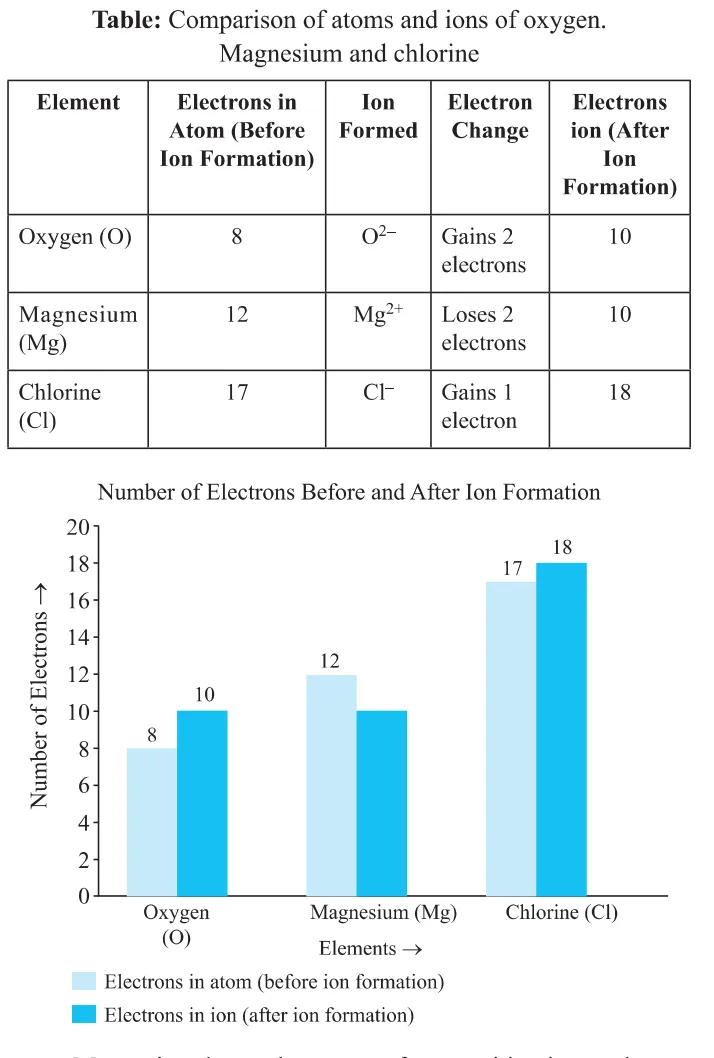
Q. Compare atoms and ions of any three elements. Show the number of electrons before and after ion formation using bar graphs.
Ans. The source compares oxygen, magnesium and chlorine. Oxygen (O) has 8 electrons before ion formation and forms O²⁻ by gaining 2 electrons, giving it 10 electrons. Magnesium (Mg) has 12 electrons and forms Mg² ⁺ by losing 2 electrons, giving it 10 electrons. Chlorine (Cl) has 17 electrons and forms Cl⁻ by gaining 1 electron, giving it 18 electrons. Magnesium loses electrons to form positive ions, whereas oxygen and chlorine gain electrons to form negative ions.
The Quest Continues
Q. Are there any chemical changes that do not obey the Law of Conservation of Mass?
Ans. No, there are no chemical changes that violate the Law of Conservation of Mass. In every chemical reaction, atoms are only rearranged to form new substances. Since atoms are neither created nor destroyed, the total mass remains constant. Any apparent change in mass is usually due to gases entering or leaving an open system. Violations of this law only occur in nuclear reactions (like fission or fusion), where a tiny amount of mass is converted directly into energy.
NCERT Solutions for Class 9 Science Chapter 9 PDF
Practising the NCERT Solutions for Class 9 Science Chapter 9 becomes easier when the questions and answers are available together. The PDF covers important concepts, activity-based questions, numerical problems, chemical formulae and diagrams related to atomic bonding and molecular formation.
Class 9 Science Chapter 9: Atomic Foundations of Matter
Study without using the internet
How to Prepare for Class 9 Science Chapter 9 with Physics Wallah?
Studying NCERT Solutions for Class 9 Science Chapter 9 by Physics Wallah can help you understand chemical combination, bonding and molecular formulae. Use the following methods to practise the chapter:
-
Understand the laws of chemical combination: Revise the Law of Conservation of Mass and the Law of Constant Proportions with numerical examples.
-
Practise chemical formulae: Learn how to write formulae using the valencies and charges of ions.
-
Study covalent and ionic bonding: Understand the difference between electron sharing and electron transfer through diagrams.
-
Solve numerical questions: Practise molecular mass and formula unit mass calculations using the given atomic masses.
-
Draw bonding diagrams: Practise electron-dot structures and the formation of molecules such as N₂, F₂, CO₂, H₂S and NH₃.
-
Revise activity-based questions: Understand the experiments related to physical changes, chemical changes and conservation of mass.
-
Solve NCERT exercises: Attempt conceptual, assertion-reason, formula-writing and application-based questions.
-
Review additional activities: Practise the experiments and tasks included in The Journey Beyond and The Quest Continues.
Atoms combine in specific ways to form molecules, and the laws of chemical combination explain these processes. By revising the concepts, practising numerical problems and solving the textbook questions, you can strengthen your understanding of Atomic Foundations of Matter and prepare more confidently for your Class 9 Science examination.
NCERT Solutions for Class 9 Science Chapter 9 FAQs
What topics are covered in Class 9 Science Chapter 9, Atomic Foundations of Matter?
What is the difference between an atom and a molecule?
How are covalent bonds formed?
What does the law of conservation of mass state?