







GATE 2026 Normalization Process: Score Calculation, Marks vs Score & Qualifying Marks — Complete Guide
The GATE 2026 normalization process explains how raw marks are converted into normalized scores and GATE scores. It covers score calculation, the difference between marks and scores, qualifying marks for different categories, and how ranks are determined for admissions and PSU recruitment.



The Indian Institute of Technology (IIT) Guwahati — the organising institute for GATE 2026 — has officially published the GATE 2026 Normalisation Process on its dedicated exam portal, gate2026.iitg.ac.in. Candidates who appeared for the Graduate Aptitude Test in Engineering 2026 can now refer to the detailed normalisation methodology to understand how their final GATE score is derived from their raw performance.
What Is the GATE 2026 Exam? — Overview
The Graduate Aptitude Test in Engineering (GATE) is a national-level competitive examination jointly conducted by the Indian Institute of Science (IISc) and seven Indian Institutes of Technology (IITs) — Bombay, Delhi, Guwahati, Kanpur, Kharagpur, Madras, and Roorkee — on behalf of the National Coordination Board (NCB)-GATE, under the Ministry of Education (MoE), Government of India.
GATE evaluates the comprehensive understanding of engineering and science graduates across 30 subjects. A valid GATE score is essential for admission to postgraduate programmes including M.E., M.Tech, MS, and direct Ph.D. programmes at premier institutions such as IITs, NITs, IISc, and centrally funded technical institutes. Additionally, leading Public Sector Undertakings (PSUs) like BHEL, NTPC, ONGC, IOCL, and GAIL use GATE scores for shortlisting candidates for direct employment.
GATE 2026 Normalisation Process — Why and How
Because the GATE exam is administered in multiple sessions across numerous examination centres on different dates, the difficulty level of question papers may vary. To ensure all candidates are evaluated on a level playing field, IIT Guwahati applies a statistical normalisation process to the marks of candidates in multi-session papers.
The fundamental assumption underlying GATE normalisation is that "in all multi-session GATE papers, the distribution of abilities of candidates is the same across all sessions." This is a statistically valid assumption because:
- The number of candidates in multi-session papers is large.
- Session allocation to candidates is completely random.
- The number of candidates in each session is of the same order of magnitude.
GATE 2026 Normalisation Formula
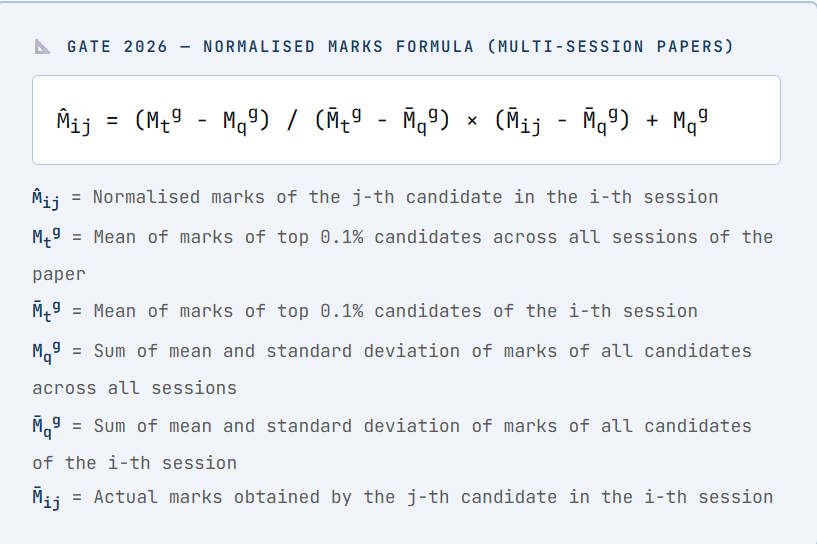
GATE Marks vs GATE Score — Key Difference
A very common source of confusion among GATE aspirants is the distinction between GATE Marks and GATE Score. Here is the definitive explanation:
| Parameter | GATE Marks | GATE Score |
|---|---|---|
| Definition | Raw marks obtained in exam | Derived metric via formula |
| Scale | 0 – 100 | 0 – 1000 |
| Used For | Qualifying determination | Admissions & PSU shortlisting |
| Shown on Result Card? | Yes | Yes |
| Same for all sessions? | Raw; varies by session difficulty | Normalised; comparable across all |
How is the GATE score calculated out of 1000?
GATE 2026 Score Calculation Formula — Explained
Once the normalised marks are determined, IIT Guwahati uses the following standard formula to convert them into the final GATE Score out of 1000:
Mq = Qualifying marks for the general category in the paper
M̄t = Mean of marks of top 0.1% candidates of the paper
Sq = 350 (score assigned to Mq)
St = 900 (score assigned to M̄t)
This formula ensures that a candidate who scores at the qualifying threshold receives a GATE score of 350, and a candidate performing at the top 0.1% mean receives a GATE score of 900, with linear interpolation for all scores in between.
GATE 2026 Qualifying Marks — Category-Wise Breakdown
The qualifying marks for GATE 2026 are dynamically computed based on the overall performance of all candidates in each subject. The formula ensures that qualifying thresholds adjust to the actual difficulty of the paper rather than being fixed arbitrarily.
| Category | Qualifying Marks Formula | Description |
|---|---|---|
| General (UR) | max(25, min(40, μ + σ)) | Capped between 25 and 40 |
| OBC-NCL / EWS | (9/10) × General qualifying marks | 90% of General threshold |
| SC / ST / PwD | (2/3) × General qualifying marks | ~66.7% of General threshold |
How GATE 2026 Scores Are Used — Admissions & PSU Recruitment
A valid GATE 2026 scorecard is accepted by over 900 institutions across India for admission to postgraduate engineering programmes. The GATE score is typically valid for three years from the date of announcement of results. Key uses include:
- M.Tech / M.E. / MS admissions at IITs, NITs, IISc, and other centrally funded institutions
- Direct Ph.D. programme admissions at IITs and IISc
- MHRD / AICTE fellowships for GATE-qualified M.Tech candidates
- PSU recruitment: BHEL, NTPC, IOCL, ONGC, GAIL, HPCL, BPCL, PowerGrid, and many more use GATE scores for shortlisting job applicants