
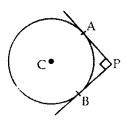
Q.6: I n the given figure, PA and PB are two tangents drawn from an external point P to a circle with centre C and radius 4 cm. If PA ⊥ PB, then find the length of each tangent.
Solution:
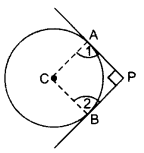
Construction: Join AC and BC. Proof: ∠1 = ∠2 = 90° ….[Tangent is I to the radius (through the point of contact ∴ APBC is a square. Length of each tangent = AP = PB = 4 cm = AC = radius = 4 cm
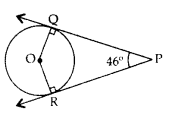
Q.7: In the given figure, PQ and PR are two tangents to a circle with Centre O. If ∠QPR = 46°, then calculate ∠QOR.
Solution:
∠OQP = 900 ∠ORP = 90° ∠OQP + ∠QPR + ∠ORP + ∠QOR = 360° …[Angle sum property of a quad. 90° + 46° + 90° + ∠QOR = 360° ∠QOR = 360° – 90° – 46° – 90° = 134°Q.8: From an external point P, tangents PA and PB are drawn to a circle with centre 0. If ∠PAB = 50°, then find ∠AOB.
Solution:
PA = PB …[∵ Tangents drawn from external point are equal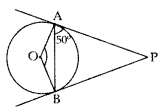 ∠PBA = ∠PAB = 50° …[Angles equal to opposite sides In ∆ABP, ∠PBA + ∠PAB + ∠APB = 180° …[Angle-sum-property of a ∆ 50° + 50° + ∠APB = 180° ∠APB = 180° – 50° – 50° = 80° In cyclic quadrilateral OAPB ∠AOB + ∠APB = 180° ……[Sum of opposite angles of a cyclic (quadrilateral is 180° ∠AOB + 80o = 180° ∠AOB = 180° – 80° = 100°
∠PBA = ∠PAB = 50° …[Angles equal to opposite sides In ∆ABP, ∠PBA + ∠PAB + ∠APB = 180° …[Angle-sum-property of a ∆ 50° + 50° + ∠APB = 180° ∠APB = 180° – 50° – 50° = 80° In cyclic quadrilateral OAPB ∠AOB + ∠APB = 180° ……[Sum of opposite angles of a cyclic (quadrilateral is 180° ∠AOB + 80o = 180° ∠AOB = 180° – 80° = 100°Q.9: If two tangents inclined at an angle 60 ∘ are drawn to a circle of radius 3 c m, then the length of each tangent is
(A) 3 2 √ 3 c m (B) 6 c m (C) 3 c m (D) 3 √ 3 c m
Solution:
Let P be an external point and a pair of tangents is drawn from point P and angle between these two tangents is 60 ∘
Radius of the circle = 3 c m Join OA and OP Also, OP is a bisector line of ∠ APC ∴ ∠ A P O = ∠ C P O = 30 ∘ O A ⊥ A P Also, tangents at any point of a circle is perpendicular to the radius through the point of contact. In right angled Δ O A P , we have tan 30 ∘ = O A A P = 3 A P ⇒ 1 √ 3 = 3 A P ⇒ A P = 3 √ 3 c m A P = C P = 3 √ 3 c m [Tangents drawn from an external point are equal]
Hence, the length of each tangent is 3 √ 3 c m .
Q.10: The tangent at any point of a circle is perpendicular to the radius through the point of contact.
Solution:
 Given: A circle with center O
with tangent X Y at point of contact P .
To Prove: O P ⊥ X Y
Proof: Let Q be a point on X Y connect O Q
Suppose it touches the circle at R
Hence,
O Q > O R
O Q > O P ( ∵ O P = O R ) (radius)
Same will be the case with all other points on the circle
Hence,
We get O P is the smallest line that connects X Y .
Q.11. Two concentric circles are of radii 7 cm and r cm respectively, where r > 7. A chord of the larger circle, of length 48 cm, touches the smaller circle. Find the value of r.
Solution:
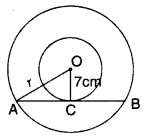 Given: OC = 7 cm, AB = 48 cm To find: r = ? ∠OCA = 90° ..[Tangent is ⊥ to the radius through the point of contact ∴ OC ⊥ AB AC = 1 2 (AB) … [⊥ from the centre bisects the chord ⇒ AC = 1 2 (48) = 24 cm In rt. ∆OCA, OA 2 = OC 2 + AC 2 … [Pythagoras’ theorem r 2 = (7) 2 + (24) 2 = 49 + 576 = 625 ∴ r= 625 −−−√ = 25 cm
Q.12: Prove that the parallelogram circumscribing a circle is a rhombus.
Solution:
ABCD is a ॥ gm . To prove. ABCD is a rhombus. Proof. In ॥ gm , opposite sides are equal
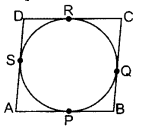 AB = CD and AD = BC ..(i) AP = AS …[Tangents drawn from an external point are equal in length PB = BQ CR = CO DR = DS By adding these tangents, (AP + PB) + (CR + DR) = AS + BQ + CQ + DS AB + CD = (AS + DS) + (BQ + CQ) AB + CD = AD + BC AB + AB = BC + BC … [From (i) 2AB = 2 BC AB = BC …(ii) From (i) and (ii), AB = BC = CD = DA ∴ ॥ gm ABCD is a rhombus.
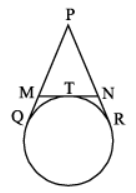
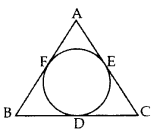
Q. 13: In the given figure, an isosceles ∆ABC, with AB = AC, circumscribes a circle. Prove that the point of contact P bisects the base BC.
Solution:
The incircle of ∆ABC touches the sides BC, CA and AB at D, E and F F respectively.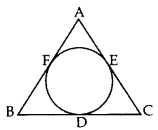 AB = AC To prove: BD = CD Proof: Since the lengths of tangents drawn from an external point to a circle are equal ∴ AF = AE … (i) BF = BD …(ii) CD = CE …(iii) Adding (i), (ii) and (iii), we get AF + BF + CD = AE + BD + CE ⇒ AB + CD = AC + BD But AB = AC … [Given ∴ CD = BD
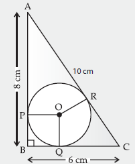
AB = AC To prove: BD = CD Proof: Since the lengths of tangents drawn from an external point to a circle are equal ∴ AF = AE … (i) BF = BD …(ii) CD = CE …(iii) Adding (i), (ii) and (iii), we get AF + BF + CD = AE + BD + CE ⇒ AB + CD = AC + BD But AB = AC … [Given ∴ CD = BDQ.14: In the given figure, a circle inscribed in ∆ABC touches its sides AB, BC and AC at points D, E & F K respectively. If AB = 12 cm, BC = 8 cm and AC = 10 cm, then find the lengths of AD, BE and CF.
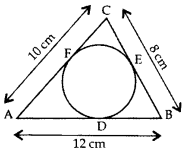 Solution:
Let AD = AF = x BD = BE = y …[Two tangents drawn from and an external point are equal CE = CF = z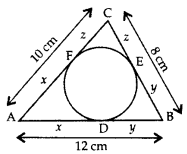
AB = 12 cm …[Given ∴ x + y = 12 cm …(i) Similarly, y + z = 8 cm …(ii) and x + z = 10 cm …(iii) By adding (i), (ii) & (iii) 2(x + y + z) = 30 x + y + z = 15 …[∵ x + y = 12 z = 15 – 12 = 3 Putting the value of z in (ii) & (iii), y + 3 = 8 y = 8 – 3 = 5 x + 3 = 10 x = 10 – 3 = 7 ∴ AD = 7 cm, BE = 5 cm, CF = 3 cm
Q: 15. The incircle of an isosceles triangle ABC, in which AB = AC, touches the sides BC, CA and AB at D, E and F respectively. Prove that BD = DC.
Solution:
The incircle of ∆ABC touches the sides BC, CA and AB at D, E and F respectively.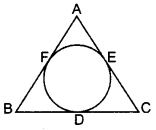
AB = AC To prove: BD = CD Proof: AF = AE ..(i) BF = BD …(ii) CD = CE …(iii) Adding (i), (ii) and (iii), we get AF + BF + CD = AE + BD + CE ⇒ AB + CD = AC + BD But AB = AC …[Given ∴ CD = BD]