







Taxation – United Kingdom (TX-UK) March/June 2026 Examiner's Report

Every sitting, the ACCA examining team publishes a detailed TX Examiner's Report that reviews candidate performance across Section A, B, and C questions. The TX Examiner's Report June 2026 (covering the March/June 2026 sittings) is no different — it walks through specific questions that caused difficulty, explains the correct answers, and highlights the most common mistakes candidates made.
Here, the given details break down the entire ACCA TX examiners report, section by section and question by question, using only the data and commentary published in the official report. Whether you're preparing for your next attempt or you're a tutor looking for teaching material, this is your roadmap to the exact pitfalls examiners flagged.
What This Taxation (TX-UK) March/June 2026 Examiner's Report Covers
The Taxation (TX-UK) exam — sometimes still referred to informally as the ACCA F6 Examiner's Report — is delivered as a computer-based exam (CBE), meaning candidates do not all receive identical question sets. The report should be used alongside the published March/June 2026 sample exam on the ACCA Practice Platform.
The report is structured into three parts: Section A – Objective test questions: four specific questions from this sitting Section B – Objective test case questions: one case scenario (Mornay Ltd, a VAT-registered trading company) that was reviewed in detail Section C – Constructed response questions: detailed commentary on three questions, Kahuna and Jacey, Luke, and Gamall Ltd and Nyr Ltd
Let's go through the TX examiners feedback for each.
Taxation – United Kingdom (TX-UK) March/June 2026 Examiner's Report PDF
Taxation Examiners Feedback Section Wise
This TX examiner feedback highlights what each question tested, the correct treatment, and the key mistakes candidates made — helping you focus your revision on both technical knowledge and exam technique.
Section A: Objective Test Questions
Question One — Self-Assessment Tax Returns.
The scenario: Jo, a basic-rate taxpayer who has never filed a return, receives several types of income, and candidates had to identify which two would normally require her to file a self-assessment return.
What it tested: Syllabus area A.3.a — the features of the self-assessment system as it applies to individuals.
Correct answer: B and C — trading income and property income, since both are received gross, meaning income tax could be payable on them.
Where candidates went wrong: Employment income is received net of tax already deducted under PAYE, and ISA income is exempt from income tax — both were incorrect distractors that could catch out candidates who didn't consider how each income type is taxed.
Question Two — Employer's Class 1 National Insurance
The scenario: Bob, self-employed with two employees, paid each employee a gross annual salary of £50,000 for 2025-26.
What it tested: Syllabus area B.6.b — understanding the annual employment allowance. Correct answer: £3,000 — calculated as (((50,000 − 5,000) × 15%) × 2) − 10,500.
Where candidates went wrong: This calculation requires applying the correct NIC rate above the secondary threshold for each employee, then deducting the employment allowance from the combined total — a step that is easy to miss or apply in the wrong order.
Question Three — Corporation Tax Groups
The scenario: Ray Ltd held shares in three other companies directly, and one of those companies held a further stake in a fourth company, and candidates had to identify which companies formed a 75% group with Ray Ltd.
What it tested: Syllabus area E.5.a — defining a 75% group and the reliefs available to group members.
Correct answer: Only Pie Ltd was in a group with Ray Ltd, since Ray Ltd held 80% of it directly.
Where candidates went wrong: Nod Ltd (70%) and Mab Ltd (55%) both fell below the 75% threshold. Boa Ltd, held indirectly, required multiplying the ownership percentages together (80% × 90% = 72%), which also fell short of 75% — a step candidates can easily overlook when shares are held indirectly.
Question Four — Business Asset Disposal Relief.
The scenario: Eric, a higher-rate taxpayer, sold his 20% shareholding in an unquoted trading company after being a director throughout his period of ownership, realising a chargeable gain of £432,100 as his only disposal of the year.
What it tested: Syllabus area C.5.b — explaining and applying business asset disposal relief.
Correct answer: £60,074 — calculated as (432,100 − 3,000) × 14%, after deducting the annual exempt amount and applying the special lower rate for qualifying business disposals.
Where candidates went wrong: Missing the annual exempt amount, or applying the standard higher-rate CGT rate instead of the business asset disposal relief rate, would both lead to an incorrect figure here.
Section B: Objective Test Case — Mornay Ltd
The examiners selected a VAT case covering the valuation of supplies, non-deductible input VAT, tax points, impairment loss relief, and VAT administration.
Question One — Output VAT on Sales.
What it tested: Syllabus area F.2.e — the principles regarding the valuation of supplies, specifically prompt payment discounts.
Correct answer: B, £27,150 — output VAT charged in full on sales with no discount offered, plus VAT on the discounted sales calculated using the discounted price, regardless of whether the discount was actually taken.
Where candidates went wrong: The most common errors were either ignoring the discount adjustment entirely, applying it only to invoices where the discount was actually taken, or applying it to the wrong portion of sales.
Question Two — Input VAT on Miscellaneous Expenditure.
What it tested: Syllabus area F.2.g — recognising the circumstances in which input VAT is non-deductible.
Correct answer: C, £755 — full recovery on the filing cabinet and on car repairs despite private use, but no recovery on UK entertaining, while overseas entertaining VAT remains recoverable.
Where candidates went wrong: Common mistakes included restricting the car repair VAT to a business-use percentage (when it is recoverable in full) and including UK entertaining VAT (which is never recoverable), while missing that overseas entertaining VAT is allowed.
Question Three — Tax Point for a Machine Purchase
What it tested: Syllabus area F.2.c — recognising the tax point when goods or services are supplied.
Correct answer: The basic tax point (dispatch date) was overridden by two separate actual tax points — the deposit, since it was paid before the basic tax point, and the balance, since the invoice was issued within 14 days of the basic tax point.
Where candidates went wrong: This question tests whether candidates understand that a single transaction can have more than one tax point, and that no input VAT should be claimed for VAT periods that fall outside these dates.
Question Four — Impairment Loss Relief.
What it tested: Syllabus area F.2.h — recognising the relief available for impairment losses on trade debts.
Correct answer: A, £690 — only the debt that was more than six months overdue, written off in the accounts, and still within four years and six months of the due date qualified for relief.
Where candidates went wrong: Common errors included claiming relief for a debt not yet written off in the accounts, claiming for a debt that was already out of time for relief, or wrongly assuming a strict six-month claim deadline rather than the correct four-year-six-month window.
Question Five — VAT Administration
What it tested: Syllabus area F.2.b — understanding how VAT is accounted for and administered.
Correct answers: A and D — the VAT return must be filed electronically, and VAT records must be retained for six years.
Where candidates went wrong: VAT payments must be made electronically, not by post, and the return deadline is one month and seven days after the quarter end (7 February 2026 in this case) — both common points of confusion.
Section C: Constructed Response Questions
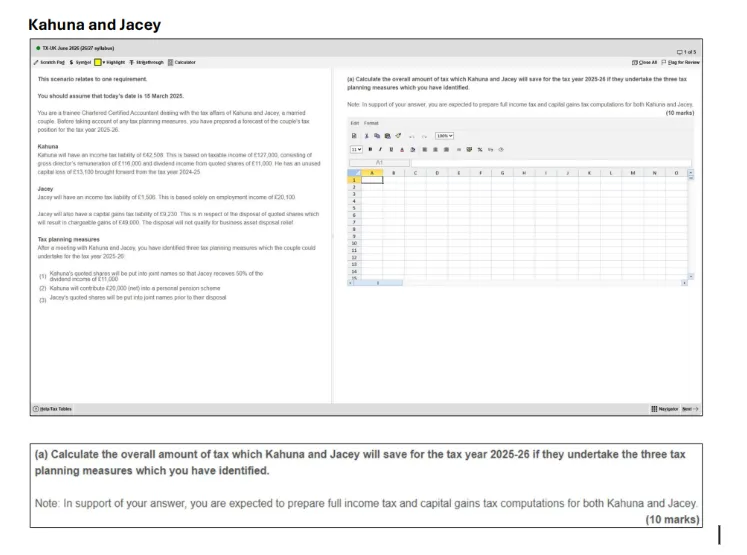
Kahuna and Jacey — Income Tax and CGT Planning
Key Points
This 10-mark tax planning question was generally well answered, but candidates needed to read the requirements carefully and consider all three tax planning measures together.
-
Dividend income: The £11,000 dividend was shared equally. The £500 dividend nil rate band was correctly applied to both Kahuna and Jacey.
-
Personal pension: Kahuna’s £20,000 net contribution equals a £25,000 gross contribution. This extends his basic-rate tax band by £25,000. It also reduces his adjusted net income below £100,000, allowing the full £12,570 personal allowance.
-
Capital gains: Jacey’s £49,000 gain was shared equally with Kahuna. Each received £24,500:
-
Kahuna: £24,500 − £3,000 annual exempt amount − £13,100 capital loss = £8,400 taxable gain, taxed at 24%.
-
Jacey: £24,500 − £3,000 annual exempt amount = £21,500 taxable gain, taxed at 18%.
-
Main lesson: Candidates needed to prepare full income tax and CGT computations, rather than calculating the tax savings separately for each measure.
Key Points
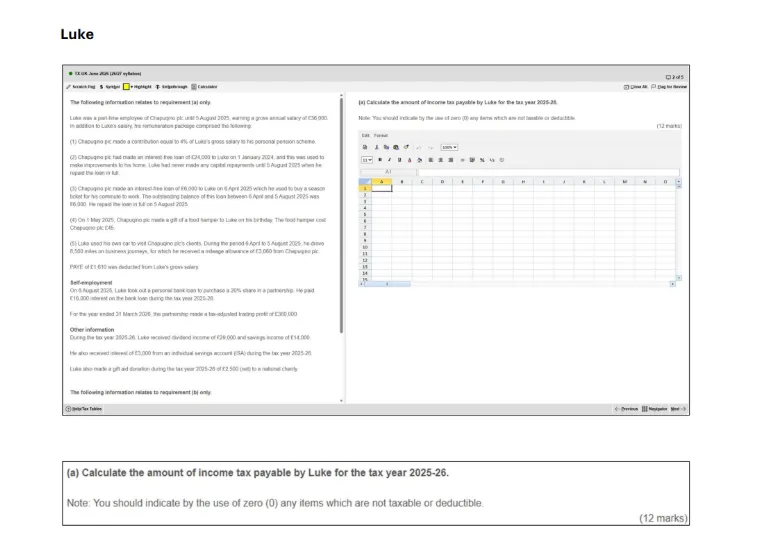
The income tax question was generally well answered, but several common errors affected candidates’ marks:
-
Employment income: Luke worked for 4 months, so salary was apportioned: £36,000 × 4/12 = £12,000.
-
Partnership profits: He was a 20% partner for 8 months, so his taxable share was £360,000 × 20% × 8/12 = £48,000.
-
Employer pension contribution: Chapuqino plc’s pension contribution was not a taxable benefit, so it should be shown as nil.
-
ISA interest: Interest from an ISA was exempt and should not be included in taxable income. Some candidates also mixed up dividend and savings income.
-
Personal allowance: The £12,570 personal allowance should not be given where adjusted net income exceeds £100,000.
-
Spreadsheet presentation: Avoid putting the entire tax computation into one spreadsheet cell. Keep the calculation clear and structured, with two main workings rather than many separate workings.
The ACCA TX Examiner's Report 2026 makes one thing clear: technical knowledge alone isn't enough. Candidates lost marks not because they didn't understand VAT, capital gains tax, or corporation tax rules in isolation, but because they misapplied time-apportionment, missed the correct order for reliefs, or presented workings that were difficult to follow. The good news is that every one of these pitfalls is avoidable with deliberate practice and careful reading technique.
FAQs
What does the TX Examiner's Report June 2026 cover?
Is the ACCA TX exam the same as the old F6 exam?
What was the most commonly failed topic in this sitting?
Where can I find the original questions referenced in this report?
Does the report give tips on exam technique, not just technical content?




Get Free Counselling Today
and Clear up all your Doubts
 Live & recorded classes available at easeDashboard for progress trackingLakhs of practice questions

