







Business Organisations & Stakeholders in ACCA BT
 Priyanka Yadav14 May, 2026
In a business world, success is no longer about individual effort but about how effectively people come together to achieve shared goals. This is where business organisations play a key role by providing structure, coordination, and direction to collective efforts.
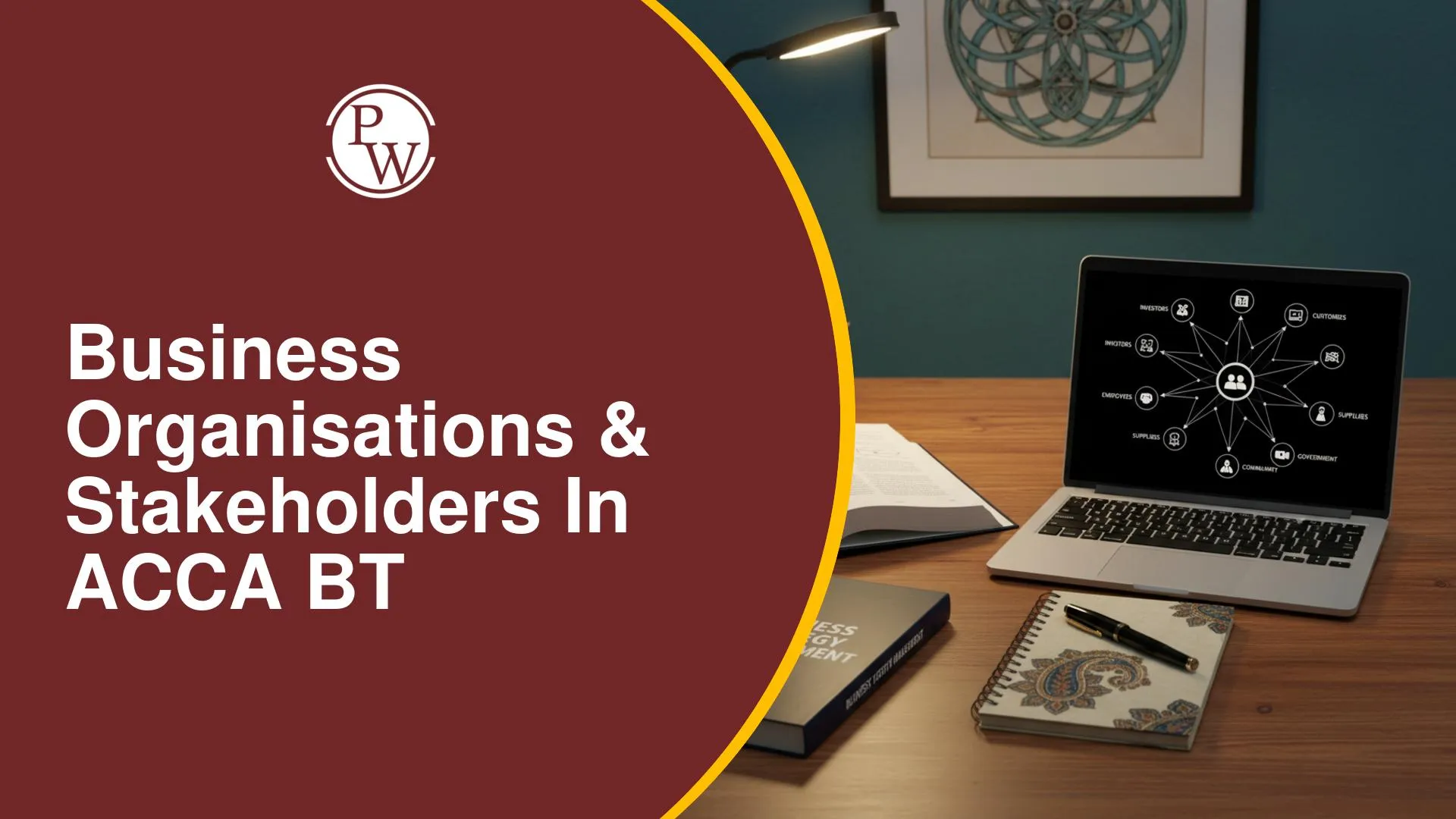
At the same time, no organisation operates in isolation, every decision impacts or is influenced by different stakeholders, ranging from employees and owners to customers, government, and society at large.
In ACCA Business and Technology (BT), understanding how organisations are formed, how they function, and how stakeholder relationships are managed is essential for making smart, real-world business decisions.
What is an Organisation?
An organization is a collective where multiple individuals collaborate to achieve a common objective or goal. These individuals bring diverse skills and knowledge, forming a structured environment that facilitates large-scale operations and specialized functions. Understanding organizational types and stakeholder dynamics is crucial for effective business management.
Also, Check: Accounting Basics for ACCA
Key Features of Organisation
An organisation has the following important features:
-
First, it is a social arrangement, meaning it consists of many people working at different levels and roles.
-
Second, performance is controlled and monitored to ensure that work is completed efficiently and objectives are achieved.
-
Third, there is a common goal that all members work towards, such as profit, growth, or service delivery
Why Organisations are Needed
Organisations are essential in modern business due to several reasons.
-
Individuals have limited time, money, and skills, so working in groups increases capacity and productivity.
-
Specialisation allows people to focus on specific tasks, improving efficiency and expertise.
-
Combined efforts also create synergy, where the total output becomes greater than individual contributions.
In addition, organisations help in sharing business risks among multiple members, reducing individual burden.
Types of Business Organizations
Types of Business Organizations refer to the different legal and operational structures through which a business can be owned, managed, and run, depending on ownership, liability, and purpose.
Sole Trader
A business owned and operated by a single individual. The sole trader receives all profits but also bears all losses alone. It has unlimited liability, making the owner personally responsible for business debts, requiring personal assets. Legally, the business and the owner are considered the same entity; there is no separate legal entity.
Partnership
A business formed by two or more persons operating via a partnership agreement, often with profit-sharing ratios.
Types of Partnerships:
-
General Partnership (Ordinary Partnership): All partners have unlimited liability, personally liable for business debts. Business and partners are not separate entities.
-
Limited Liability Partnership (LLP): All partners have limited liability, liable only for invested capital, protecting personal assets. The LLP and partners are separate legal entities.
-
Limited Partnership (LP): A hybrid with two partner types:
-
General Partner: Has unlimited liability.
-
Limited Partner: Has limited liability.
Company
Companies are owned by shareholders who provide capital. Shareholders have limited liability, restricted to their invested amount. A company has a separate legal entity from its owners, allowing it to own assets, enter contracts, in its own name. Shareholders are not personally liable for company obligations.
Not for Profit (NFP) Organization
Primary objective is not to earn profit but public service or social welfare.
Monitoring Performance in NFPs (The 3 Es):
-
Economy: Ensuring expenditure is kept to a minimum necessary level, within budget. Example: Efficient purchasing.
-
Efficiency: Achieving maximum output from minimum input by effective resource use. Example: Completing tasks efficiently.
-
Effectiveness: The ability to achieve stated goals. Example: Achieving set targets.
Types of Not for Profit Organizations:
-
Public Sector Organizations: Government-controlled organizations (e.g., police, government hospitals) providing public services.
-
Non-Governmental Organizations (NGOs): Independent of government control, pursuing social/political goals. Can receive government funding.
Cooperatives
A group created for the welfare of its members ("for the members, by the members"). Owned and democratically controlled by their members, aiming to meet members' needs. Each member has one vote, irrespective of investment. Example: Farmers sharing technology.
Stakeholders
Stakeholders are individuals or groups who affect a business or are affected by a business (e.g., Employees, Directors, Shareholders, Customers).
Types of Stakeholders
Types of Stakeholders refer to the different groups or individuals who are affected by or can affect a business, classified based on their relationship and level of involvement with the organisation.
-
Internal Stakeholders: Those within the organization and who work inside it (e.g., Employees, Managers, Directors). Often Primary Stakeholders.
-
Connected Stakeholders: Those with direct dealings or contracts and regular transactions (e.g., Shareholders, Customers, Suppliers, Lenders). Often Primary Stakeholders.
-
External Stakeholders: Those outside the immediate organizational structure without direct dealings, but who can occasionally affect the business (e.g., General Public, Government Officials, Environmental NGOs). Also Secondary Stakeholders.
Mendelow’s Power-Interest Matrix
The Power-Interest Matrix is used to analyse stakeholders based on two factors: power and interest.
-
Power refers to the ability to influence business decisions, while interest refers to how much a stakeholder cares about the business.
-
Stakeholders with high power and high interest must be closely managed and actively engaged because they are key decision influencers.
-
Those with high power but low interest should be kept satisfied to avoid conflicts.
-
Stakeholders with low power but high interest should be kept informed about business activities.
-
Those with low power and low interest require minimal attention.
-
This model helps organisations prioritise stakeholder management effectively.
Agency
Agency describes a relationship where an agent acts on behalf of a principal. The agent performs tasks for the principal.
-
Formation of Agency:
-
Express Agency: Through explicit words or written agreements.
-
Implied Agency: Through actions, conduct, or default expectations.
-
Example in Business: Shareholders (principals) own a company. Directors (agents) manage it. Directors must act in good faith for shareholders.
Practical Application of Stakeholder Analysis
In real situations, stakeholder analysis helps businesses understand different reactions to decisions.
For example, if a new airport is built near a residential area, local residents will be highly interested due to noise and environmental impact.
However, they may have low power to influence the final decision.
Therefore, they fall under the category of low power and high interest, and should be kept informed about developments.
Business organisations provide structure and efficiency to economic activities, while stakeholders ensure that all parties connected to a business are considered in decision-making. Understanding organisation types, liability, and stakeholder management is essential for success in ACCA Business and Technology.
Business Organisations & Stakeholders in ACCA BT FAQs
What is an organisation?
Q2. What is unlimited liability?
What are stakeholders?
What are the 3 Es in not-for-profit organisations?
What is Mendelows Matrix used for?





Get Free Counselling Today
and Clear up all your Doubts
 Live & recorded classes available at easeDashboard for progress trackingLakhs of practice questions

