RRB JE 2025 Total Form Fill Up Details Out, Check Below
Check RRB JE 2025 total form fill-up details with zone-wise application numbers and competition level. The exam saw lakhs of applicants against around 2,588 vacancies, making selection highly competitive across all RRB regions.
 Neha Tanna25 Mar, 2026
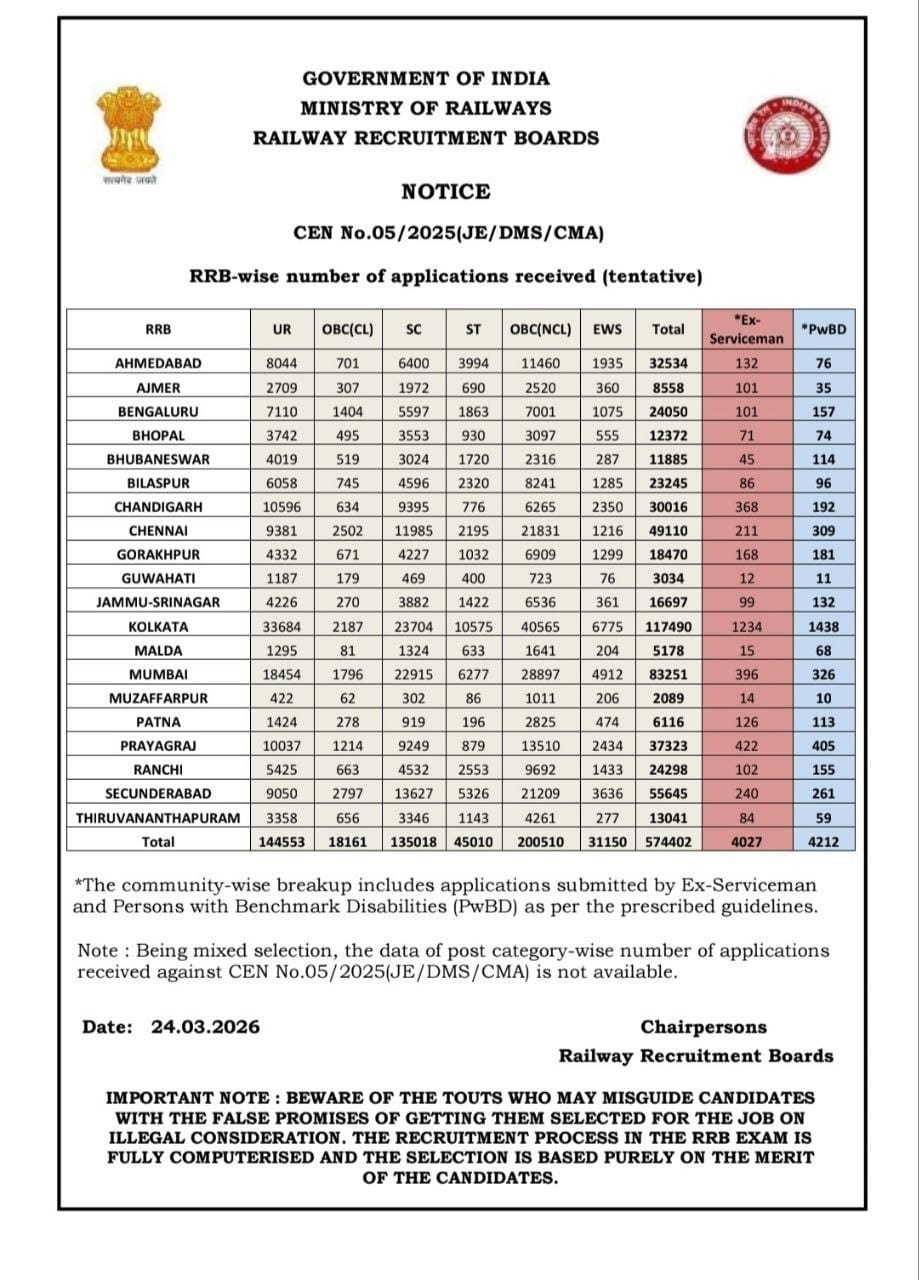
RRB JE 2025 Total Form Fill Up: The Railway Recruitment Board (RRB) has officially released the final application statistics for the RRB JE 2025 (CEN 05/2025) recruitment, revealing a massive turnout of approximately 5,74,402 applicants competing for 2,588 vacancies. According to the zone-wise form fill-up data, RRB Kolkata has emerged as the most competitive hub with a staggering 1,17,490 registrations, followed closely by Mumbai and Secunderabad. Conversely, zones like Muzaffarpur saw the lowest engagement with just over 2,000 applications, highlighting a significant variation in competition levels across different regions. This official data is a crucial indicator for aspirants to gauge the per-seat competition and refine their preparation strategies for the upcoming CBT-1.
RRB JE 2025 Total Form Fill Up Details Out
The official data confirms that over 15.38 lakh candidates have successfully registered to compete for the 7,951 advertised vacancies in the RRB JE 2025 recruitment drive. This massive turnout results in an average pan-India competition ratio of approximately 193 candidates per seat, though this figure fluctuates significantly between technical branches and specific railway zones. Aspirants can now analyze these figures to gauge the cutoff trends and difficulty levels expected for their respective regions in the upcoming Computer Based Tests.
RRB JE 2025 Total Form Fill Up Data
The table below provides the detailed zone-wise and category-wise application breakdown for the RRB JE 2025 recruitment (CEN 05/2025). Please note that these figures are based on the official data shared by the recruitment boards:
Nature of Railway Recruitment
Indian Railways operates as a Central Government organization, responsible for conducting recruitment for non-gazetted personnel on an All-India basis. This ensures standardized hiring across the country for these critical roles.
Recent Recruitment Cycles (2024-2025)
Presently, recruitment is underway for 144,386 vacancies for non-gazetted personnel. This is part of the Indian Railways' Annual Calendar for 2024 and 2025, indicating a structured approach to filling positions.
2024 Recruitment Cycle: Detailed Breakdown
Between January and December 2024, 10 Centrally Employed Notifications (CENs) were issued. The first stage Computer-Based Test (CBT) data reveals significant candidate participation:
|
2024 Recruitment Cycle Detailed Breakdown |
|||
|---|---|---|---|
|
Post |
Vacancies |
Candidates Registered |
Exam Conduct (Cities) |
|
Assistant Loco Pilot (ALP) |
18,799 |
1,840,000 |
156 |
|
Technician |
14,298 |
2,699,892 |
139 |
|
Junior Engineer (JE), DMS, CMA |
7,951 |
1,112,666 |
146 |
Exams were conducted across 15 languages for all categories. The total number of candidates who registered for various railway exams in this period was 3,58,59,270 (3.58 Crore), a figure highlighting the immense scale of railway recruitment.
For the Second Stage CBT (Mains), specifically for the 7,951 JE/DMS/CMA vacancies, 1,73,390 candidates were shortlisted. This translates to a shortlisting ratio of approximately 1:10 to 1:11 for the mains examination, demonstrating a high level of competition.
2025 Recruitment Cycle: Observations and Comparison
In 2025, 9 Centrally Employed Notifications were announced, offering a total of 5,970 vacancies. This shows a definite and significant drop in vacancies compared to the 2024 cycle.
-
The 2024 cycle had around 90,000 total vacancies (including higher numbers for JE, Technician, and ALP).
-
The 2025 cycle offered only 2,585 vacancies for Junior Engineer and Depot Material Superintendent, representing a substantial reduction.
Candidate interest and registration numbers are strongly influenced by available vacancies:
-
With 7,000-8,000 vacancies (2024 JE/DMS), approximately 1.1 million candidates registered.
-
With around 2,500 vacancies (2025 JE/DMS), only 574,351 candidates registered.
This indicates that candidates often pursue other examinations when vacancy numbers are lower.
Historical Recruitment Data
Official data reveals recruitment trends in Indian Railways:
-
2004-2005 to 2013-2014: Total recruitment was 4.11 Lakh (411,000).
-
2014-2015 to 2023-2024: Total recruitment was approximately 5 Lakh (500,000).
-
2026 Cycle (Current/Upcoming): Currently, 41,000 vacancies have been announced.
System Improvements and Future Outlook
The Ministry of Railways has implemented system improvements, notably introducing an Annual Calendar for the 2024 recruitment cycle and initiatives for Group C positions. These reforms aim to provide:
-
More opportunities for aspiring candidates.
-
The chance for candidates to be eligible every year.
-
Certainty regarding examination schedules.
-
A faster recruitment process, addressing previous delays.
RRB JE 2025 Total Form Fill Up Details FAQs
What is the official source of railway recruitment data?
What is the nature of recruitment in Indian Railways?
How many non-gazetted vacancies are currently under recruitment for the 2024-2025 cycles?