UPSSSC AGTA 2026 High Scoring Topics
 Priyanka Yadav9 Apr, 2026

UPSSSC AGTA exam notification has been released, making strategic preparation essential. Check a comprehensive analysis of the highest-scoring topics within the Agriculture section, based on previous year papers. Understanding these critical areas is vital for focused study and achieving a significant advantage in this competitive examination.
Examination Structure and Importance of Agriculture
The UPSSSC AGTA exam comprises 100 questions. The distribution across subjects is as follows:
-
Agriculture Section: 65 questions
-
Computer: 15 questions
-
General Knowledge (GK): 20 questions
The 65 questions from the Agriculture section are the deciding factor for success. Performing well here can be a game-changer, particularly for B.Sc. Agriculture graduates. Questions cover both trend-based topics like current affairs and recent Uttar Pradesh schemes, and essential foundational concepts.
Agricultural Subjects and Their Weightage
The Agriculture section encompasses several subjects, each with varying emphasis:
-
Crop Science: This is a core area and consistently a major focus in past exams.
-
Soil and Water: These topics hold medium weightage.
-
Plant Protection: An important part, frequently appearing in previous year papers.
-
Horticulture: Questions primarily revolve around Post-Harvest aspects, rather than direct fruit and vegetable cultivation.
-
Seed and Irrigation: Though considered minor, questions from these subjects become significant when they appear.
-
Agri-Economics: Features scheme-based questions, an often-skipped but important segment.
-
Extension Education / Miscellaneous: Consistently includes around five questions.
-
Animal Husbandry: Also carries medium weightage.
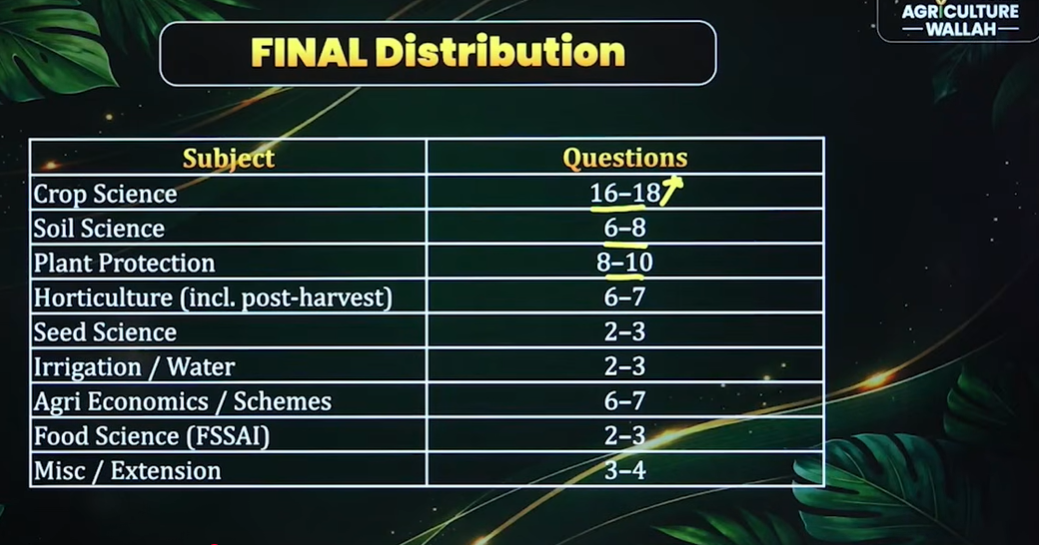
Detailed Subject-Wise Question Distribution
Previous UPSSSC AGTA exams showed the following question distribution within the Agriculture section:
-
Agronomy (Crop Science): 16-18 questions
-
Soil Science: 6-8 questions
-
Plant Protection: 8-10 questions
-
Horticulture: Questions predominantly focused on Post-Harvest.
-
Example Question: As per FSSAI norms, ready-to-serve fruit beverages "shall not occupy less than [X]% of the water capacity of the container" when properly packed.
-
Seed Science: 2-3 questions
-
Irrigation Water: 2-3 questions
-
Agri-Economics: An important part, with approximately 6-7 questions.
-
Food Science (FSSAI standards): 2-3 questions
-
Miscellaneous, Extension, Animal Husbandry: 3-4 questions (with an additional 2-3 questions under miscellaneous).
This breakdown provides a clear understanding of the most important, heavily weighted topics for targeted preparation.
Analysis of Key Agricultural Subjects
Agronomy
Agronomy questions include 3-4 questions on Crop Classification (e.g., Kharif, Rabi, minor millets). Questions also cover Botanical names (e.g., Black Gram) and Nitrogen-fixing crops used in crop rotation (with 2 questions specifically on crop rotation). Additionally, 4-5 questions relate to yield and general agronomy. Options are often close and confusing, demanding precise recall.
Soil Science
Soil Science typically features 3-4 nutrient-based questions (e.g., N-P-K), 1-2 questions on Soil Fertility, and 1-2 questions on Soil Improvement. Questions range from concept-based (e.g., identifying Splash Erosion) to direct factual (e.g., identifying complex fertilizers).
Horticulture
Horticulture questions include 1-2 direct questions from Fruits and Vegetables, and 1 question from Propagation. However, Post-Harvest topics carry major weightage with 2-3 questions. Examples include FSSAI norms for fruit beverages, identifying the cause of Whiptail in Cauliflower, and components of a Post-Harvest Management Project. Post-Harvest is a frequently tested and crucial area often overlooked by students.
Seed Science and Irrigation
From Seed Science, 1-2 questions focus on Seed Types. From Irrigation, 1-2 questions cover Irrigation Methods. Example questions include identifying the most water-saving irrigation method or methods to verify genetic purity. Though the number of questions is low, these topics are important when they appear.
Plant Protection
Plant Protection includes 3-4 questions on Diseases (e.g., Leaf Rust Disease affecting Wheat crop), 2-3 questions on Pests, and 1-2 chemical-based questions. Questions often involve crop-plus-disease linking, requiring accurate recall for correct answers.
Agri-Economics and Scheme-Based Questions
Agri-Economics gives major weightage to Schemes, with 4-5 direct questions. Additionally, 1-2 questions come from Digital Agriculture (e.g., AI use). Example questions relate to E-Kisan Upaj Nidhi, loans via warehouse receipts, MSP increment, or institutional mechanisms for farmer matters. Schemes are a highly significant and scoring area, despite often being skipped by students.
Food Science
Food Science and FSSAI Standards contribute 1-2 questions. These include topics like container fill percentages (cross-referenced with Horticulture) and compliance standards for commercial food-producing animals. These questions are often highly specific.
Animal Husbandry
Animal Husbandry typically has 2-3 direct questions. Examples include identifying breeds like the "Black Gold of India" (for high milk production) or the stage of lactation where cows are most susceptible to mastitis.
Overall Examination Question Pattern
The previous year's paper showed a varied distribution of question types:
-
Direct Fact-based: 35-40%
-
Conceptual: 30%
-
Statement-based: Approximately 20%
-
Application-based (practical scenarios): 10%
Statement-based questions can be particularly confusing, requiring careful identification of correct information from multiple statements.
Key Insights for Focused Preparation
Analysis of the 65 Agriculture questions reveals a clear pattern for effective preparation:
-
Dominant Subjects: Approximately 70% of the Agriculture paper originates from Crop Science, Soil Science, and Plant Protection. These are foundational and must be thoroughly covered.
-
Hidden Scoring Subjects: These topics are often neglected but are significant sources of questions:
-
Post-Harvest (within Horticulture)
-
Schemes (within Agri-Economics)
-
Food Standards (e.g., FSSAI norms)
Students commonly overlook these "hidden scoring subjects," mistakenly believing they are of minor importance. However, they consistently yield crucial marks and are essential for maximizing overall scores.
UPSSSC AGTA 2026 High Scoring Topics FAQs
What is the weightage of the Agriculture section in the UPSSSC AGTA exam?
Which agricultural subjects are considered dominant in the UPSSSC AGTA exam?
What are the "hidden scoring subjects" that students often overlook but are crucial for the UPSSSC AGTA exam?
How many questions typically come from Agronomy and Soil Science?
Why are "schemes" in Agri-Economics considered important for the exam, despite often being skipped by students?


Have questions about your prep?
Our experts can answer all your questions