CA Inter Law May 2026: Last 3 Months Plan for Corporate & Other Laws
 Aarti .23 Feb, 2026

CA inter exam is conducted three times a year; the recent exam is scheduled in May 2026. Eligible students need a strategy for all subjects, but specifically for the law exam, as the subject is conceptual, theory-heavy, and application-based.
Therefore, a three-month strategy is provided here with a detailed revision plan, with days divided into phases, and proper time allotted to mock tests. Study and revision tips are also given here.
CA Inter Law Syllabus Overview and Weightage
The effective study duration is approximately 86 days, which consists of February, March, and April. This plan is structured around an estimate of 80 effective study days, with May reserved for the Accounts exam and final comprehensive revisions.
Syllabus Structure:
The complete syllabus comprises 15 chapters.
-
Companies Act (Parts I & II):
-
Consists of 11 chapters, from Preliminary concepts to Companies Incorporated Outside India & LLP.
-
Weightage: 70 Marks (including LLP).
-
Other Laws (Part III):
-
Includes 3 chapters: General Clauses Act, Interpretation of Statutes, and FEMA.
-
Weightage: 30 Marks.
Note on ABC Analysis: While an ABC analysis might exist, it is not a reliable preparation tool. The institute frequently alters its paper pattern and introduces unexpected elements, making 100% syllabus coverage essential for success.
Recommended Chapter Sequence for Revision
To build momentum and confidence effectively, the syllabus should be revised in a specific, strategic order rather than a strictly sequential one.
-
Phase 1: Master Other Laws (40-45 Marks)
-
Start with FEMA, The General Clauses Act (TGC Act), and Interpretation of Statutes (IOS), alongside LLP.
-
Why: Securing this significant 40-45 mark section initially provides a strong foundation. These topics, especially TGC Act and IOS, demand multiple revisions to master keywords and score well. Revising them early helps in repeated review cycles.
-
Phase 2: Quick-Win Company Law Chapters
-
Next, come to the smaller, less time-consuming chapters from the Companies Act:
-
Deposits & Charges
-
Dividend
-
Companies Incorporated Outside India
-
Why: Completing these four chapters swiftly builds significant confidence and a sense of accomplishment, propelling further study.
-
Phase 3: Major Company Law Chapters
-
With confidence established, proceed to the larger, more substantial chapters:
-
Management and Administration
-
Accounts of Companies
-
Audit and Auditors
-
Why: These chapters require considerable time and attention, and they can be tackled more effectively once a huge portion of the syllabus is already covered.
-
Phase 4: Foundational Company Law Chapters
-
Finally, revise the initial, foundational chapters:
-
Prospectus and Allotment of Securities
-
Share Capital and Debentures
-
Incorporation of Company
-
Why: This revision flow ensures an efficient and rewarding process, preventing early discouragement by not getting bogged down by extensive chapters in the syllabus.
Detailed 3-Phase Revision Plan
This comprehensive plan divides the 80-day schedule into distinct revision and practice phases.
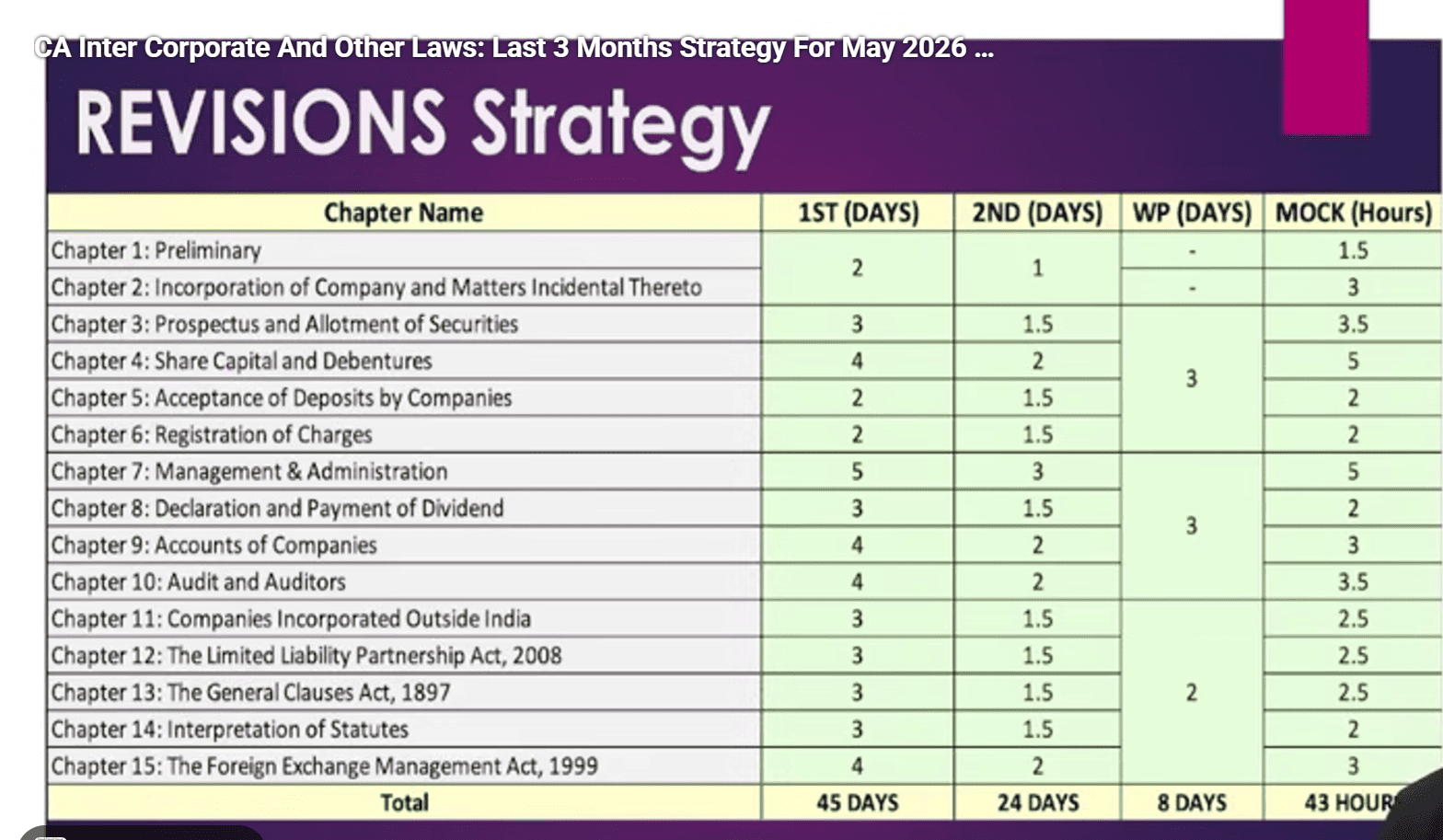
Phase A: First & Second Revisions (Comparative Time Allocation)
A minimum of two revisions is necessary. The time allocated for each chapter should decrease significantly in the second revision.
Phase B: Dedicated Writing Practice (8 Days)
After completing the conceptual revisions, dedicate 8 days for writing practice of questions.
-
Days 1-3: Practice questions from Prospectus, Share Capital, Deposits, and Charges.
-
Days 4-6: Practice questions from Management & Administration, Dividend, Accounts, and Audit.
-
Days 7-8: Practice questions from Other Laws, Companies Incorporated Outside India, and LLP.
Phase C: The Mock Revision (3 Days)
This is a high-intensity revision designed to prepare for the crucial 1.5-day pre-exam study period.
-
Goal: Condense the entire syllabus, which typically requires approximately 43 hours of study time, into a focused 36-hour (3-day) period.
-
Method: Allocate specific hours to each chapter (e.g., Preliminary: 1.5 hrs, Incorporation: 3 hrs, Share Capital: 5 hrs). This method forces efficient revision under simulated time pressure.
-
Outcome: Successfully completing a 3-day full-syllabus revision builds immense confidence for the final 1.5-day revision immediately preceding the exam.
Daily Study Habits and Best Practices
Incorporate these essential habits into your daily routine for maximum effectiveness and retention.
-
"Recall 30": Dedicate 30 minutes every morning and 30 minutes every evening to a quick recall of a random topic you have already studied. This reinforces memory.
-
Slot System: Study in focused slots of 1.5 to 2 hours each to maintain concentration and productivity.
-
Topic Prioritization: Study tough topics in the morning when your mind is fresh and most alert, reserving easier topics for the later parts of the day.
-
Daily Writing Slot: Allocate one dedicated slot of 1.5 to 2 hours every day for writing practice. This is crucial for improving answer presentation and speed.
-
Sunday Focus: Utilize Sundays exclusively for exam-oriented activities, such as solving mock papers and taking comprehensive tests.
Prerequisites for CA Inter Law May 2026 Revision
Before starting the revisions, you must complete the following foundational steps:
-
Initial Reading: At least one complete reading of the study module or primary textbook should have been finished during your classes.
-
Past Paper Analysis: Solve Mock Test Papers (MTPs), Revision Test Papers (RTPs), and Past Year Question Papers from a minimum of the last four attempts.
-
Regular Testing: Daily Practice Papers, Weekly Tests, and a Master Test Series is crucial for building a grasp of theoretical subjects.
-
ICAI Mock Tests: Attempt the official mock tests provided by ICAI closer to the examination date.
-
Daily Writing Practice: A commitment to daily writing is very necessary.
Tips for CA Inter Law May 2026
Success in law subjects, from Foundation to Intermediate levels, depends on four critical principles that demand diligent application:
-
100% Syllabus Coverage: The practice of selective studying is no longer useful for this subject; complete coverage is advised for students.
-
Revision with Writing Practice: Revision alone is insufficient; it must be combined with consistent writing practice to make the understanding and expression clear.
-
A Day-wise and Chapter-wise Plan: A clear, structured plan is important, as it breaks down the syllabus by chapter and allocates specific days for each topic.
-
Consistency: This is a powerful tool. Consistent daily effort, even in small increments, is key to overcoming challenging goals and achieving desired results.
-
Memory Tip: A simple rule to follow is: "Two questions a day will keep the failure away."
The "Last Page Legend" (LPL) Revision Technique
The "Last Page Legend" (LPL) is a powerful technique designed to smooth your final-day revision.
-
When to Start: Begin creating your LPL during your very first revision.
-
How it Works:
-
Dedicate the last page of your notebook or a specific section for creating your LPL for each chapter.
-
As you revise, identify any concept, section number, or specific question that you find difficult, hard to recall, or confusing.
-
Immediately note these items down on the LPL page designated for that particular chapter.
-
Purpose: This technique creates a personalized, high-priority list of topics that you know require focused review just before the exam, ensuring you target your specific weak areas effectively.
Corporate & Other Laws FAQs
Q1: Why is 100% syllabus coverage essential for the CA Inter Law exam?
Q2: What are the "Four Mantras of Preparation" for law subjects?
Q3: How does the "Last Page Legend" (LPL) technique aid revision?
Q4: What is the recommended strategic sequence for revising chapters in CA Inter Law?
Q5: Why is daily writing practice so important for theoretical subjects like Law?