How to Register a Company in India? CA Foundation Law Explained
 Priyanka Yadav18 Apr, 2026
Share
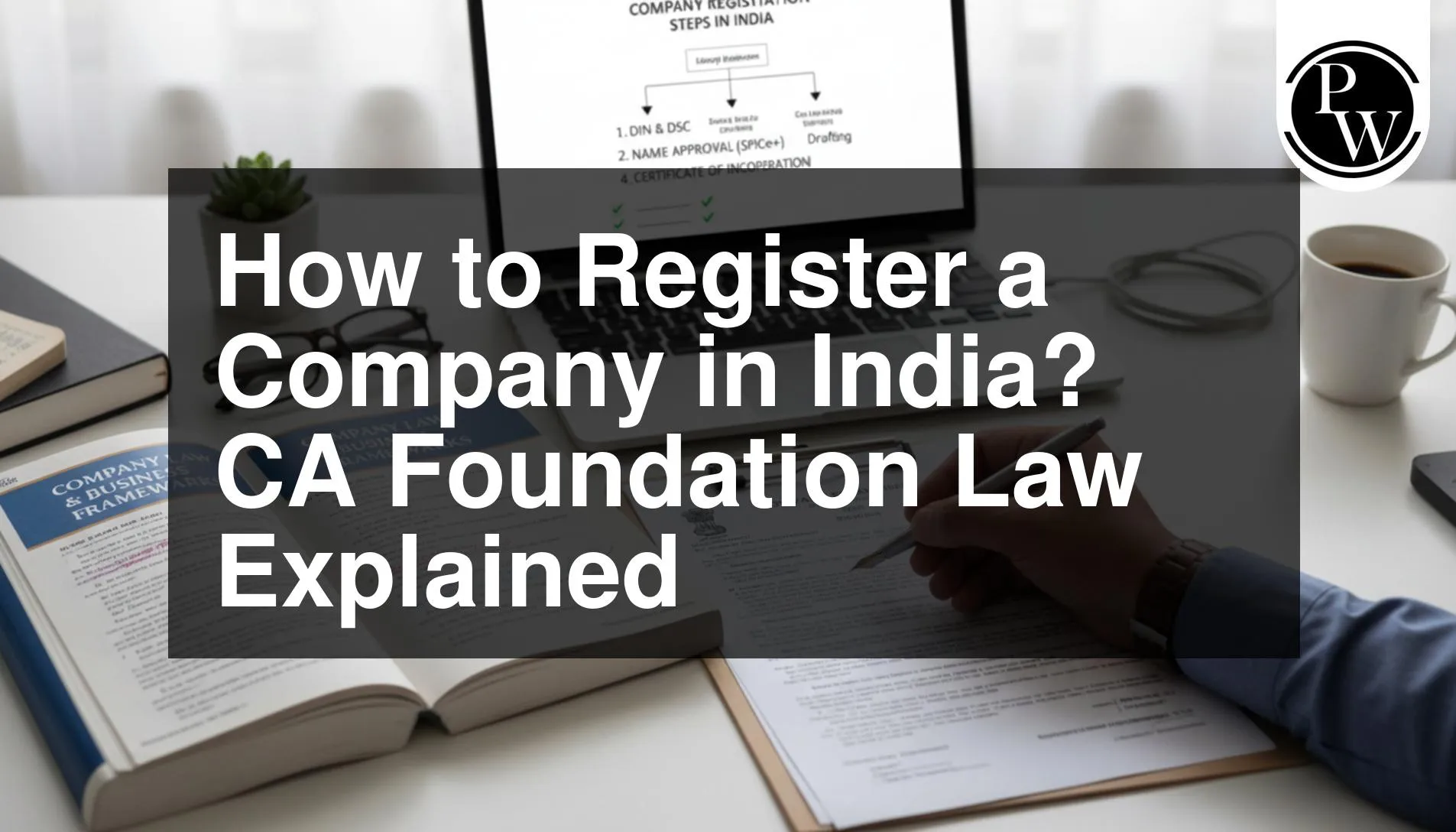
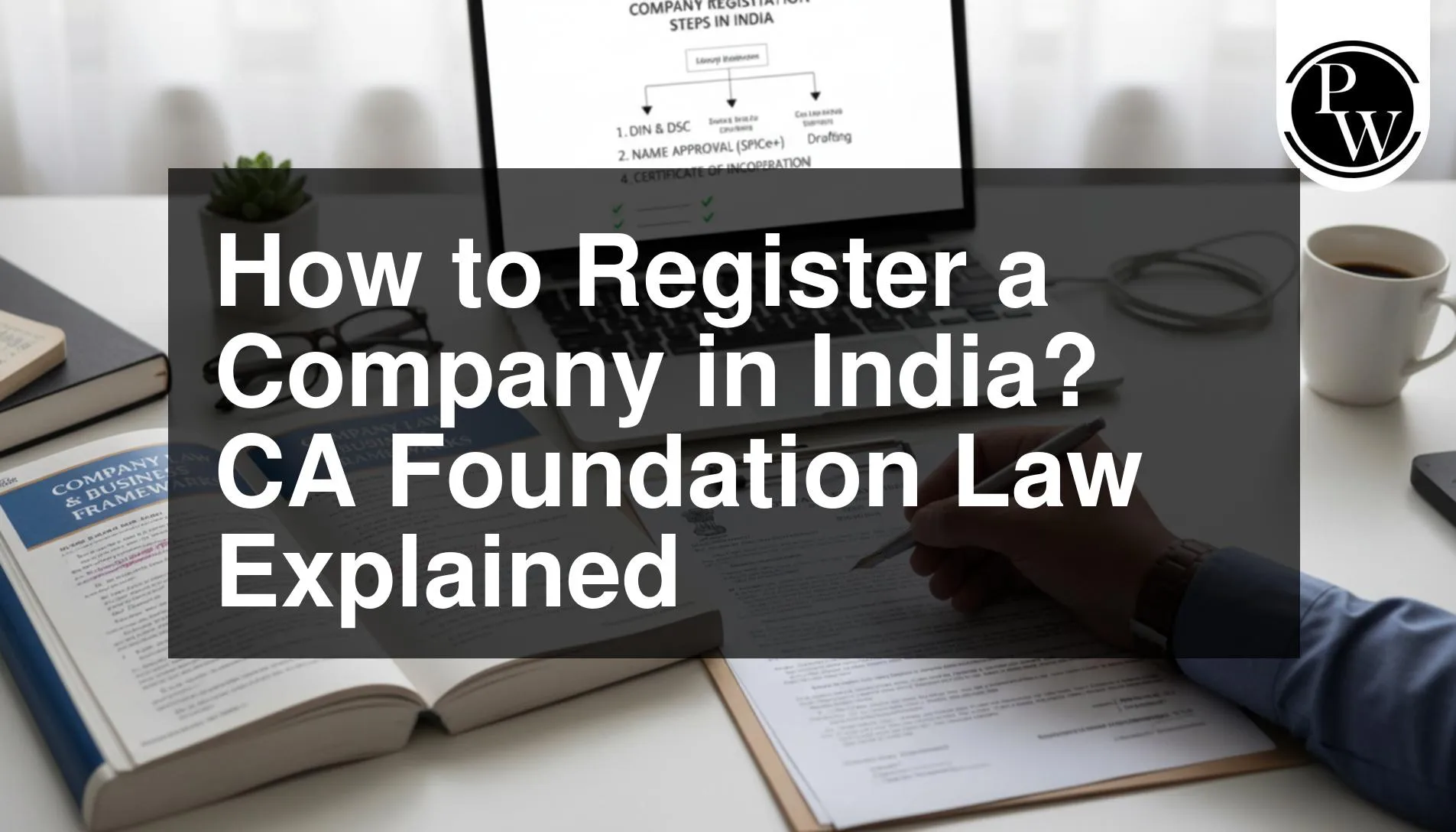
Registering a company in India is not just an administrative task; it is a structured legal process that gives a business its separate legal identity under the Companies Act, 2013. For CA Foundation students, understanding company incorporation is crucial because it forms the backbone of corporate law questions in exams.
The process involves multiple legal steps, such as obtaining a Digital Signature Certificate (DSC), Director Identification Number (DIN), filing the SPICe+ form, and submitting key constitutional documents like the Memorandum of Association (MoA) and Articles of Association (AoA).
Learn here how to register a company in India.
Understanding Company Incorporation
Company incorporation is the legal process that creates a company as a separate legal entity. It is different from general “registration” because incorporation gives the company a distinct identity, allowing it to own property, enter contracts, and sue or be sued in its own name.
The term "incorporate" is a legal word signifying a formal process, distinct from casual registration. Incorporation is a legal process that grants a company its separate legal identity. While "registration" often refers to partnerships, "incorporate" is specifically used for forming a Limited Liability Partnership (LLP) or a Company.
Legally, these terms denote distinct processes, even if a layperson might use them interchangeably. Before a company can be incorporated, it must first be formed.
Who is a Promoter?
A promoter is the person who ideates, decides, and initiates the process of company formation. A promoter can be an individual, a group of individuals, a company (e.g., a holding company forming a subsidiary), or a partnership firm.
Key Functions and Characteristics of a Promoter (as per Section 2, Clause 69):
-
The individual who conceives the idea for the company.
-
The individual who takes all necessary steps to form the company.
-
The individual under whose Direction, Instruction, or Advice (DIA) the Board of Directors acts.
-
The individual who controls the affairs of the company.
A promoter's name can be identified in the Prospectus (for public offers), the Annual Return (as per Section 92 of the Companies Act), or the Annual Report of the company. It's important to note that a promoter is not necessarily involved only from the inception; they can join subsequently to guide new initiatives or raise funds.
Minimum Requirements for Company Formation (Section 3)
Section 3 of the Companies Act outlines the fundamental requirements without which company formation is not possible. To form a company, one requires:
-
A Lawful Purpose for the business; it cannot be illegal or unlawful.
-
A Minimum Number of Members:
-
Private Company: Minimum two (2) members.
-
Public Company: Minimum seven (7) members.
-
One Person Company (OPC): One (1) member.
-
By subscribing their names to the Memorandum of Association (MoA).
-
The MoA is an important document for company formation, often called the Constitution of the Company or the Charter of the Company.
-
Subscribers are those who sign the MoA, pledging to take at least one share.
-
Complying with all the requirements of the Companies Act.
(Memory Tip: Remember the minimum members for each type: OPC (1), Private (2), Public (7).)
Authorities Responsible for Company Incorporation
Company incorporation is an online process primarily governed by the Ministry of Corporate Affairs (MCA). The MCA is responsible for acts like the Companies Act 2013, LLP Act 2008, and the Insolvency and Bankruptcy Code 2016. Its website offers various services, including company registration.
The hierarchy within the Ministry includes:
-
Director General / Secretary (top position).
-
Regional Directors (RDs).
-
Registrar of Companies (RoCs).
Both Regional Directors and Registrar of Companies are designations held by individual persons, not just office names.
Recent Amendments to Regional Directors and RoCs Structure
The structure of Regional Directors and RoCs has seen recent changes.
Regional Directors (RDs):
-
As per a February 2026 announcement, the number of RDs has increased from 7 to 10.
-
The previous 7 RDs included Ahmedabad, Chennai, Hyderabad, Kolkata, Mumbai, New Delhi, and Shillong (Shillong has been removed).
-
The new 10 RDs include the previous 6 (excluding Shillong), plus Navi Mumbai, Bengaluru, Guwahati, and Chandigarh.
Registrar of Companies (RoCs):
-
The total number of RoCs is now 30.
-
Significant additions/splits include:
-
Delhi: Split into Delhi One and Delhi Two.
-
Uttar Pradesh: Split into Kanpur and Noida.
-
Maharashtra: Added Nagpur, alongside Mumbai and Pune, which are now Mumbai One and Mumbai Two.
-
Kolkata and Chennai have also seen additions (e.g., Coimbatore for Chennai).
Step 1: Obtaining Digital Signature Certificate (DSC) and Director Identification Number (DIN)
Before initiating the online incorporation process, two essential prerequisites are required:
-
Digital Signature Certificate (DSC):
-
Purpose: Used for online signatures and authorizations in electronic filings.
-
Issuing Authorities: Ministry-approved certifying authorities like National Informatics Centre (NIC), e-Mudhra, and NSDL.
-
Form Factor: Comes as a USB (pen drive-like device).
-
Director Identification Number (DIN):
-
Purpose: A unique identification number provided to an individual who wishes to be a director in a company.
-
Content: Contains the director's name and address.
Step 2: Filing the SPICe+ Form (INC-32) and Name Reservation
The primary form for company incorporation is the SPICe+ Form (Simplified Proforma for Incorporating Company Electronically), designated as Form INC-32. This is a single, integrated form that consolidates various applications.
SPICe+ Functionality: It allows for:
-
Application for DIN (if not already obtained).
-
Reservation of the company name.
-
Submission of other incorporation details.
The SPICe+ Form has two parts:
-
Part A: Used for Name Reservation. Applicants can propose two names, which must not be identical to or nearly resemble existing company names and must not be undesirable.
-
Part B: Used for submitting all other company-related details required for incorporation, including the type, class, and category of the company.
Existing companies seeking to change their name use a separate form called RUN (Reserve Unique Name).
Step 3: Required Documents for Company Incorporation
In addition to the SPICe+ form, several crucial documents are required:
-
Electronic Memorandum of Association (e-MoA): Form INC-33.
-
Electronic Articles of Association (e-AoA): Form INC-34.
-
Declarations:
-
Declaration by Professionals (Form INC-8): Certifies compliance with the Companies Act by professionals (CA, CS, Advocate, Cost Accountant) involved.
-
Declaration by Subscribers and First Directors (Form INC-9): States that they have not been convicted for certain offenses, not found guilty of fraud under the Companies Act in the last five years, and all submitted information is correct and complete.
-
Address for Correspondence: The proposed registered office address and current communication address (Form INC-22 for verification).
-
Particulars of Directors and Subscribers: Comprehensive details are required for each director and subscriber. (Memory Tip: Remember D.O.N.A. for Director's details: **D**IN, **O**ccupation, **N**ame & Nationality, **A**ddress.)
-
Director's Consent: Formal consent from each director to act as a director.
-
Director's Interest: Disclosure of any interest a director may have in other entities.
Step 4: Certificate of Incorporation
After verification by CRC, the Certificate of Incorporation (INC-11) is issued.
It includes:
-
Corporate Identification Number (CIN)
-
Company name
-
Date of incorporation
-
Legal status under Companies Act
Detailed Examination of Memorandum of Association (MoA)
The Memorandum of Association (MoA) is a fundamental document for a company, outlining its constitution and external scope. Key Clauses and their Content:
-
Name Clause: States the full name of the company (e.g., "Reliance Industries Ltd.").
-
Situation Clause (Registered Office Clause): Specifies the State where the company's registered office is located (e.g., "State of Maharashtra").
-
Object Clause: Outlines the business activities the company is authorized to undertake. This can be very extensive for large companies.
-
Capital Clause: Details the company's Authorized Share Capital, including types and amounts (e.g., Equity and Preference Share Capital). This can be modified over time.
-
Subscription Clause: Lists the names of the initial subscribers to the MoA, including details like the number of shares subscribed by each, their address, and occupation.
Consolidated Flow of Company Incorporation and Consequences of False Information
The incorporation process culminates with careful submission and scrutiny of documents.
Final Steps in Incorporation:
-
The completed SPICe+ Form (INC-32), along with e-MoA (INC-33), e-AoA (INC-34), and all other relevant documents and declarations, are submitted to the Central Registration Center (CRC).
-
The RoC (CRC) scrutinizes these documents.
-
If satisfied, the RoC (CRC) issues the Certificate of Incorporation (INC-11), which includes the Corporate Identification Number (CIN).
-
All submitted documents must be permanently maintained by the company.
Consequences of False or Incorrect Information (Section 7):
If any material information provided for incorporation is found to be false, incorrect, or suppressed (whether detected before or after incorporation), action can be taken by the Tribunal (National Company Law Tribunal - NCLT).
-
Liable Parties: Promoters, first directors, and all persons who have given declarations (including professionals and subscribers).
-
Penalty: Such individuals and entities can be penalized under Section 447 (Fraud) of the Companies Act.
-
Powers of the Tribunal (NCLT): The Tribunal may issue orders such as:
-
Directing changes to the Memorandum of Association (MoA) and/or Articles of Association (AoA).
-
Declaring that the liability of the members is unlimited.
-
Ordering the winding up of the company.
-
Ordering the striking off/removal of the company's name from the register.
-
Issuing any other order it deems just and appropriate.
Fundamental Legal Principle: Before taking any action or passing an order, the Tribunal will provide an Opportunity of Being Heard (Audi Alteram Partem) to the affected parties.
Company Incorporation FAQs
What is company incorporation?
What is the SPICe+ form?
Who is a promoter in company law?
What is the role of MoA?
What happens if false information is given during incorporation?