CLASSIFICATION AND EVOLUTION

Share
CLASSIFICATION AND EVOLUTION
Diversity of organism of Class 9
Body designs in form and function of living organisms is the basis of identification and classification. However, body design is not a constant feature and there is always a possibility of a slight variation in one or the other character in some generation. These changes in living organisms with time is called organic or biological evolution.
However the existing characters are likely to be more basic than the characteristics that have come into existence. When we correlate the idea of evolution to classification, it becomes apparent that some groups of organisms which have ancient body designs have not changed very much. There are other groups of organisms that have evolved their particular designs relatively. The group with ancient body designs are commonly known as primitive or lower organisms. For example, prokaryotes are considered primitive than eukaryotes. The groups with recent body designs are called advanced or higher organisms. For example, birds are considered advanced than amphibians. So, it is clear that the existing complex organisms have evolved by modifications of the earlier simpler ones.
NOMENCLATURE
Each organism should have a distinct name for identification. The naming is not only significant for identification but to distinguish one organism from another. Giving a correct scientific name to an organism or a taxon is called nomenclature.
There are two categories of names:
- Common vernacular names
-
Scientific names
Common vernacular names
These are the name of the organisms which are mostly made up of words from regional or native language of the country.
Naming of organisms has been started with the appearance of language in human civilization.
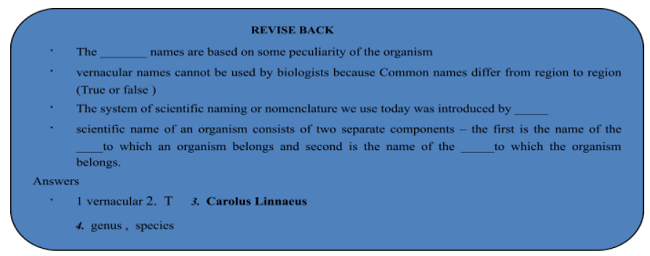
- Common names, are local names which are given to the animals and plants in a particular language and region of the world such as in English, Hindi, Punjabi, Gujarati, Bengali, etc. by local persons. The vernacular or common names are based on some peculiarity of the organism. They are brief and easier to pronounce and remember by the residents of an area.
-
Forexample, the bird that we know as Gauraiyain Hindi in Indiaand Pakistan is known by different names in other countries - house sparrow in England, Pardal in Spain, Musch in Holland, Suzunein Japan, and so on. Similarly, a dog is called ‘kutta’ in Hindi, Kukur in Banglaand ‘Naai’ in Tamil. These names are not understood elsewhere.
- Moreover, the same common name may be used for different kinds of animals. For example, the name Kenchua is used both for the earthworm and Ascaris. It is therefore, important to have a single scientific name to be followed all over the world.
- Even then the vernacular names cannot be used by biologists due to the following reasons:
- (i)Common names differ from region to region and language to language.
- (ii)An organism may have several names in a given language.
- (iii)A common name may have different meanings in different area.
Scientific names
For systematic naming of living organisms, the concept of scientific name was introduced. The scientific name for an organism is thus unique and can be used to identify it anywhere in the world.
The system of scientific naming or nomenclature we use today was introduced by Carolus Linnaeus in the eighteenth century. According to it, scientific name of an organism consists of two separate components – the first is the name of the genus to which an organism belongs and second is the name of the species to which the organism belongs. Such a nomenclature consisting of two names of each organism is called Binomial nomenclature. Both the names are used in Latin forms. This system is accepted internationally and guided by a set of rules stated in the International code of biological nomenclature (ICBN).