






PERMANENT TISSUE
Tissue of Class 9
- The permanent tissues are composed of those cells which have lost their capability to divide. They have definite shape, size and thickness. The permanent tissue may be dead or living.
- The division & differentiation of the cells of Meristematic tissues give rise to permanent tissues. In cell differentiation, developing tissue and organs change from simple to more complex forms to become specialized for specific functions. The cells of permanent tissue loose the capacity to divide and attain a permanent shape, size and function.
CHARACTERISTICS OF PERMANENT TISSUES:
- The cells have lost their power of division.
- The cells possess definite shape, size and function.
- They may be living or dead.
- The living permanent cells are large, thin walled with a vacuolated cytoplasm.
- Dead permanent cells are thick walled without cytoplasm.
TYPES OF PERMANENT TISSUES:
The permanent tissues are classified on the basis of their composition into two types.
- simple permanent tissue
- Complex permanent tissue
- Simple permanent tissues: on the basis of structure of constituent cell, Simple tissues are of three types Parenchyma, Collenchyma and sclerenchyma.
Parenchyma
Parenchyma (Gk. para = beside; en-chein = to pour; i.e., some semi liquid substance poured beside other solid tissues; Grew 1682) is the most basic type of differentiated tissue from which other types have evolved.
Parenchyma

Characteristics
- The cells are living and may be rounded, oval, rectangular, star shaped but usually polygonal. Number of sides in a polygonal cell is usually 14 but in Elodea, it may be 17.
- Cells are loosely arranged with many intercellular spaces, either schizogenous or lysigenous (exception epidermis/epiblema, endodermis, pericycle and pith rays, where cells are compactly arranged).
- The cell wall is thin and is made up of cellulose, hemicellulose and pectin. Though the cell wall of xylem parenchyma is thick, that of epidermal cells is cutinised and that of endodermal cells is suberised.
- Cytoplasm is dense, granular with a central, large prominent nucleus.
- Vacuoles are many but small.
- Cytoplasm has all the cell organelles but instead of chloroplasts, there are leucoplasts.
Modifications of parenchyma
To perform functions other than normal (storage of food), parenchyma gets modified into following types:
- Chlorenchyma: Parenchyma cells having chloroplast; found in mesophyll of leaves; meant for photosynthesis.
- Aerenchyma: Parenchyma with air filled spaces; found in hydrophytes, meant for buoyancy.
Origin
- Parenchyma originates from the cells of meristem by loosening their divisional capacity.
functions
- Storage of food is the main function.
- Storage of water especially in xerophytes.
- Parenchyma associated with the vascular tissues (xylem and phloem) plays an important role in the conduction of sap and transportation of food.
COLLENCHYMA
- Collenchyma [Gk. Colla: glue, referring to its characteristic shining wall; Schleiden, (1839)] is a specialized supporting tissue which has living cells and possesses considerable tensile strength.
- It is usually found in stems beneath the epidermis as a complete cylinder or in the form of longitudinal strips.
STRUCTURE
- Cells of collenchyma are elongated, tubular and are arranged along the long axis of the stem but in T.S. they appear as circular, oval or polyhedral.
- The peculiarity of collenchyma cells is the unevenly thickened cell wall i.e., thickenings are restricted to the corners of the cells.
- The thickening materials are mostly pectin in addition to cellulose and hemicellulose.
- The cells are living and the protoplast is highly vacuolated. Therefore, cytoplasm and nucleus become peripheral.
- Cytoplasm has all the cell organelles including chloroplasts.
DIFFERENT TYPES OF COLLENCHYMA
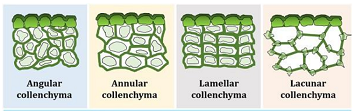
- On the basis of mode of wall thickening, collenchyma may be classified into the following three types:
Lamellar : In this type, the thickenings are more heavily deposited on the tangential than on the radial cell walls. This type of collenchyma occurs in the stem of Raphanus, Helianthus, Rheum, etc.
Angular : In this type, the thickenings are primarily deposited at the corners or angles of the cells. Angular collenchyma, the most common type of collenchyma is found in the stems of Datura, Lycopersicum, Cucurbita, Solanum, Ficus, Vitis, Morus, Polygonum, etc.
Lacunar : In this type, the thickenings are primarily deposited around the intercellular spaces, e.g., in aerial roots of Monstera and petioles of Malva, Asclepias, etc.
Lamellate collenchyma Angular collenchyma Lacunate collenchyma
FUNCTIONS
❒ Collenchyma performs the following functions:
It is simple living mechanical tissue which provides mechanical support.
Being flexible in nature, it provides tensile strength to the plant body.
As the cells of collenchyma are living and often contain chloroplasts they also take part in photosynthesis.
Differences between parenchyma and collenchymas:
| S.No. | Parenchyma | Collenchyma |
| 1. | It consists of thin-walled living cells. | It consists of cells with localized thickenings. |
| 2. | It is distributed in all plant parts. | It is found in aerial parts and restricted to outer layers. |
| 3. | The cells of parenchyma assimilate, store food and waste products. | Collenchyma forms the mechanical tissue in young parts of the plants. |
SCLERENCHYMA
- Sclerenchyma (Gk. Scleros: hard; Mettenius 1805) is also a simple permanent tissue composed of thick walled, dead often lignified and hard cells. There is considerable variation in shape, size, origin and development of the cells.
- The mature sclerenchyma cells differ from parenchyma and collenchyma cells in the presence of lignified secondary walls and the absence of living protoplasts.
Different types of Sclerenchyma
- Fibres and sclereids are the two common categories of sclerenchyma.
Fibres
- They are specialized sclerenchymatous cells that occur in different parts of the plant body in bands or in the form of uninterrupted hollow cylinder.
They have great tensile strength, flexibility and elasticity which enable plant organs to withstand a variety of strains and tensions caused by the action of gravity, wind, etc.
Structure
- Fibres are long, narrow, thick and lignified sclerenchyma cells, usually with pointed or blunt ends. In transverse section, they appear rounded or polygonal in outline with a well defined lumen.
- Pits are few and simple, except fibre tracheids.
- Fibres are always found in sheets.
- Fibres are perhaps the longest cells among plant kingdom.
Sclereids
- Sclereids (Tschierch, 1885) are widely distributed and may occur almost anywhere in the plant body, either singly or in groups. When they occur singly, they are called sclerite or spicular cells or idioblastic cells.
Structure
- Sclereids, also known as stone cells or sclerotic cells, are isodiametric, spherical, oval, stellate, ‘T’ shaped or cylindrical in shape.
- They usually have thick and strongly lignified secondary walls with numerous simple pits. In mature sclereids, tannins and mucilage are often present as shrivelled remains of protoplasm.
FUNCTIONS
The main functions of sclerenchyma are :
- It is mainly responsible for providing mechanical strength and rigidity to the plant.
- It saves the plant from various stresses and strains of environmental forces like strong winds, etc.
- It protects internal soft tissues.
Differences between collenchyma and sclerenchyma:
| S.No. | Collenchyma | Schlerenchyma |
| 1. | Cells of collenchyma are living | Cells of sclerenchyma are dead. |
| 2. | Cells have thin walls. | Cells have thick and hard walls. |
| 3. | Cells have localized thickenings at corners. | Cells have uniform thickening. |
| 4. | Cells are filled with protoplasm. | Cells are empty with narrow lumen. |
| 5. | Collenchyma provides mechanical strength and elasticity. | Sclerenchyma provides mechanical support. |
Complex Permanent Tissue
They are a group of different types of cells having a common origin and working together as a unit. They are of two types, xylem and phloem. Both are conducting and together constitute the vascular bundle. Presence of vascular bundle is a distinctive feature of complex plants making their survival in terrestrial environment possible.
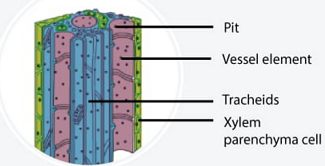
(i) Xylem: Xylem consist of four types of cells
- Tracheids
- Vessels
- Xylem Parenchyma
- Xylem Fibres.
Tracheids are elongated, tube-like dead cells with oblique end walls. The walls are lignified and cavities are empty (dead cell).
Vessels form long tubes fitting together end to end with perforated or no end walls. Vessels are absent in ferns.
Xylem parenchyma stores food and help in lateral conduction of water or sap.
Xylem fibres are supportive in function. Except xylem parenchyma, other xylem cells are dead cells.
Function
- It serves for the upward movement of water and mineral salts from root to different aerial parts of the plant.
- Xylem gives strength to the plant body.
Component cells of Xylem tissue
Phloem : Phloem consists of four types of cells.
- Sieve tubes
- Companion cells
- Phloem Parenchyma
- Phloem Fibres.
Sieve tubes are tubular structures with perforated walls (called sieve plates). The sieve elements (cells) have thin lining of cytoplasm with no nucleus.
Companion cells are living cells associated with the sieve tubes. They have dense cytoplasm and elongated nucleus. Ferns and pines do not have companion cells.
Phloem Parenchyma store food and help to conduct it.
Phloem fibres are dead sclerenchymatous cells associated with phloem. Except phloem fibres, other phloem cells are living cells.
Function
- Phloem helps in translocation of organic solutes from leaves to the storage organs and then to growing regions. Unlike xylem, in phloem materials can move in both directions.
(a) Component cells of phloem tissue (b) L.S. of phloem showing sieve tube and companion cell
EPIDERMIS (PROTECTIVE TISSUE):
Epidermis forms the outermost protective layer of all plant parts like leaf, stem, root, etc. It is a single continuous layer made up of flat cells with their outer and side walls thicker than the inner wall. There is no intercellular space between the cells. The epidermis of some plants living in very dry habitats may be thinker to prevent excessive loss of water.
Epidermal cells on aerial parts of the plant secrete a waxy, water resistant layer called cutin on its outer surface. It protects against loss of water, mechanical injury and invasion by parasitic fungi.
Epidermal cells of leaf bear small pores called stomata. Each is enclosed by two modified epidermal cells called guard cells which are kidney-shaped.
Epidermal cells of the roots bear long thread like structures called root hairs. They increase the absorptive surface area.
As stems and roots grow older, a strip of secondary meristem replaces the epidermis. The cells on the outer side of the meristem divide to form several layered cork or bark. The cork cells are dead and compactly arranged in radial rows without intercellular spaces. Suberin (a waxy substance) gets deposited in their walls making them impervious to water and gases.
| Cork is used in bottle stoppers because they are impervious and also insulators. |
Function of Epidermis (Protective tissue)
- Epidermal cells of aerial plant parts with cutin and bark of older roots and stems with suberin aid in protection against water loss, mechanical injury and invasion by parasitic fungi.
- Epidermal cells (guard cells) of leaf bearing stomata help in gaseous exchange and transpiration (loss of water in the form of water vapour)
- Epidermal cells of roots helps in water absorption.

Complex Permanent Tissue
They are a group of different types of cells having a common origin and working together as a unit. They are of two types, xylem and phloem. Both are conducting and together constitute the vascular bundle. Presence of vascular bundle is a distinctive feature of complex plants making their survival in terrestrial environment possible.
Xylem: Xylem consist of four types of cells
- Tracheids
- Vessels
- Xylem Parenchyma
- Xylem Fibres.
Tracheids are elongated, tube-like dead cells with oblique end walls. The walls are lignified and cavities are empty (dead cell).
Vessels form long tubes fitting together end to end with perforated or no end walls. Vessels are absent in ferns.
Xylem parenchyma stores food and help in lateral conduction of water or sap.
Xylem fibres are supportive in function. Except xylem parenchyma, other xylem cells are dead cells.
Function
- It serves for the upward movement of water and mineral salts from root to different aerial parts of the plant.
- Xylem gives strength to the plant body.

Component cells of Xylem tissue
Phloem : Phloem consists of four types of cells.
- Sieve tubes
- Companion cells
- Phloem Parenchyma
- Phloem Fibres.
Sieve tubes are tubular structures with perforated walls (called sieve plates). The sieve elements (cells) have thin lining of cytoplasm with no nucleus.
Companion cells are living cells associated with the sieve tubes. They have dense cytoplasm and elongated nucleus. Ferns and pines do not have companion cells.
Phloem Parenchyma store food and help to conduct it.
Phloem fibres are dead sclerenchymatous cells associated with phloem. Except phloem fibres, other phloem cells are living cells.
Function
Phloem helps in translocation of organic solutes from leaves to the storage organs and then to growing regions. Unlike xylem, in phloem materials can move in both directions.

EPIDERMIS (PROTECTIVE TISSUE):
Epidermis forms the outermost protective layer of all plant parts like leaf, stem, root, etc. It is a single continuous layer made up of flat cells with their outer and side walls thicker than the inner wall. There is no intercellular space between the cells. The epidermis of some plants living in very dry habitats may be thinker to prevent excessive loss of water.
Epidermal cells on aerial parts of the plant secrete a waxy, water resistant layer called cutin on its outer surface. It protects against loss of water, mechanical injury and invasion by parasitic fungi.
Epidermal cells of leaf bear small pores called stomata. Each is enclosed by two modified epidermal cells called guard cells which are kidney-shaped.
Epidermal cells of the roots bear long thread like structures called root hairs. They increase the absorptive surface area.
As stems and roots grow older, a strip of secondary meristem replaces the epidermis. The cells on the outer side of the meristem divide to form several layered cork or bark. The cork cells are dead and compactly arranged in radial rows without intercellular spaces. Suberin (a waxy substance) gets deposited in their walls making them impervious to water and gases.
Cork is used in bottle stoppers because they are impervious and also insulators
Function of Epidermis (Protective tissue)
- Epidermal cells of aerial plant parts with cutin and bark of older roots and stems with suberin aid in protection against water loss, mechanical injury and invasion by parasitic fungi.
- Epidermal cells (guard cells) of leaf bearing stomata help in gaseous exchange and transpiration (loss of water in the form of water vapour)
- Epidermal cells of roots helps in water absorption.



