







CBSE 2026 New Rules: Digital Answer Sheet Checking Process & Benefits by Love Kaushik Sir
 Punit Kumar14 Feb, 2026
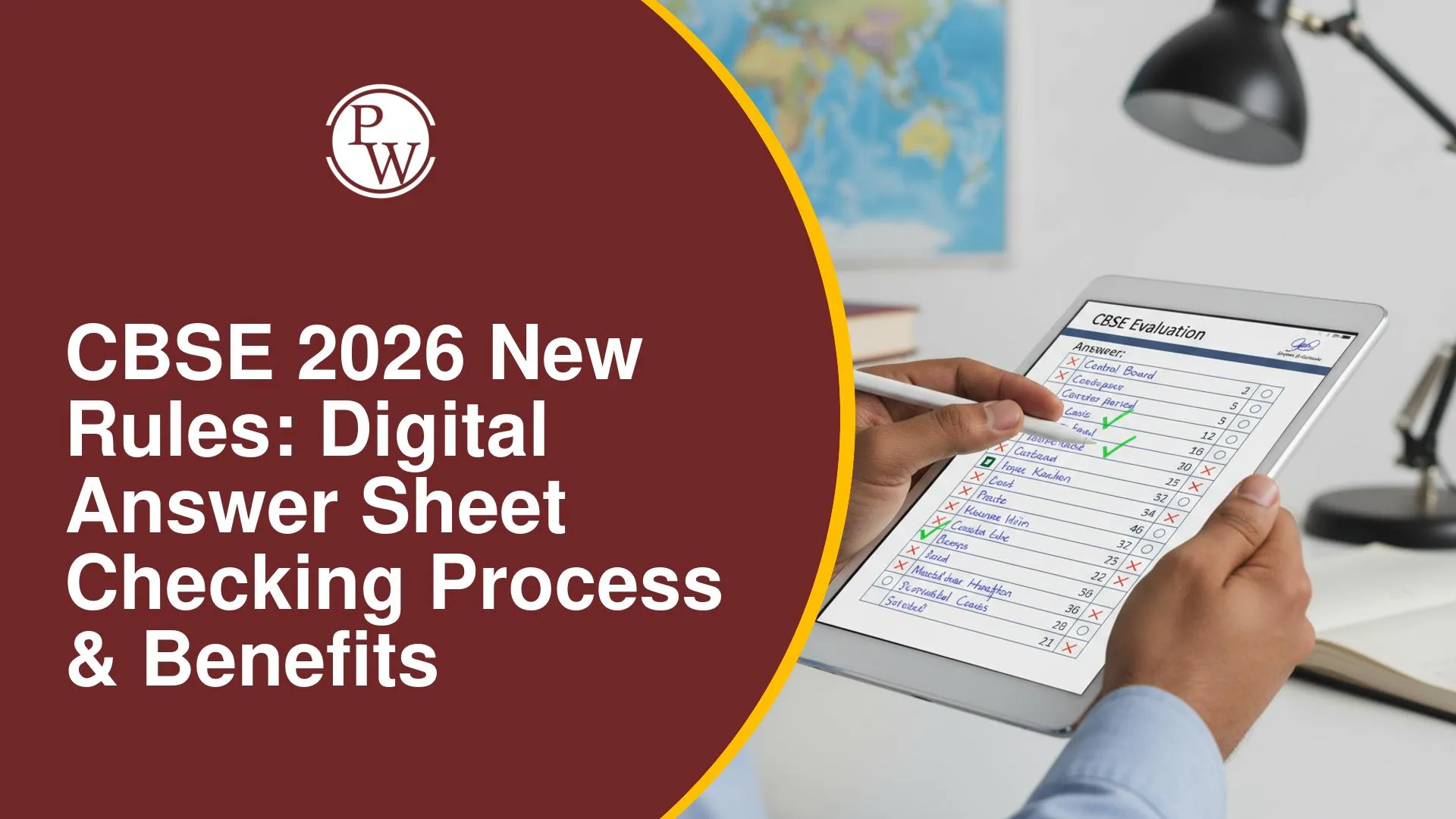
CBSE 2026 New Rules bring significant changes to the board exam evaluation process, particularly for Class 12 students. The introduction of On-Screen Marking (OSM) aims to digitalize the evaluation, ensuring a more accurate and efficient assessment of student performance.
Students will need to follow clear guidelines for answering MCQs, descriptive, and numerical questions, emphasizing structured and step-by-step answers.
Additionally, presenting error-free work and incorporating subject-specific tips, such as including Working Notes in Accountancy and diagrams in Business Studies, will be crucial for securing optimal marks. However, Class 10 exams will continue with manual checking.
CBSE 2026 Board Exams: Understanding the New Evaluation System
The Central Board of Secondary Education (CBSE) is modernizing its evaluation process for Class 12 board examinations.
The new On-Screen Marking (OSM) system aims to enhance accuracy and efficiency in checking answer sheets. Here are details of the new digital evaluation process and crucial guidelines for students to maximize their scores.
Introduction to On-Screen Marking (OSM) for CBSE Class 12
CBSE's circular, dated February 9, announces the implementation of On-Screen Marking (OSM) for Class 12 board examinations. Under this system, Class 12 answer sheets will be scanned and evaluated digitally by teachers using specialized software on computers or laptops. This marks a significant shift from the traditional manual checking with a pen.
| Comparative Structure: Class 12 V/s Class 10 Evaluation | ||
|---|---|---|
| Class Level | Evaluation Method | Details |
| Class 12 | On-Screen Marking (OSM) | Digital evaluation of scanned answer sheets. |
| Class 10 | Traditional Manual Method | Physical answer sheets are checked manually. |
A vital rule for students is that if a question is attempted twice, only the first attempt will be graded. Subsequent attempts will not be evaluated, irrespective of their accuracy.
CBSE 2026 New Rules - Guidelines for Answering Multiple Choice Questions (MCQs)
To ensure clarity and efficiency when answering MCQs, students should follow a specific procedure:
-
Write the question number and only the letter corresponding to the correct option. For instance, for Question 13, if option D is the answer, simply write "Ans. 13: D".
-
It is not necessary to write the full text of the answer.
-
For MCQs involving numerical calculations, showing the full solution or rough work is not required. The correct option is sufficient for full marks.
CBSE 2026 New Rules - Strategy for Answering Descriptive Questions
For descriptive questions, particularly in subjects like Economics and Business Studies, structuring answers clearly is crucial for scoring well.
-
Use Headings: Start each point with a clear heading.
-
Point-wise Answers: Present answers in distinct points rather than long paragraphs. Use line breaks or new paragraphs for each new point.
-
Match Length to Marks: The length of your explanation should align with the allocated marks and the number of points requested.
-
For a 4-mark question asking for 2 points, provide a more detailed explanation for each point.
-
For a 4-mark question asking for 4 points, offer a concise, two-line explanation for each point to manage time effectively.
-
Abbreviations: Only use standard, universally accepted abbreviations like GST (Goods and Services Tax). Avoid creating personal or informal shortcuts.
CBSE 2026 New Rules - Guidelines for Answering Numerical Problems
While not directly marked, a clear structure for solving numerical problems (e.g., in Economics or Accountancy) helps prevent errors. Marks are primarily awarded for the formula and calculation.
Recommended Structure for Numerical Problems:
-
Given: List all provided data (e.g., MPC, ΔI).
-
To Calculate: State the variable you need to determine (e.g., ΔY).
-
Formula & Substitution: Write the correct formula and accurately substitute the given values. This is a critical step for step-by-step marking.
-
Final Answer: Present the final answer clearly. It is highly recommended to place the final answer in a box to make it stand out for the examiner.
Marks are awarded for each correct step in the process (step-by-step marking), emphasizing the importance of showing the formula and correct substitution.
Best Practices for Presentation and Error Correction
Clean presentation and appropriate error correction are essential for readability and clarity.
-
Correcting Mistakes: If a mistake is made, strike it through with a single, clean line. Do NOT scribble, overwrite, or black out the text. The correct word or phrase can be written neatly above the strikethrough.
-
Pen Usage: Students must use a blue pen for the examination. The use of red or green pens is prohibited.
-
Handwriting: Perfect handwriting is not required, but it must be readable. Legibility takes precedence over calligraphic perfection.
-
Saving Time: To be efficient, simply write the question number (e.g., "Ans. 33") instead of longer phrases like "Answer to Question Number 33".
Subject-Specific Presentation: Accountancy
-
Working Notes: Clearly show all Working Notes (WN). These are vital for demonstrating calculation processes for items like Interest on Capital or Goodwill and carry specific marks. Label them as "Working Notes" or "WN".
-
Rough Work: Rough calculations can be performed on the right-hand margin of the answer sheet. This is separate from formal Working Notes.
-
Calculators: Calculators are strictly NOT allowed in the CBSE Class 12 board examinations. All calculations must be performed manually.
Subject-Specific Presentation: Business Studies
-
Presentation Matters: In theoretical subjects like Business Studies, effective presentation significantly impacts scoring.
-
Headings and Explanation: Use clear headings for each point, followed by a concise explanation.
-
Flowcharts and Diagrams: Simple, clear flowcharts or diagrams are effective for presenting information (e.g., for Factors Affecting Working Capital). Diagrams should be easy to understand and not overly complex. A well-constructed diagram can effectively convey your understanding to the examiner.
The Role of the Marking Scheme and Teacher Discretion
Examiners evaluate answer sheets using a detailed marking scheme provided by CBSE, which specifies marks allocated for each step or point. However, the system incorporates professional judgment.
-
Teacher Discretion: Examiners have the liberty to award full marks for a correct answer even if the student's point is not explicitly mentioned in the marking scheme. If the examiner finds the answer conceptually sound and accurate, they can assign credit.
CBSE 2026 New Rules bring significant changes to the board exam evaluation process, particularly for Class 12 students. The introduction of On-Screen Marking (OSM) aims to digitalize the evaluation, ensuring a more accurate and efficient assessment of student performance.
Students will need to follow clear guidelines for answering MCQs, descriptive, and numerical questions, emphasizing structured and step-by-step answers.
Additionally, presenting error-free work and incorporating subject-specific tips, such as including Working Notes in Accountancy and diagrams in Business Studies, will be crucial for securing optimal marks. However, Class 10 exams will continue with manual checking.
CBSE 2026 Board Exams: Understanding the New Evaluation System
The Central Board of Secondary Education (CBSE) is modernizing its evaluation process for Class 12 board examinations.
The new On-Screen Marking (OSM) system aims to enhance accuracy and efficiency in checking answer sheets. Here are details of the new digital evaluation process and crucial guidelines for students to maximize their scores.
Introduction to On-Screen Marking (OSM) for CBSE Class 12
CBSE's circular, dated February 9, announces the implementation of On-Screen Marking (OSM) for Class 12 board examinations. Under this system, Class 12 answer sheets will be scanned and evaluated digitally by teachers using specialized software on computers or laptops. This marks a significant shift from the traditional manual checking with a pen.
| Comparative Structure: Class 12 vs. Class 10 Evaluation | ||
|---|---|---|
| Class Level | Evaluation Method | Details |
| Class 12 | On-Screen Marking (OSM) | Digital evaluation of scanned answer sheets. |
| Class 10 | Traditional Manual Method | Physical answer sheets are checked manually. |
A vital rule for students is that if a question is attempted twice, only the first attempt will be graded. Subsequent attempts will not be evaluated, irrespective of their accuracy.
CBSE 2026 New Rules - Guidelines for Answering Multiple Choice Questions (MCQs)
To ensure clarity and efficiency when answering MCQs, students should follow a specific procedure:
-
Write the question number and only the letter corresponding to the correct option. For instance, for Question 13, if option D is the answer, simply write "Ans. 13: D".
-
It is not necessary to write the full text of the answer.
-
For MCQs involving numerical calculations, showing the full solution or rough work is not required. The correct option is sufficient for full marks.
CBSE 2026 New Rules - Strategy for Answering Descriptive Questions
For descriptive questions, particularly in subjects like Economics and Business Studies, structuring answers clearly is crucial for scoring well.
-
Use Headings: Start each point with a clear heading.
-
Point-wise Answers: Present answers in distinct points rather than long paragraphs. Use line breaks or new paragraphs for each new point.
-
Match Length to Marks: The length of your explanation should align with the allocated marks and the number of points requested.
-
For a 4-mark question asking for 2 points, provide a more detailed explanation for each point.
-
For a 4-mark question asking for 4 points, offer a concise, two-line explanation for each point to manage time effectively.
-
Abbreviations: Only use standard, universally accepted abbreviations like GST (Goods and Services Tax). Avoid creating personal or informal shortcuts.
CBSE 2026 New Rules - Guidelines for Answering Numerical Problems
While not directly marked, a clear structure for solving numerical problems (e.g., in Economics or Accountancy) helps prevent errors. Marks are primarily awarded for the formula and calculation.
Recommended Structure for Numerical Problems:
-
Given: List all provided data (e.g., MPC, ΔI).
-
To Calculate: State the variable you need to determine (e.g., ΔY).
-
Formula & Substitution: Write the correct formula and accurately substitute the given values. This is a critical step for step-by-step marking.
-
Final Answer: Present the final answer clearly. It is highly recommended to place the final answer in a box to make it stand out for the examiner.
Marks are awarded for each correct step in the process (step-by-step marking), emphasizing the importance of showing the formula and correct substitution.
Best Practices for Presentation and Error Correction
Clean presentation and appropriate error correction are essential for readability and clarity.
-
Correcting Mistakes: If a mistake is made, strike it through with a single, clean line. Do NOT scribble, overwrite, or black out the text. The correct word or phrase can be written neatly above the strikethrough.
-
Pen Usage: Students must use a blue pen for the examination. The use of red or green pens is prohibited.
-
Handwriting: Perfect handwriting is not required, but it must be readable. Legibility takes precedence over calligraphic perfection.
-
Saving Time: To be efficient, simply write the question number (e.g., "Ans. 33") instead of longer phrases like "Answer to Question Number 33".
Subject-Specific Presentation: Accountancy
-
Working Notes: Clearly show all Working Notes (WN). These are vital for demonstrating calculation processes for items like Interest on Capital or Goodwill and carry specific marks. Label them as "Working Notes" or "WN".
-
Rough Work: Rough calculations can be performed on the right-hand margin of the answer sheet. This is separate from formal Working Notes.
-
Calculators: Calculators are strictly NOT allowed in the CBSE Class 12 board examinations. All calculations must be performed manually.
Subject-Specific Presentation: Business Studies
-
Presentation Matters: In theoretical subjects like Business Studies, effective presentation significantly impacts scoring.
-
Headings and Explanation: Use clear headings for each point, followed by a concise explanation.
-
Flowcharts and Diagrams: Simple, clear flowcharts or diagrams are effective for presenting information (e.g., for Factors Affecting Working Capital). Diagrams should be easy to understand and not overly complex. A well-constructed diagram can effectively convey your understanding to the examiner.
The Role of the Marking Scheme and Teacher Discretion
Examiners evaluate answer sheets using a detailed marking scheme provided by CBSE, which specifies marks allocated for each step or point. However, the system incorporates professional judgment.
-
Teacher Discretion: Examiners have the liberty to award full marks for a correct answer even if the student's point is not explicitly mentioned in the marking scheme. If the examiner finds the answer conceptually sound and accurate, they can assign credit.
CBSE 2026 New Rules FAQs
What is On-Screen Marking (OSM) for CBSE Class 12?
How do I answer MCQs in the CBSE Class 12 board exams?
What is the correct way to correct a mistake in the answer sheet?
Are calculators allowed in CBSE Class 12 board exams?
How important are Working Notes in Accountancy?






Get Free Counselling Today
and Clear up all your Doubts
 Live & recorded classes available at easeDashboard for progress trackingLakhs of practice questions

