







Class 12 Accountancy Part 2 Chapter 5 NCERT Solutions: Accounting Ratios
 Mehjabeen Hussain21 Sept, 2026
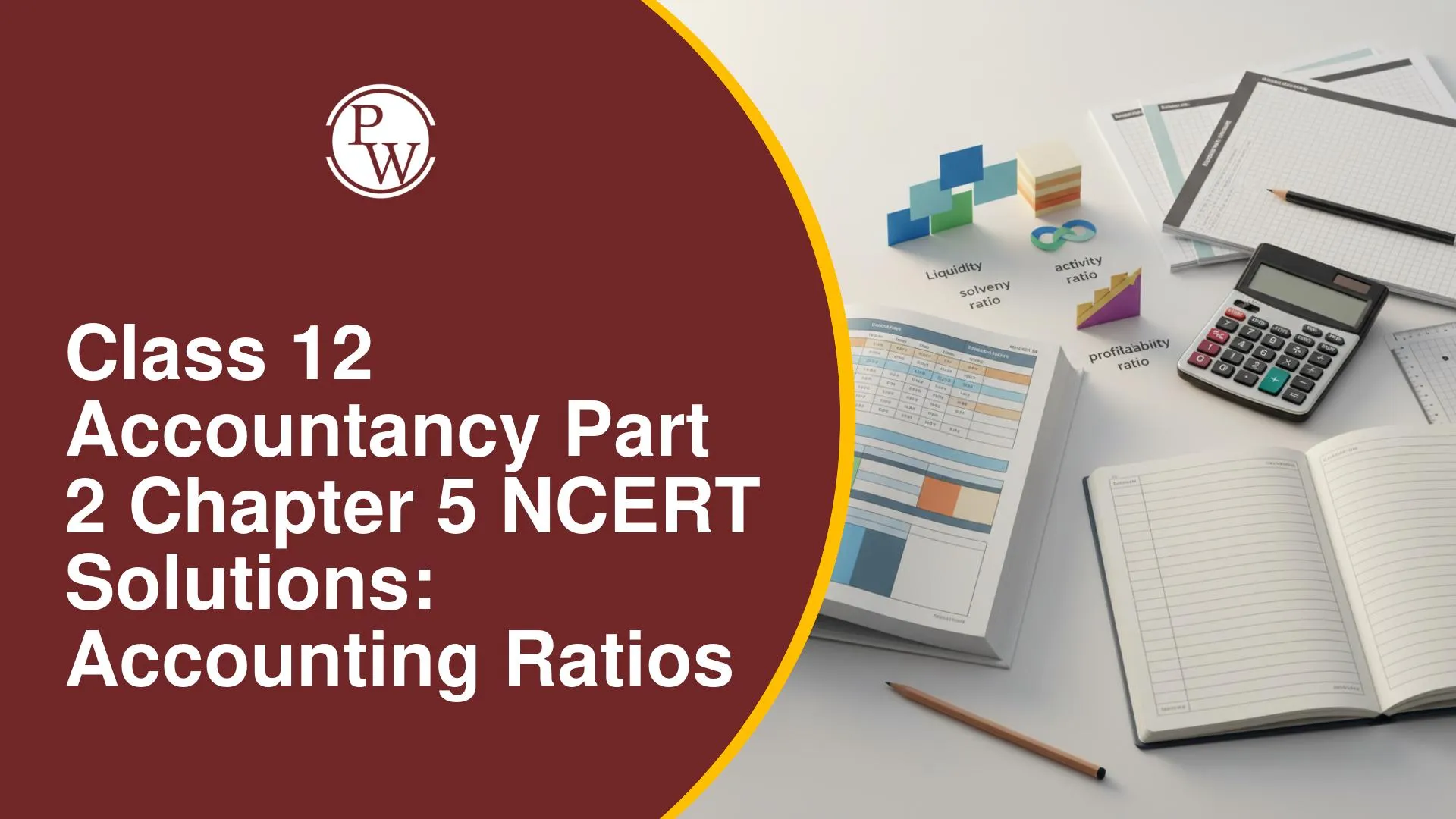
Accounting Ratios is the chapter where you use figures from the Balance Sheet and Statement of Profit and Loss to assess a company's short-term liquidity, long-term solvency, efficiency in using assets, and profitability. You may need to calculate a ratio from the given figures or work backwards from a given ratio to find a missing amount in the financial statements.
You can lose marks even when you know the formula if you select the wrong figures for the numerator or denominator. For example, you may use Gross Profit when the question requires Net Profit or include a non-current asset while calculating current assets. The Part 2 Chapter 5 Accountancy Solutions help you identify the correct figures, apply the appropriate formula, and follow the calculation step by step.
Important Numericals: Accounting Ratios Class 12 NCERT Solutions
The following solutions cover important questions from Chapter 5. Attempt each one yourself before checking the working below.
1. What do you mean by Ratio Analysis?
Answer:
Ratio Analysis is a technique of analysing the financial statements of a business by establishing relationships between different items of the financial statements. It helps you evaluate the liquidity, solvency, efficiency, and profitability of a business.
2. What are various types of ratios?
Answer:
The various types of accounting ratios are:
-
Liquidity Ratios: These ratios measure the ability of a business to meet its short-term obligations. Examples include Current Ratio and Quick Ratio.
-
Solvency Ratios: These ratios measure the ability of a business to meet its long-term obligations. Examples include Debt-Equity Ratio, Proprietary Ratio, and Interest Coverage Ratio.
-
Activity Ratios: These ratios measure how efficiently a business uses its assets and resources. Examples include Inventory Turnover Ratio, Trade Receivables Turnover Ratio, Trade Payables Turnover Ratio, and Working Capital Turnover Ratio.
-
Profitability Ratios: These ratios measure the profitability of a business in relation to its sales, assets, or capital employed. Examples include Gross Profit Ratio, Operating Ratio, Net Profit Ratio, and Return on Investment.
3. What relationships will be established to study: (a) Inventory turnover, (b) Trade receivables turnover, (c) Trade payables turnover, and (d) Working capital turnover?
Answer:
(a) Inventory Turnover:
Inventory Turnover Ratio establishes the relationship between Cost of Revenue from Operations and Average Inventory.
Inventory Turnover Ratio
= Cost of Revenue from Operations ÷ Average Inventory
(b) Trade Receivables Turnover:
Trade Receivables Turnover Ratio establishes the relationship between Net Credit Revenue from Operations and Average Trade Receivables.
Trade Receivables Turnover Ratio
= Net Credit Revenue from Operations ÷ Average Trade Receivables
(c) Trade Payables Turnover:
Trade Payables Turnover Ratio establishes the relationship between Net Credit Purchases and Average Trade Payables.
Trade Payables Turnover Ratio
= Net Credit Purchases ÷ Average Trade Payables
(d) Working Capital Turnover:
Working Capital Turnover Ratio establishes the relationship between Revenue from Operations and Working Capital.
Working Capital Turnover Ratio
= Revenue from Operations ÷ Working Capital
4. The liquidity of a business firm is measured by its ability to satisfy its long-term obligations as they become due. What are the ratios used for this purpose?
Answer:
The statement refers to solvency, rather than liquidity. Solvency refers to the ability of a business to meet its long-term obligations as they become due.
The ratios used to measure the solvency of a business include:
-
Debt-Equity Ratio
-
Proprietary Ratio
-
Total Assets to Debt Ratio
-
Interest Coverage Ratio
5. The average age of inventory is viewed as the average length of time inventory is held by the firm. Explain with reasons.
Answer:
Average age of inventory refers to the average period for which inventory remains with the business before being sold. It is calculated using the Inventory Turnover Ratio.
Average Age of Inventory
= 365 days ÷ Inventory Turnover Ratio
A lower average age indicates that inventory is being sold more quickly, while a higher average age indicates that inventory remains unsold for a longer period. Therefore, the average age of inventory helps you understand the efficiency of inventory management.
6. What are liquidity ratios? Discuss the importance of current and liquid ratio.
Answer:
Liquidity ratios measure the ability of a business to meet its short-term obligations as and when they become due. These ratios help you assess whether the business has sufficient current assets to meet its current liabilities.
Current Ratio:
Current Ratio measures the relationship between current assets and current liabilities.
Current Ratio
= Current Assets ÷ Current Liabilities
It indicates the availability of current assets to meet current liabilities.
Liquid Ratio:
Liquid Ratio, also known as Quick Ratio, measures the relationship between liquid assets and current liabilities.
Quick Ratio
= Quick Assets ÷ Current Liabilities
It provides a more immediate measure of liquidity because inventory and prepaid expenses are excluded from current assets.
Answer: The Current Ratio gives an overall measure of short-term liquidity, while the Quick Ratio provides a stricter measure by considering only assets that can be converted into cash more quickly.
7. How would you study the Solvency position of the firm?
Answer:
You can study the solvency position of a firm with the help of solvency ratios. These ratios show the firm's ability to meet its long-term obligations and assess the relationship between borrowed funds and owners' funds.
The important solvency ratios are:
-
Debt-Equity Ratio:
Debt-Equity Ratio
= Long-term Debt ÷ Shareholders' Funds -
Proprietary Ratio:
Proprietary Ratio
= Shareholders' Funds ÷ Total Assets -
Total Assets to Debt Ratio:
Total Assets to Debt Ratio
= Total Assets ÷ Long-term Debt -
Interest Coverage Ratio:
Interest Coverage Ratio
= Profit before Interest and Tax ÷ Interest
These ratios help you assess the long-term financial stability of a firm.
8. What are various profitability ratios? How are these worked out?
Answer:
Profitability ratios measure the profitability of a business in relation to its revenue, assets, or capital employed. The important profitability ratios are:
Gross Profit Ratio:
= (Gross Profit ÷ Revenue from Operations) × 100
Operating Ratio:
= (Operating Cost ÷ Revenue from Operations) × 100
Operating Profit Ratio:
= (Operating Profit ÷ Revenue from Operations) × 100
Net Profit Ratio:
= (Net Profit ÷ Revenue from Operations) × 100
Return on Investment:
= (Profit before Interest and Tax ÷ Capital Employed) × 100
These ratios help you assess the profitability and operating performance of the business.
9. The current ratio provides a better measure of overall liquidity only when a firm's inventory cannot easily be converted into cash. If inventory is liquid, the quick ratio is a preferred measure of overall liquidity. Explain.
Answer:
The Current Ratio considers all current assets while measuring the ability of a business to meet its current liabilities. Inventory is included in current assets even though it may take time to convert into cash.
When inventory cannot be easily converted into cash, the Current Ratio provides a useful measure of liquidity because it considers the firm's entire pool of current assets.
However, if inventory is easily and quickly converted into cash, the Quick Ratio can provide a more useful measure of overall liquidity. The Quick Ratio excludes inventory and prepaid expenses from current assets and considers only quick assets.
Therefore, the Current Ratio gives an overall view of current assets, while the Quick Ratio provides a stricter measure of short-term liquidity.
10. Following is the Balance Sheet of Raj Oil Mills Limited as at March 31, 2017. Calculate Current Ratio.
|
I. Equity and Liabilities |
|
|
Particulars |
Rs |
|
Share Capital |
7,90,000 |
|
Reserves and Surplus |
35,000 |
|
Trade Payables |
72,000 |
|
Total |
8,97,000 |
II. Assets |
|
|
Fixed Assets – Tangible Assets |
7,53,000 |
|
Inventories |
55,800 |
|
Trade Receivables |
28,800 |
|
Cash and Cash Equivalents |
59,400 |
|
Total |
8,97,000 |
Solution:
Current Assets
= Inventories + Trade Receivables + Cash and Cash Equivalents
= ₹55,800 + ₹28,800 + ₹59,400
= ₹1,44,000
Current Liabilities
= Trade Payables
= ₹72,000
Current Ratio
= Current Assets ÷ Current Liabilities
= ₹1,44,000 ÷ ₹72,000
= 2:1
Answer: Current Ratio = 2:1
Ratio Analysis Class 12 NCERT Solutions PDF
If you want to revise all the selected solutions together, you can use the Class 12 Accountancy Part 2 Chapter 5 NCERT Solutions PDF. Download the PDF and refer to the detailed solutions while practising the chapter.
Ratio Analysis Class 12 NCERT Solutions PDF
How to Use Chapter 5 Accountancy NCERT Solutions for Revision?
Solving the questions yourself before checking the solutions can make your revision more useful.
-
Attempt Before Checking: Try each numerical on your own before referring to the solution.
-
Check the Adjustments: Pay attention to how goodwill, revaluation, reserves, and other adjustments are treated.
-
Understand the Working Notes: Do not skip the calculations used to arrive at the final amount.
-
Review Your Mistakes: Compare your working with the solution and identify where your approach differed.
-
Practise Similar Questions: After understanding a solution, attempt another question based on the same concept
Practising these questions can help you get comfortable moving between absolute figures, percentages, and the interpretation those percentages call for.
Use the Chapter 5 Accounting Ratios Solutions to check your calculations, understand what each ratio reveals, and revise the chapter before your exams.
FAQs
1. What topics are covered in Accounting Ratios Chapter 5?
2. Why should I practise Accounting Ratios numericals?
3. Are these solutions based on the Class 12 NCERT Accountancy Chapter 5?
4. How should I study Accounting Ratios?





Get Free Counselling Today
and Clear up all your Doubts
 Live & recorded classes available at easeDashboard for progress trackingLakhs of practice questions

