






CSIR NET 2026 Life Sciences Most Expected & High-Weightage Topics
Preparing for CSIR NET 2026 Life Sciences Most Expected & High-Weightage Topics with limited time requires smart revision. Prioritizing the core units and repeatedly asked concepts can help maximize preparation and improve scoring potential.

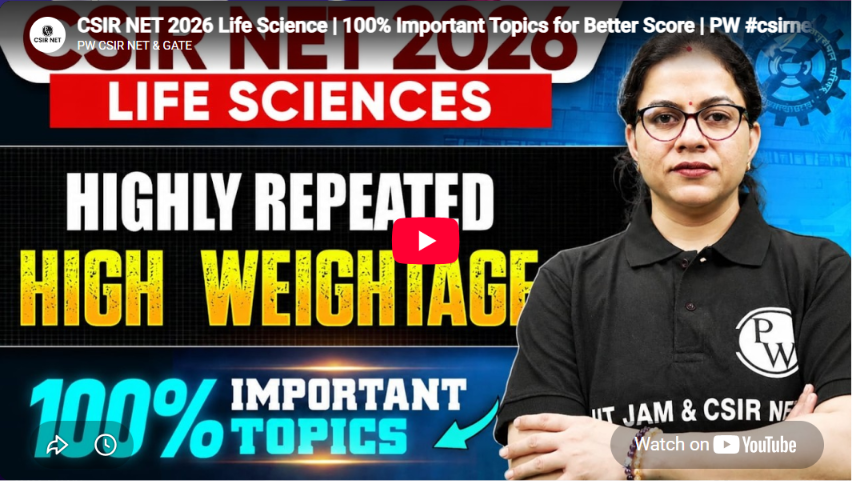
Many CSIR NET Life Sciences aspirants struggle to decide what to revise when time is limited. Trying to cover all 13 units equally can make revision overwhelming and less effective.
Focusing on the CSIR NET 2026 Life Sciences most expected & high-weightage topics helps candidates prioritize the core units and frequently asked concepts, making revision more organized and improving exam readiness.
CSIR NET 2026 Life Sciences High-Weightage Units
Five units are considered the foundation of CSIR NET Life Sciences preparation because they consistently include several repeatedly asked questions. Candidates should prioritize these units during preparation.
| CSIR NET 2026 Life Sciences High-Weightage Units | ||
| Unit | Core Unit | Why It Should Be Prioritized |
| Unit 1 | Biochemistry | Covers biomolecules, metabolism, enzyme kinetics, and other frequently asked concepts. |
| Unit 2 | Cellular Organization | Includes plasma membrane, membrane transport, cell cycle, cytoskeleton, and chromosome organization. |
| Unit 3 | Molecular Biology | Focuses on DNA replication, transcription, translation, RNA processing, and gene regulation. |
| Unit 4 | Cell Communication and Cell Signalling | Covers signalling pathways, apoptosis, cancer biology, immunology, and cell communication mechanisms. |
| Unit 8 | Genetics (Inheritance Biology) | Includes Mendelian genetics, pedigree analysis, linkage, recombination, gene mapping, and population genetics. |
CSIR NET 2026 Life Sciences Unit-Wise Important Topics
Understanding the CSIR NET 2026 Life Sciences unit-wise important topics helps candidates prioritize the most relevant concepts from each unit during preparation. The following sections highlight the key topics from all 13 units that should be revised to strengthen conceptual understanding and improve exam readiness.
Unit 1: Biochemistry
-
Amino acid properties, charges, and pI
-
Protein structures from primary to quaternary
-
Ramachandran plot phi and psi angles
-
Enzyme kinetics and inhibition
-
DNA and RNA structures
-
Buffers and pH control
-
Metabolism: glycolysis, TCA cycle, \beta-oxidation
Unit 2: Cellular organisation
-
Membrane structure
-
Membrane Transport (Active, Passive, Facilitated, ABC transporters)
-
Cytoskeleton/ECM/Junctions
-
Cell cycle and division
-
Organization of genes and chromosomes
Unit 3: Fundamental processes
-
DNA replication
-
Transcription regulation
-
RNA processing
-
Translation steps
-
RNA interference
-
DNA repair
-
Genetic code
Unit 4: Cell communication & Cell Signaling
-
Cell signaling (GPCRs, RTKs)
-
Cancer & Apoptosis
-
Innate & adaptive immune system- a. Lymphoid organs b. T-cells and B-cells (maturation & activation) c. Hematopoiesis (Macrophages, Dendritic cells, NK cells) d. Antibodies (types, structure, & functions) e. MHCs & Complement system g. Hypersensitivity and Mab (Hybridoma technology)
Unit 5: Developmental Biology
-
Cell specifications: Autonomous, Conditional and Syncytial specification
-
Drosophila Axis formation: Maternal effect genes (Bicoid, Nanos), Zygotic genes (Gap-pair rule, Segment polarity) and Homeotic selector genes
-
Amphibian Development: Spemann Organizer, Nieuwkoop Center
-
C. elegans- Vulva formation, Anchor cell signaling
Unit 6: Plant Physiology
-
Photosynthesis & Photorespiration- PSI and PSII, Z-scheme, C3, C4 and CAM pathways and C2 (photorespiration)
-
Phytohormones
-
Sensory photobiology- Phytochromes, Cryptochromes, Phytotropins, Photoperiodism, movement
-
Flowering genes- ABC model / ABCDE
-
Solute transport & water relations: Phloem loading & unloading
-
Secondary metabolites & Nitrogen metabolism
Unit 7: Animal Physiology
-
Endocrinology: Hormones, Mechanism of action, Feedback regulation
-
Excretory system: Counter-current mechanism, Nephron function, GFR
-
Circulatory system- Cardiac cycle, ECG, Blood pressure regulation
Unit 8: Inheritance biology
-
Mendelian genetics, Epistasis, Codominance (gene interaction)
-
Pedigree analysis (Autosomal/X-linked, Dominant/recessive)
-
Quantitative genetics
-
Chromosomal aberration & alteration
-
Linkage, Recombination & gene mapping
Unit 9: Diversity of life forms
-
Cladistics & phylogenetics
-
Comparative anatomy & adaptive radiations
-
Classification of micro-organisms, plants & animals
-
Biomes, Habitats & endemic species
-
Common parasites, pathogens & vectors
-
IUCN Red list categories & Conservation strategies
-
Ex-situ and In-situ conservation
Unit 10: Ecology
-
Population ecology, growth curves
-
Lotka-Volterra competition equations
-
Niche Concepts & Resource partitioning
-
Biodiversity & Diversity indices (Shannon, Simpson)
-
Ecosystem ecology
Unit 11: Evolution
-
Hardy-Weinberg Principle
-
Genetic drift
-
Speciation (Allopatric/sympatric/parapatric & Pre-zygotic/Post zygotic isolation mechanisms)
-
Molecular clock & Neutral Theory
-
Geological time scale
Unit 12: Applied Biology
-
Bioprocess technology & fermentation-Batch, fed batch and continuous and growth kinetics, Bioreactor and its components
-
Production of recombinant products
-
Totipotent, pluripotent, multipotent stem cells, iPSCs
-
Gene therapy & Transgenic organisms
-
Biosensors
Unit 13: Methods in biology
-
Gel electrophoresis
-
PCR & Sequencing techniques
-
Blotting techniques
-
Chromatography
-
Microscopy
Revision Strategy for CSIR NET 2026 Life Sciences
A properly planned revision strategy helps candidates cover the syllabus efficiently while focusing on the most important and high-weightage topics. Giving priority to core units, revising frequently asked concepts, and practising questions regularly can improve accuracy, confidence, and overall exam readiness.
-
Complete the five core units thoroughly before focusing on other units.
-
Revise the high-weightage topics from the remaining units.
-
Solve Previous Year Questions (PYQs) based on these important topics.
-
Once approximately eight to nine units are well prepared, attempt four to five full-length mock tests.
-
Take each mock test under the actual three-hour exam duration to assess preparation and identify areas that require further revision.
FAQs
Which are the most important units for CSIR NET 2026 Life Sciences preparation?
Which Molecular Biology topics should candidates revise?
Which topics are repeatedly asked from Genetics?
Is it necessary to study all 13 units for CSIR NET Life Sciences?
What revision strategy is recommended?






Get Free Counselling Today
and Clear up all your Doubts
 Online Classes for CSIR NET Exams.Learn from PW's Educators through Live Lectures.Live & Recorded Classes are available at ease.Lectures are available in Hinglish (Hindi and English mix).Get access to Study Materials, Notes & Mock Tests.

