







CSIR NET June 2026 Chemical Sciences Success Story: How Nikhil Gupta Secured AIR 34 with PW
PW student Nikhil Gupta secured AIR 34 in CSIR NET June 2026 Chemical Sciences with 140 marks. He started preparing during his MSc with guidance from his professors, focusing on Physical and Inorganic Chemistry, regular practice, revision, mock-test analysis and targeted aptitude practice.

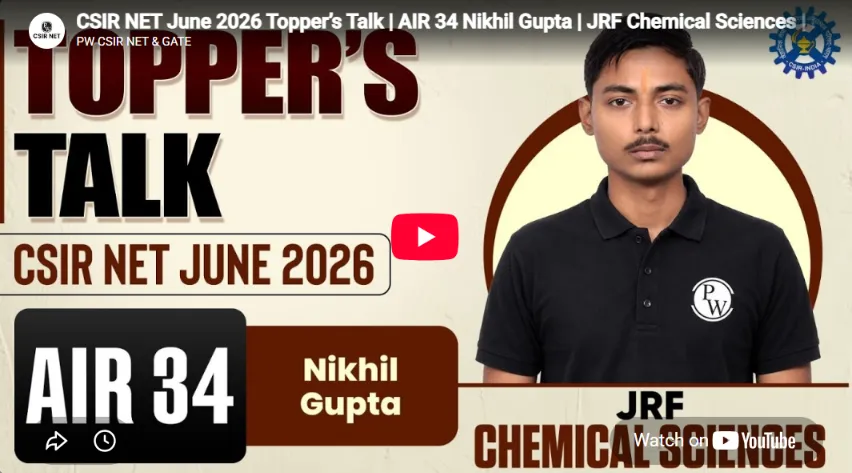
Clearing CSIR NET is not always about starting preparation years in advance. For Nikhil Gupta, the journey became serious during his MSc when he received the right guidance and began connecting his university studies with CSIR NET preparation.
Nikhil completed his BSc from the University of Allahabad in 2024 and completed his MSc from the same university in May 2026. He started preparing for CSIR NET during his MSc after his professors encouraged him to take the exam seriously.
After appearing in two earlier attempts, he finally achieved a strong result in his third attempt, securing AIR 34 in Chemical Sciences with 140 marks.
His journey shows how students can use their MSc coursework, regular practice and repeated attempts to gradually improve their performance.
Nikhil Started CSIR NET Preparation During His MSc
Nikhil admitted that he did not start his MSc with a clear CSIR NET preparation plan. His first semester was mainly about understanding his course and figuring out how to approach the exam.
Things changed during his second semester when he came in contact with his professors. They encouraged him to start preparing for CSIR NET alongside his MSc.
In his words:
“Second semester se preparation start kiya.”
His professors played an important role in helping him understand how to prepare and what level of preparation was required.
This gave Nikhil a clearer direction and allowed him to use his MSc coursework for his NET preparation as well.
Two Attempts Helped Nikhil Understand the Exam Better
Nikhil did not qualify CSIR NET in his first attempt. In his second attempt, he qualified for Admission to PhD, but could not qualify NET.
Instead of treating these attempts as failures, he used them to understand the examination better.
By his third attempt, his preparation had become more focused and he was able to perform much better.
This is one of the important lessons from his journey: an early attempt can also become a learning experience. Students can understand the paper, identify their weak areas and improve their strategy before the next attempt.
Physical Chemistry Was Nikhil’s Strongest Area
When asked about his strongest subjects, Nikhil said that Physical Chemistry was his strongest area. He was also comfortable with Inorganic Chemistry, while Organic Chemistry was comparatively weaker.
His preparation strategy reflected this.
He focused more on Physical Chemistry first, followed by Inorganic Chemistry. For Organic Chemistry, he selected the topics that he had prepared well rather than attempting questions from areas he was not confident about.
This helped him use his strengths effectively during the exam.
Nikhil Used a Flexible Strategy During the Exam
Nikhil had a strategy in mind before entering the examination hall, but he changed it according to the actual paper.
He initially started with Part C and marked questions that required review. He then moved to Part B and later shifted to Part A after finding some Part B questions comparatively difficult.
He explained his approach simply:
“Jo question nahi aa rahe the, usko mark review kar diya.”
After attempting the easier Part A questions, he returned to Part B and then reviewed the questions he had marked earlier.
According to Nikhil, Part A felt relatively easy, while Part B was slightly tricky. He was able to get all the Part A questions correct.
PW Aptitude Videos Helped Him Prepare for Part A
Interestingly, Nikhil did not spend a long period separately preparing for Part A.
He mentioned that around a week before the exam, he practised aptitude questions through PW’s aptitude videos. This practice helped him handle the Part A questions in the actual examination.
He said:
“Ek week pehle PW ke aptitude videos mein practice kar li.”
This shows why last-minute practice can be useful when it is focused on a specific area rather than replacing complete preparation.
Practice and Revision Became the Final Phase of His Preparation
For Nikhil, completing the syllabus was only the first step. Once his syllabus was completed around April–May, he spent the next one and a half months mainly on practice and revision.
His approach was simple:
-
Complete the syllabus first
-
Practise different types of questions
-
Revise regularly
-
Analyse mock tests
-
Work on weak areas
-
Revise important formulas and concepts
He particularly highlighted the importance of the final practice and revision sessions.
“Last mein ek–dedh mahine sirf practice aur revision.”
He also found practice sessions useful because they exposed him to different question types and helped him recognise patterns in questions that appeared regularly.
Short Notes Helped Nikhil Revise Important Concepts
Nikhil also maintained a separate notebook for formulas and concepts that he frequently forgot.
Instead of repeatedly going through the entire syllabus, he noted down important points and revised them closer to the examination.
He explained:
“Jo formulas bhool ja rahe the, usko ek alag copy mein likh kar exam ke kuch din pehle revise kar liya.”
This helped him keep important formulas and concepts fresh without going through every chapter again.
Nikhil Learned to Stay Productive Even on Low-Motivation Days
Like most students, Nikhil also had days when he did not feel like studying.
Instead of completely stopping his preparation, he changed the type of work he was doing.
For example, he would analyse a test, revise a one-shot video or go through concepts and short notes.
His approach was:
“Kuch nahi padhne ka mann ho raha ho toh test analyse kar lo ya one-shot video revise kar lo.”
This allowed him to remain connected with his preparation even on days when sitting down for long study sessions felt difficult.
PW Practice Sessions Supported His Preparation
During his preparation, Nikhil used PW’s practice sessions and aptitude videos as part of his preparation routine.
For students preparing for CSIR NET Chemical Sciences, PW batches and practice resources can be used alongside regular syllabus preparation to revise concepts, practise questions and work on exam-oriented preparation.
The important point from Nikhil’s journey is not simply using one resource. He combined his MSc coursework, professor guidance, practice, revision, tests and PW resources to prepare for the exam.
Nikhil’s MSc Became Part of His CSIR NET Preparation
One of the strongest takeaways from Nikhil’s journey is his advice to MSc students.
According to him, students should not treat their MSc syllabus and NET syllabus as two completely separate things. Instead, they can study the topics taught in their MSc at greater depth while also covering the corresponding NET syllabus.
His advice was:
“MSc mein jo syllabus hai, usko deep mein padho aur NET ka syllabus bhi saath-saath cover karo.”
This approach can help students use their regular university studies for competitive exam preparation instead of trying to manage two completely different study plans.
Nikhil’s Advice: Complete the Syllabus Before Focusing Only on Practice
Nikhil strongly emphasised completing the syllabus before moving entirely towards practice and revision.
His preparation followed a clear sequence:
Syllabus → Practice → Revision → Mock/Test Analysis → Final Revision
He also recommended covering the CSIR NET syllabus during MSc rather than waiting until after graduation.
For students entering MSc, this can provide multiple opportunities to attempt the examination and learn from each attempt.
From a Weak BSc Phase to AIR 34 in CSIR NET
Nikhil also shared that he was not very serious about studies during his BSc. He described his academic approach at that time as mainly focused on passing examinations.
However, things changed when he entered MSc.
The support of his professors, friends and family helped him become more serious about his studies and competitive exam preparation.
His journey is therefore not about being academically perfect from the beginning. It is about making a change at the right time and remaining consistent after making that decision.
Nikhil’s CSIR NET June 2026 Result
After two earlier attempts, Nikhil secured a strong result in his third attempt.
| Nikhil’s CSIR NET June 2026 Result | |
| Particular | Details |
| Candidate | Nikhil Gupta |
| Exam | CSIR NET June 2026 |
| Subject | Chemical Sciences |
| All India Rank | 34 |
| Marks | 140 |
| BSc | University of Allahabad, 2024 |
| MSc | University of Allahabad, May 2026 |
| Preparation | During MSc |
| Strongest Subject | Physical Chemistry |
| Other Strong Area | Inorganic Chemistry |
| Future Plan | PhD and research |
Nikhil now plans to pursue research and is looking towards PhD opportunities at institutions such as IIT Bombay and IIT Kanpur, as mentioned during the interview.
Nikhil’s Message to CSIR NET Aspirants
Nikhil’s journey gives a simple message to students: you do not have to begin as a perfect student to achieve a strong result.
What matters is recognising where you need to improve and becoming consistent.
His preparation can be summed up through these points:
-
Start CSIR NET preparation during MSc itself.
-
Use your MSc syllabus to strengthen NET concepts.
-
Complete the syllabus before focusing heavily on revision.
-
Practise as many different question types as possible.
-
Analyse tests instead of simply checking your score.
-
Maintain short notes for formulas and frequently forgotten concepts.
-
Use your stronger subjects to maximise your score.
-
Do not ignore weaker subjects; prepare selected areas strategically.
-
Stay productive even when you do not feel like studying.
-
Use practice sessions and revision resources regularly.
Nikhil Gupta’s AIR 34 in CSIR NET June 2026 Chemical Sciences came after multiple attempts and a change in his preparation approach during his MSc. His experience shows how students can combine university studies with competitive exam preparation, use guidance effectively and dedicate the final phase to practice, revision and test analysis.








Get Free Counselling Today
and Clear up all your Doubts
 Live & recorded classes available at easeDashboard for progress trackingLakhs of practice questions

