







CSIR NET June 2026 Mathematical Sciences Topper Priyanshi AIR 17 Success Story With PW
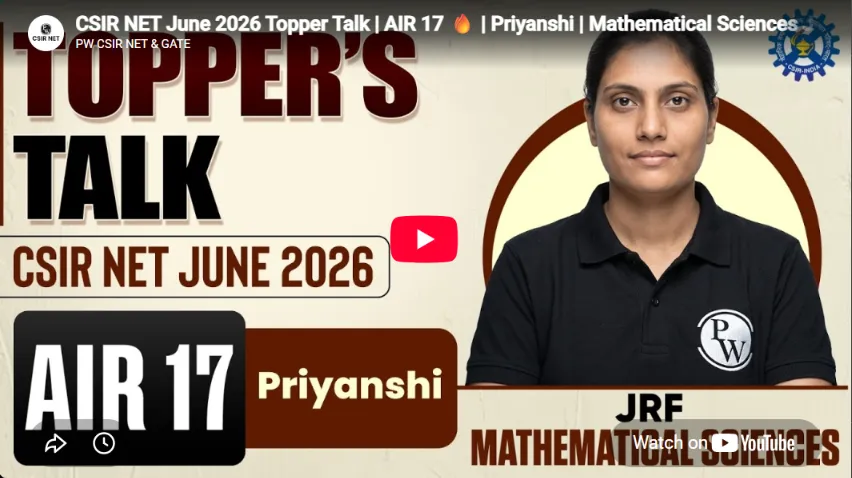
Priyanshi secured AIR 17 in CSIR NET June 2026 Mathematical Sciences after building her concepts through IIT JAM preparation, practising timed PYQs, and improving her question-solving approach. Her journey also includes using PW YouTube lectures during her early preparation.

Preparing for CSIR NET alongside a Master’s degree can require careful time management. Students have to balance their regular academic workload with competitive exam preparation while also developing the ability to apply concepts to different types of questions.
Priyanshi, who is currently pursuing her Master’s from IIT Guwahati, followed this approach during her CSIR NET preparation. Her preparation journey started when she came across IIT JAM through PW’s YouTube lectures during her Bachelor’s.
After securing admission to IIT Guwahati through JAM, she continued building her mathematical concepts during her Master’s and later prepared for CSIR NET by focusing on the additional syllabus, PYQs, question-solving ability, and timed practice. Her efforts helped her secure AIR 17 in CSIR NET June 2026 Mathematical Sciences.
Priyanshi’s Journey From a Local College in Ayodhya to IIT Guwahati
Priyanshi belongs to Ayodhya, Uttar Pradesh, where she also completed her Bachelor’s from a local college. She came across IIT JAM during her second year and gradually started preparing after learning more about the examination.
“To sir main Ayodhya se hoon. Ayodhya Uttar Pradesh se hoon aur maine apni Bachelors bhi wahin se ki thi. Wahan pe ek local college tha to maine wahan se kari thi aur then second year mein mujhe JAM ke baare mein pata chala ki JAM jaisi koi cheez hoti hai and then we can pursue that.”
PW’s YouTube lectures became an early part of her preparation as she started working towards JAM.
“Us time thoda unsure thi ki kaise karungi but phir YouTube lectures the PW ke to tab se phir thoda-thoda karna shuru kiya.”
Her preparation for JAM eventually helped her reach IIT Guwahati, where she continued strengthening her concepts.
Building Strong Concepts Made the Transition to CSIR NET Easier
After joining IIT Guwahati through JAM, Priyanshi already had a strong conceptual base. For CSIR NET, she identified that she needed to cover some additional topics and work more on solving questions within the available time.
“Aur phir JAM se maine IIT Guwahati join kara aur phir IIT Guwahati join karne ke baad kahin na kahin concepts usi time build up ho gaye the. Bas NET ke liye ye tha ki thodi bahut cheezein extra padhni thi aur 20-30% cheezein extra hoti hai.”
The additional challenge was not limited to learning new topics. Priyanshi also had to understand how to select questions wisely because the examination provides multiple choices but has a fixed time limit.
“Aur questions kaise attempt karne hain? Kyunki aapke paas choices bahut saari hain. Ye plus point bhi minus point bhi because option hai ki aap koi bhi question attempt kar sakte ho. But time constraint hai to you have to choose wisely.”
How PW Helped Priyanshi Build Her Preparation Foundation
PW’s YouTube lectures played an important role in Priyanshi’s early preparation for IIT JAM. The concepts she developed during that preparation later became useful when she moved towards CSIR NET.
“Us time thoda unsure thi ki kaise karungi but phir YouTube lectures the PW ke to tab se phir thoda-thoda karna shuru kiya.”
Her JAM preparation through these lectures helped her build the conceptual foundation that she carried forward to her Master’s and later used while preparing for NET.
Priyanshi Balanced CSIR NET Preparation With Her Master’s
Priyanshi was pursuing her Master’s at IIT Guwahati while preparing for CSIR NET. Her classes occupied much of her day, so she used her evening time for lectures and question practice.
“To sir classes ka aisa scene hota tha ki subah se shaam subah hamari classes hoti thi. To mostly main kya karti thi classes ke notes jitna ho sakta tha main class mein hi cover karne ki koshish karti thi because time limited hai to usko main aage nahi badha sakti.”
She generally watched lectures in the evening and tried solving questions before looking at the solution. Questions that she could not solve became part of her short notes for later revision.
“Agar mujhe koi question mujhse solve nahi hota tha. To wo mere short notes mein zaroor jata tha ki ye wala question mujhse nahi hua tha aur iski approach thodi different thi.”
This method allowed her to use her revision time to revisit questions and approaches that had previously challenged her.
Timed PYQ Practice Helped Priyanshi Understand the Exam
Priyanshi did not take a separate test series for this attempt. Instead, she used previous year questions as timed tests, a method she had also followed during her JAM and GATE preparation.
“Maine JAM ke time mein bhi, GATE ke time mein bhi main yahi karti thi. PYQ liya. PYQ download kiya aur usko main timer laga ke wo test de rahi hoon.”
Attempting PYQs under a time limit helped her understand which sections and questions she should attempt first.
“Mere hisaab se shayad timed test dena thoda achha tha because usse mujhe pata chala ki mujhe kya cheezein pehle attempt karni hai kya cheezein baad mein attempt karni hai.”
This practice helped her develop an exam-day strategy based on question selection and time management.
Priyanshi Focused on Question-Solving Skills
Along with conceptual preparation, Priyanshi focused on applying what she had studied. She made it a habit to attempt difficult questions more than once before checking the solution.
“Agar aapko koi question diya hai just pause aur ek baar try karo, try nahi ek baar do baar teen baar agar lag raha hai ki kahin pe stuck ho rahe ho to main phir se video lagati thi ek hint mila de.”
If she still could not solve the question, she studied the approach and recorded the important concept in her short notes. This gave her a collection of questions and concepts to revisit during revision.
Priyanshi Used a Flexible Strategy During the CSIR NET Exam
Priyanshi had planned to attempt Part C, followed by Part B and Part A. However, she changed her approach during the actual examination depending on the questions and time available.
“Main pehle socha tha ki main pehle Part C karungi phir B aur phir A. Lekin aisa hamesha nahi hota hai ki exam mein jo soch ke jaaun wahi karna padta hai.”
She initially gave Part C around an hour before moving to Part B and then Part A. Her practice with timed PYQs had helped her understand how much time she could dedicate to different sections.
“Main pehle se prepare ho ke jaati hoon ki matlab kis section ko kitna time dena hai taaki matlab you know mera paper chhoot jaaye.”
She also recognised that questions taking too much time should be left and revisited later instead of affecting the rest of the paper.
“Agar koi concept tumne padha hai usse related question aaya hai. But agar question karne mein tumhein bahut time lag raha hai just leave the question.”
Priyanshi Secured AIR 17 in CSIR NET June 2026
Priyanshi’s focused preparation and ability to balance her Master’s studies with competitive exam practice helped her secure All India Rank 17 in CSIR NET June 2026 Mathematical Sciences.
“To main kya karti thi? Maine JAM ke time mein bhi, GATE ke time mein bhi main yahi karti thi. PYQ liya. PYQ download kiya aur usko main timer laga ke wo test de rahi hoon.”
Her result came after working on concepts, analysing PYQs, practising questions under time limits, and improving her approach to question selection.
Priyanshi’s Advice for Future CSIR NET Aspirants
Priyanshi believes that understanding concepts is only one part of preparation. Aspirants also need to work on applying those concepts to unfamiliar questions and developing confidence in their preparation.
“Preparation to sab karte hain. Jaise maine bataya ki concept sab padhte hain. But the thing is ki kaise tum apply kar pa rahe ho un concepts ko?”
She also advises students not to spend too much time on one question during the examination.
“Agar ye question aa raha hai, well and good. Usko ek baar try karna hai. Nahi hua, just leave the question aur aage badho.”
For Part C in particular, she recommends selecting questions carefully rather than trying to solve every question.
“Humein sahi questions batorne hain. Do kam ho jaaye but accuracy apni sahi rehni chahiye.”
Her journey highlights the importance of conceptual clarity, question-solving practice, PYQ analysis, time management, and maintaining accuracy while preparing for CSIR NET Mathematical Sciences.








Get Free Counselling Today
and Clear up all your Doubts
 Live & recorded classes available at easeDashboard for progress trackingLakhs of practice questions

