Number Systems – Types, Definition & Examples
 Nivedita Dar19 Jan, 2026
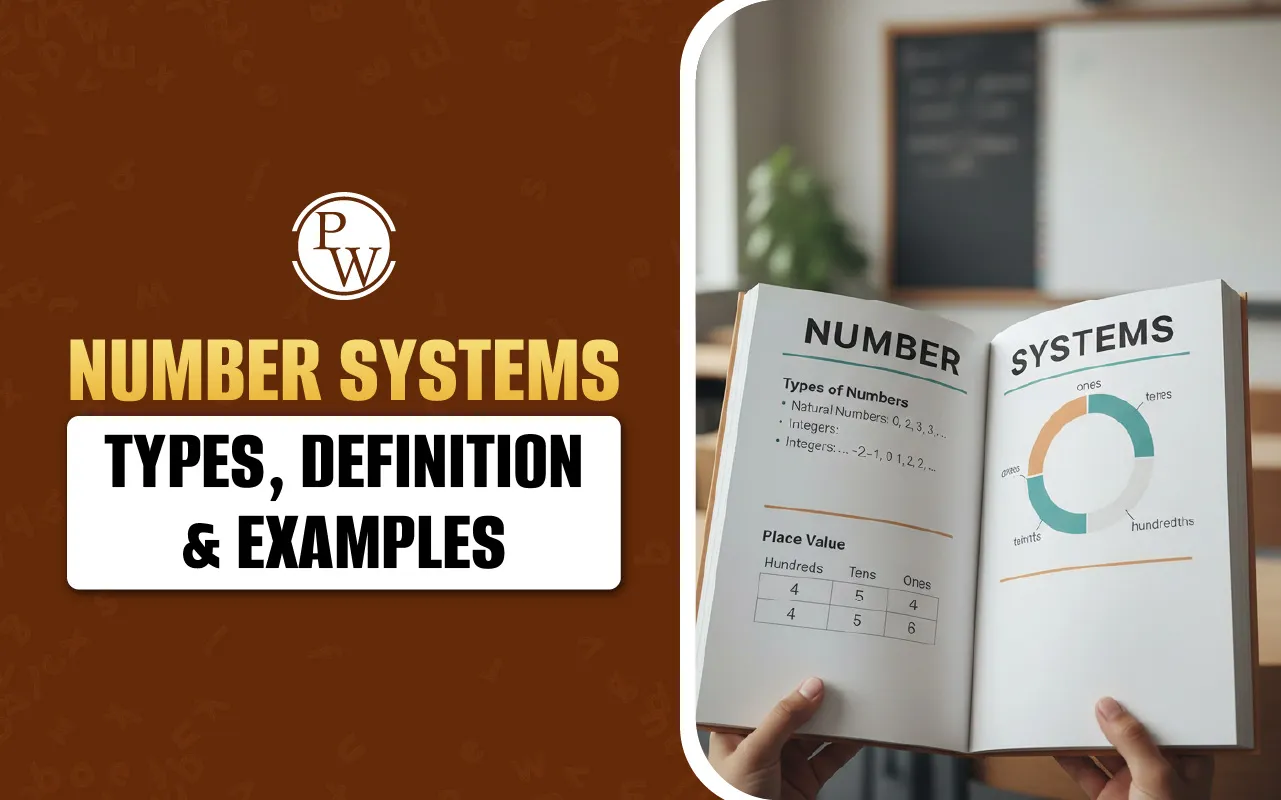
Number systems are the logical frameworks we use to show and organize numbers. Think of them as the "languages" of math. By using a specific set of digits or symbols, these systems let us do everything from basic addition to complex computer programming. They define how numbers relate to one another and give us a consistent way to talk about quantities.
What is a Number System? Understanding the Basics
When people ask, what do you mean by number system, they are usually looking for the "rules" of counting. The most basic number system definition is a set of values used to represent different amounts. For example, the system we use every day to buy groceries or tell time is the decimal system, which relies on ten digits (0 through 9).
To explain number system logic to someone new to the concept, you just have to look at "place value." The position of a digit tells you how powerful it is. In the number 543, the "5" isn't just a five; it's in the hundreds place, meaning it represents five hundreds. This positional logic is the heartbeat of the number system in maths.
Whether you’re a developer writing code or a student looking at a number system chart, you are working within a structured language of digits. Understanding the different types of numbers in maths—like whole numbers, integers, and fractions—is the first step toward mastering the number system in mathematics. By identifying these distinct categories, you begin to see the logical architecture that allows us to quantify everything from simple household items to the complex, infinite variables found in advanced physics and modern data encryption.
The Four Most Common Number Systems
To really get what is number system variety, we need to look at the four main "bases" used in math and technology. The "base" just tells you how many unique digits the system has to work with.
1. The Decimal System (Base 10)
This is the "human" language of math. We use ten digits (0–9) probably because we have ten fingers to count on! Every time you move a space to the left in a number, you are moving up by a power of 10 (ones, tens, hundreds, and so on).
2. The Binary System (Base 2)
This is the "machine" language. Computers don't have fingers; they have electrical circuits that are either "On" or "Off." Because of this, they use only two digits: 0 and 1. Even though it looks like a string of nonsense to us, it’s the core of number systems math for every digital device on the planet.
3. The Octal System (Base 8)
This system uses eight digits (0 through 7). It’s like a middle ground for computer scientists. Since 8 is a power of 2, it’s a handy way to shorten long strings of binary code into something easier for humans to read.
4. The Hexadecimal System (Base 16)
Hexadecimal is the "cool" system that uses both numbers and letters. It uses 0–9 and then jumps to A, B, C, D, E, and F to reach sixteen symbols. You’ll see this a lot in web design (color codes) and deep computer memory addresses.
Sorting the Different Types of Numbers in Maths
Beyond the bases (like binary or decimal), number systems math also sorts numbers into a "family tree" based on what they do. You can see this clearly on a number systems chart.
The Real Number Family
Real numbers are pretty much any number you can find on a number line. They are split into two main camps:
-
Rational Numbers: These are the "clean" numbers that can be written as a fraction, like 1/2 or 0.75.
-
Irrational Numbers: These are the "messy" numbers that go on forever without a pattern, like Pi ($\pi$) or the square root of 2.
Natural, Whole, and Integers
This is how we build up our understanding of the number system in mathematics:
-
Natural Numbers: Your basic counting numbers (1, 2, 3...).
-
Whole Numbers: All natural numbers, but we include 0.
-
Integers: This includes all whole numbers and their negative "twins" (...-2, -1, 0, 1, 2...).
Why Should We Care About Number Systems?
Learning to explain number system concepts isn't just about passing a math test; it's about understanding the foundation of our modern world. The number system in mathematics is the reason we can launch rockets, build smartphones, and manage global banks.
For instance, if you want to learn how to code, you have to understand the binary and hexadecimal systems. If you want to study engineering or physics, you have to master the difference between rational and irrational types of numbers in maths. By exploring these different "bases," we realize that math is a universal language that can be spoken in many different ways depending on who—or what—is doing the counting.
Number Systems FAQs
What is the simplest number system definition?
What are the four most common types?
How do you explain the "base" of a number system?
Why is zero so important in the number system in maths?
What do you mean by "Real Numbers"?