What is Quotient - Definition, How to Find, Examples
 Shivam Singh2 Jan, 2026
What is Quotient?
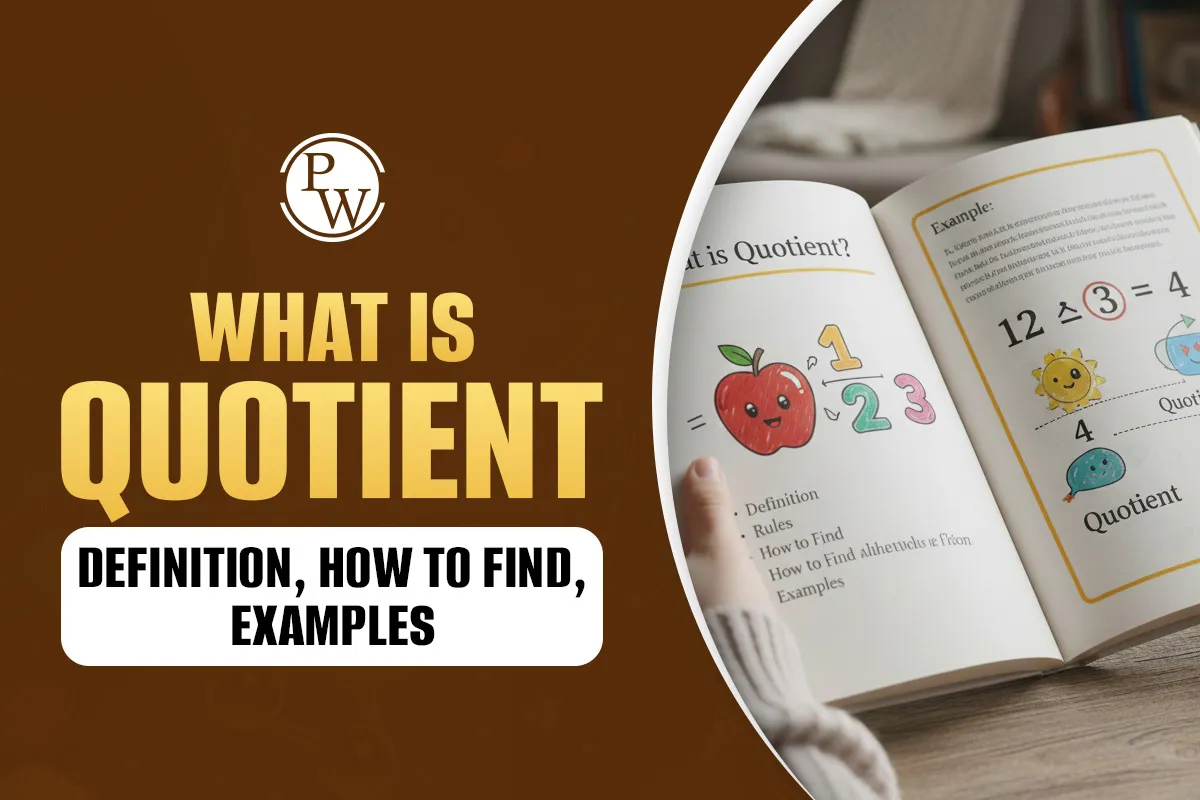
In simple terms, the quotient is the answer obtained when one number is divided by another. It represents the result of distributing a total quantity into a specified number of equal groups.
In any division problem, there are four key parts:
-
Dividend: The number being divided (the total amount).
-
Divisor: The number by which the dividend is being divided (the number of groups or the size of each group).
-
Quotient: The result of the division (the size of each group or the number of times the divisor fits into the dividend).
-
Remainder: The amount left over after the division is complete (zero in the case of a perfect division).
Quotient Definition
Mathematically, the quotient is defined as the result of the division of a number by any divisor. It literally tells us the number of times the divisor is contained in the dividend.
For example, in the statement 15÷3=5
-
15 is the Dividend.
-
3 is the Divisor.
-
5 is the Quotient.
This means that the number 3 is contained exactly 5 times in the number 15. The quotient can be a whole number (like 5 in the example above) or a decimal number (such as 12÷5=2.4). While the quotient is always smaller than the dividend, it can be larger or smaller than the divisor.
How to Find the Quotient
The quotient is determined by the process of division, often using the long division method, especially for larger numbers. The process systematically checks how many times the divisor can be subtracted from the dividend until the remaining value is smaller than the divisor.
The general relationship between the division terms is expressed by the formula:
Dividend ÷ Divisor = Quotient
The Role of the Remainder
In many cases, a number does not divide perfectly. When this happens, the division process yields a remainder.
Consider the division 17÷4
-
The number 4 can fit into 17 four times (4* 4 = 16).
-
The difference is 17 - 16 = 1.
-
Therefore, the quotient is 4 and the remainder is 1.
The relationship that includes the remainder is crucial for verifying your answer:
Dividend = Divisor * Quotient + Remainder
Using our example: 17=(4*4)+1 which is 17 = 16 + 1. This equation confirms the quotient and remainder are correct.
Read More: Division
Estimating the Quotient
In situations where an exact answer is not required, or to quickly check the reasonableness of a calculation, we can estimate the quotient. This is done by rounding off both the dividend and the divisor to numbers that are easy to divide mentally.
Example: Estimate the quotient of 825÷24
-
Round the Dividend (825): Rounding to the nearest hundred gives you 800.
-
Round the Divisor (24): Rounding to the nearest ten gives you 200.
-
Divide the Rounded Numbers: 800÷20 = 40
The estimated quotient is 40, which is close to the exact quotient of 34.375, making it a reliable quick check.
Read More: How to Do Long Division
Finding the Quotient Examples
The quotient is a tool we use every day, often without realizing it.
Example 1: Calculating Equal Distribution
A company has $4000 to distribute equally among 25 workers as a bonus. How much does each worker receive?
Dividend: $4,000 (Total amount)
Divisor: 25 (Number of workers)
Quotient: $4,000 ÷ 25
Using long division, we find that $4,000 ÷ 25 = 160
Answer: The quotient is 160. Each worker receives $160.
Example 2: Division with a Remainder
Find the quotient and remainder for 66 ÷7
We look for the largest multiple of 7 that is less than or equal to 66.
-
7*9 = 63
-
7*10= 70 (Too large).
The division is 66 ÷7 = 9 with a remainder of 66 - 63 = 3.
Answer: The quotient is 9 and the remainder is 3.
Also Read: Division of fractions
Transform your child's math journey with CuriousJr!
CuriousJr’s online Mental Maths classes make learning math fun and easy through an engaging, gamified approach. With interactive quizzes, enjoyable challenges, and live sessions, even difficult concepts become simple to understand. The platform also offers personalised learning paths so every child can strengthen their math foundation at their own pace. Book a demo class today to explore how our classes can help your child.
Quotient FAQs
What is the difference between a quotient and a product?
Is the quotient always a whole number?
How can I verify if a quotient is correct?
What is the difference between a quotient and a remainder?