GATE 2027 Wastewater Treatment and Sewage Management Notes by PW
 Mehjabeen Hussain16 Nov, 2026

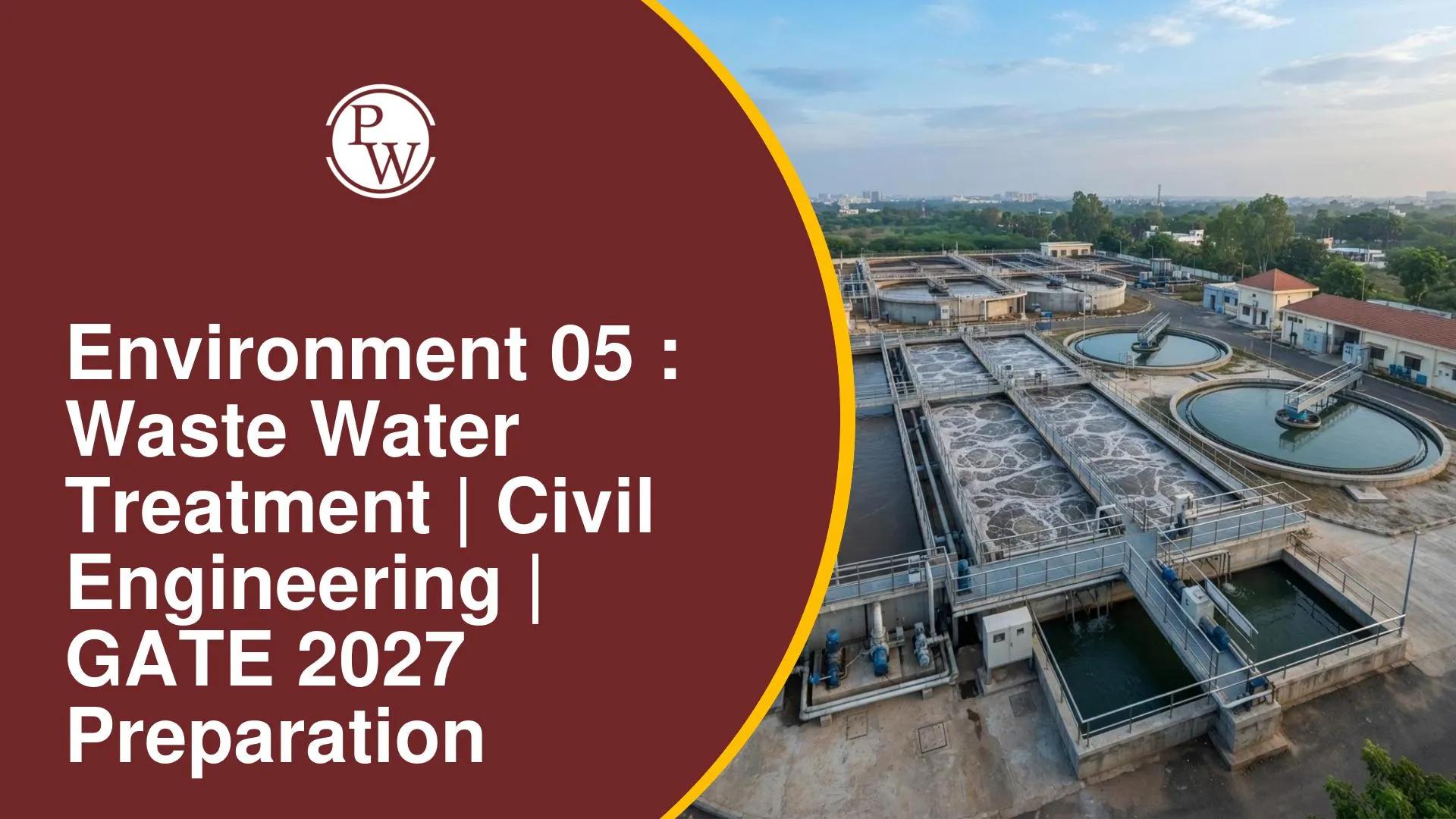
Wastewater treatment involves removing pollutants, organic matter and harmful substances from sewage before its safe disposal or reuse. For GATE preparation, understanding oxygen-demand parameters, treatment methods, biological processes, sludge management and river self-purification is essential. These concepts also form the basis of several numerical questions in Environmental Engineering.
Physics Wallah notes help you understand important wastewater treatment processes, revise essential formulas and strengthen your conceptual understanding. Study the treatment stages, remember key design parameters and practise numerical problems to prepare effectively for the GATE 2027 examination.
Characteristics of Sewage
Sewage contains organic matter, inorganic particles, suspended solids and microorganisms. Its characteristics change with the extent of decomposition.
Fresh sewage is generally yellowish or light brown with a mild odour, while septic sewage becomes dark brown or black and develops a foul smell.
Important characteristics include:
-
Colour: Fresh sewage is light brown; septic sewage is darker.
-
Odour: Fresh sewage has a mild smell, while septic sewage has a foul odour.
-
Turbidity: Septic sewage generally has higher turbidity due to suspended decomposition products.
-
pH: Fresh sewage is usually near neutral, while septic conditions may make it acidic.
BOD, COD, TOD and ThOD
Oxygen-demand parameters indicate the oxygen required to oxidise pollutants in wastewater.
Biochemical Oxygen Demand (BOD)
BOD is the amount of dissolved oxygen required by aerobic microorganisms to decompose biodegradable organic matter.
It is commonly measured over five days at 20°C and is called BOD₅.
BOD = (Initial DO − Final DO) × Dilution Factor
For seeded samples, seed correction is also required.
BOD occurs in two stages:
-
First-stage BOD: Heterotrophic bacteria oxidise carbonaceous organic matter.
-
Second-stage BOD: Autotrophic bacteria oxidise nitrogenous compounds through nitrification.
The BOD curve helps determine ultimate BOD and the deoxygenation constant.
Chemical Oxygen Demand (COD)
COD represents the oxygen equivalent required for chemical oxidation of biodegradable and non-biodegradable organic matter.
The dichromate method is commonly used. Important chemicals include:
-
Potassium dichromate: Oxidising agent.
-
Mercuric sulphate: Reduces chloride interference.
-
Silver sulphate: Catalyst.
-
Sulphuric acid: Provides an acidic medium.
The remaining dichromate is measured through titration.
Total Oxygen Demand (TOD)
TOD represents the oxygen required to oxidise organic matter and oxidisable inorganic substances. It is generally determined through high-temperature oxidation.
Theoretical Oxygen Demand (ThOD)
ThOD is the theoretical oxygen requirement calculated using the stoichiometric chemical oxidation of a compound.
Important relationships for GATE:
-
TOD ≥ COD ≥ BOD
-
ThOD ≥ COD
Relative Stability
Relative stability indicates the extent of stabilisation of biodegradable organic matter.
Relative Stability = (1 − e⁻ᵏᵗ) × 100
Here, k is the deoxygenation constant and t is time.
It also represents the percentage of ultimate BOD already exerted.
Memory Tip: BOD measures biological oxygen demand, COD measures chemical oxygen demand, and TOD includes organic and oxidisable inorganic matter.
Stages of Sewage Treatment
Sewage treatment involves four main stages:
-
Preliminary treatment
-
Primary treatment
-
Secondary treatment
-
Tertiary treatment
Preliminary Treatment
Preliminary treatment removes large solids, grit, oil and grease to protect equipment and prevent blockages.
-
Screening: Removes floating materials such as plastics, rags and sticks. Screens are generally inclined to improve their effective area.
-
Grit Removal: Removes heavy inorganic particles such as sand and gravel. Excessive velocity prevents settling, while very low velocity allows organic solids to settle.
-
Detritus Tank: Removes finer inorganic particles.
-
Skimming Tank: Removes floating oil and grease, sometimes using compressed air. Typical detention time is 3–5 minutes.
Primary Treatment
Primary treatment mainly involves sedimentation in a primary clarifier. Suspended solids settle as primary sludge, while floating materials are removed from the surface.
A primary clarifier may remove approximately 70% of settleable solids and 30% of BOD, depending on operating conditions.
Important settling types are:
-
Discrete settling
-
Flocculent settling
-
Hindered or zone settling
-
Compression settling
Biological Treatment Processes
Secondary treatment uses microorganisms to break down biodegradable organic matter. Biological processes are classified into suspended-growth and attached-growth systems.
Biomass Growth Phases
Microorganisms pass through four growth phases:
-
Lag Phase: Microorganisms adapt to the wastewater.
-
Log Phase: Rapid multiplication occurs due to sufficient food.
-
Stationary Phase: Growth slows as nutrients decrease.
-
Endogenous Decay Phase: Microorganisms consume internal reserves, reducing active biomass.
The Monod-based growth equation is:
dX/dt = [μmax S/(Ks + S)]X − kdX
Where:
-
X = Biomass concentration
-
S = Substrate concentration
-
μmax = Maximum specific growth rate
-
Ks = Half-saturation constant
-
kd = Endogenous decay coefficient
Activated Sludge Process (ASP)
ASP is an aerobic, suspended-growth biological process used for secondary treatment.
Its main components are:
-
Aeration tank
-
Secondary settling tank
-
Return activated sludge line
-
Waste activated sludge line
Wastewater enters the aeration tank, where microorganisms consume organic matter in the presence of oxygen. The mixture then enters the secondary clarifier, where biomass settles. Some settled sludge is returned to maintain microbial activity, while excess sludge is removed.
Important ASP Design Parameters
Food-to-Microorganism Ratio (F/M):
Indicates the amount of organic food supplied per unit mass of microorganisms.
F/M = QS₀/VX
Here, Q = influent flow rate, S₀ = influent substrate concentration, V = aeration tank volume and X = MLSS concentration.
BOD Removal Efficiency:
BOD Removal (%) = [(S₀ − Sₑ)/S₀] × 100
Sₑ represents effluent BOD concentration.
Organic Loading Rate:
Organic Loading Rate = QS₀/V
Hydraulic Detention Time:
HRT = V/Q
Sludge Age:
Also called mean cell residence time (MCRT), it represents the average time microorganisms remain in the system.
Sludge Age = Total mass of solids in the system / Mass of solids wasted per day
Sludge Volume Index (SVI):
SVI indicates the settling characteristics of activated sludge.
SVI = (Settled sludge volume in mL/L × 1000) / MLSS in mg/L
It is expressed in mL/g. Higher SVI generally indicates poor settling and may be associated with sludge bulking.
Problems in Activated Sludge Process
Two common problems are:
-
Rising Sludge: Occurs when nitrogen gas forms due to denitrification in the secondary clarifier. Gas bubbles become trapped in the sludge, causing it to rise.
-
Bulking Sludge: Occurs when sludge develops poor settling characteristics, often due to excessive filamentous bacterial growth, nutrient imbalance or unsuitable operating conditions.
Memory Tip: Rising sludge is associated with gas formation, while bulking sludge is associated with poor settling.
Trickling Filters and Oxidation Ponds
Trickling Filters
A trickling filter is an aerobic, attached-growth biological treatment system containing stones, bricks or plastic media covered with microbial slime.
Wastewater trickles over the media, where microorganisms consume organic matter and reduce BOD. As the biological layer becomes thick, older biomass detaches. This is called sloughing.
Important types include:
-
Standard-Rate Filters: Lower loading and generally higher treatment efficiency.
-
High-Rate Filters: Higher hydraulic and organic loading, commonly with recirculation.
-
Two-Stage Filters: Useful for high organic loading or when lower effluent BOD is required.
The NRC equation is used for trickling-filter design. Recirculation ratio and recirculation factor should not be confused.
Oxidation Ditch
An oxidation ditch is a modified activated sludge process using extended aeration. Its longer aeration period allows organic matter breakdown and substantial sludge stabilisation.
Oxidation Ponds
Oxidation ponds use natural biological processes involving algae and bacteria.
They work through algal-bacterial symbiosis:
-
Bacteria decompose organic matter and release nutrients and carbon dioxide.
-
Algae use sunlight, nutrients and carbon dioxide for photosynthesis.
-
Algae release oxygen, which supports bacterial activity.
Oxidation ponds work best in warm, sunny conditions. Their typical detention time is 2–6 weeks, making them suitable for small communities with sufficient land.
Septic Tanks and Sludge Treatment
Septic Tanks
A septic tank provides individual wastewater treatment through sedimentation and anaerobic digestion.
Heavier solids settle as sludge, lighter materials form a scum layer, and anaerobic microorganisms decompose organic matter.
Important features include:
-
Detention time: 24–48 hours.
-
Separate liquid, sludge and gas zones.
-
Periodic sludge removal, commonly every 1–3 years depending on usage and capacity.
Sludge Treatment
Sludge is the semi-solid material separated during wastewater treatment. It contains water, organic matter, inorganic solids and microorganisms.
Its treatment reduces volume and stabilises organic matter.
The general sequence is:
Thickening → Digestion → Conditioning → Dewatering and Drying
-
Thickening: Reduces water content. Gravity thickening is suitable mainly for primary sludge, air flotation for lighter biological sludge, and centrifugation where space is limited.
-
Digestion: Stabilises organic matter through biological decomposition.
-
Conditioning: Improves sludge properties before dewatering.
-
Dewatering and Drying: Removes additional water and reduces sludge volume.
Anaerobic Sludge Digestion
Anaerobic digestion is the decomposition of organic matter by microorganisms in the absence of oxygen.
It involves four stages:
-
Hydrolysis: Complex organic compounds break into simpler soluble substances.
-
Acidogenesis: Microorganisms produce organic acids, alcohols and other compounds.
-
Acetogenesis: Intermediate products are converted mainly into acetate, hydrogen and carbon dioxide.
-
Methanogenesis: Methanogens produce methane and carbon dioxide.
Methane-forming microorganisms generally perform best at pH 6.5–7.5.
Seeding with digested sludge introduces active microorganisms and accelerates digestion.
Memory Tip: Remember the sequence as Hydrolysis → Acidogenesis → Acetogenesis → Methanogenesis.
Types of Anaerobic Digesters
-
Standard-Rate Digester: Digestion and sludge separation occur in the same tank, with limited mixing.
-
High-Rate Digester: Provides better mixing and controlled conditions, with digestion and separation potentially occurring in separate tanks.
High-rate digesters are preferred where greater treatment capacity and process control are required.
River Self-Purification and Oxygen-Sag Curve
Rivers naturally reduce pollution through physical, chemical and biological processes. This is called self-purification.
Important processes include dilution, dispersion, sedimentation, oxidation, biological degradation and reaeration.
When wastewater enters a river, microorganisms consume dissolved oxygen (DO) while decomposing organic matter. This decreases DO concentration and produces an oxygen-sag curve.
Zones of Self-Purification
A polluted river generally passes through four zones:
-
Zone of Degradation: Wastewater enters and dissolved oxygen begins to decrease.
-
Zone of Active Decomposition: Organic matter undergoes intense decomposition, and DO may reach its minimum.
-
Zone of Recovery: Pollution decreases and reaeration gradually restores DO.
-
Clear-Water Zone: Water quality and dissolved oxygen approach natural conditions.
Oxygen Deficit
Oxygen deficit is the difference between saturation DO and actual DO.
Oxygen Deficit = DO Saturation − Actual DO
Therefore:
DO at time t = DO Saturation − Oxygen Deficit at time t
Streeter–Phelps Equation
The Streeter–Phelps model describes the combined effects of deoxygenation and reaeration.
Dₜ = [k₁L₀/(k₂ − k₁)] (e⁻ᵏ¹ᵗ − e⁻ᵏ²ᵗ) + D₀e⁻ᵏ²ᵗ
Where:
-
Dₜ = Oxygen deficit at time t
-
D₀ = Initial oxygen deficit
-
L₀ = Initial ultimate BOD
-
k₁ = Deoxygenation rate constant
-
k₂ = Reaeration rate constant
-
t = Time
Critical time represents the point at which oxygen deficit is maximum and dissolved oxygen is minimum. Critical deficit and critical time are important GATE numerical topics.
Effluent Disposal and Land Application
Treated wastewater can be discharged into water bodies or applied to land, depending on environmental conditions and applicable standards.
Important effluent quality parameters include:
-
BOD
-
COD
-
Suspended solids
-
Oil and grease
-
pH
Required discharge limits depend on regulatory standards, the receiving environment and the disposal method.
Land Application of Treated Wastewater
Land application uses soil as a natural treatment medium. Wastewater undergoes infiltration, evaporation and biological decomposition.
Continuous sewage application may clog soil pores and reduce infiltration. This condition is called sewage sickness.
It can be controlled by:
-
Temporarily stopping wastewater application.
-
Allowing the land to dry.
-
Ploughing and loosening the soil.
-
Using alternate land areas during recovery.
Proper land management helps restore infiltration and prevents soil deterioration.
Would live classes help you connect BOD, ASP, sludge digestion and the oxygen-sag curve more clearly? Explore PW’s GATE Civil Engineering batches
Wastewater treatment and sewage management for GATE 2027 comes down to understanding the treatment sequence, oxygen-demand parameters, biological processes, sludge handling and river self-purification. Revise the key relationships, such as TOD ≥ COD ≥ BOD, and practise numerical questions on ASP design parameters and the Streeter–Phelps equation. PW offers GATE Civil Engineering notes, batches and test series that can help you revise this topic and prepare for GATE 2027 with greater confidence.
FAQs
What is the difference between BOD and COD?
What are the main stages of sewage treatment?
What is the difference between rising sludge and bulking sludge?