Must-Have Engineering Skills for High Paying Placements in 2026
 Priyanka Yadav8 Jun, 2026
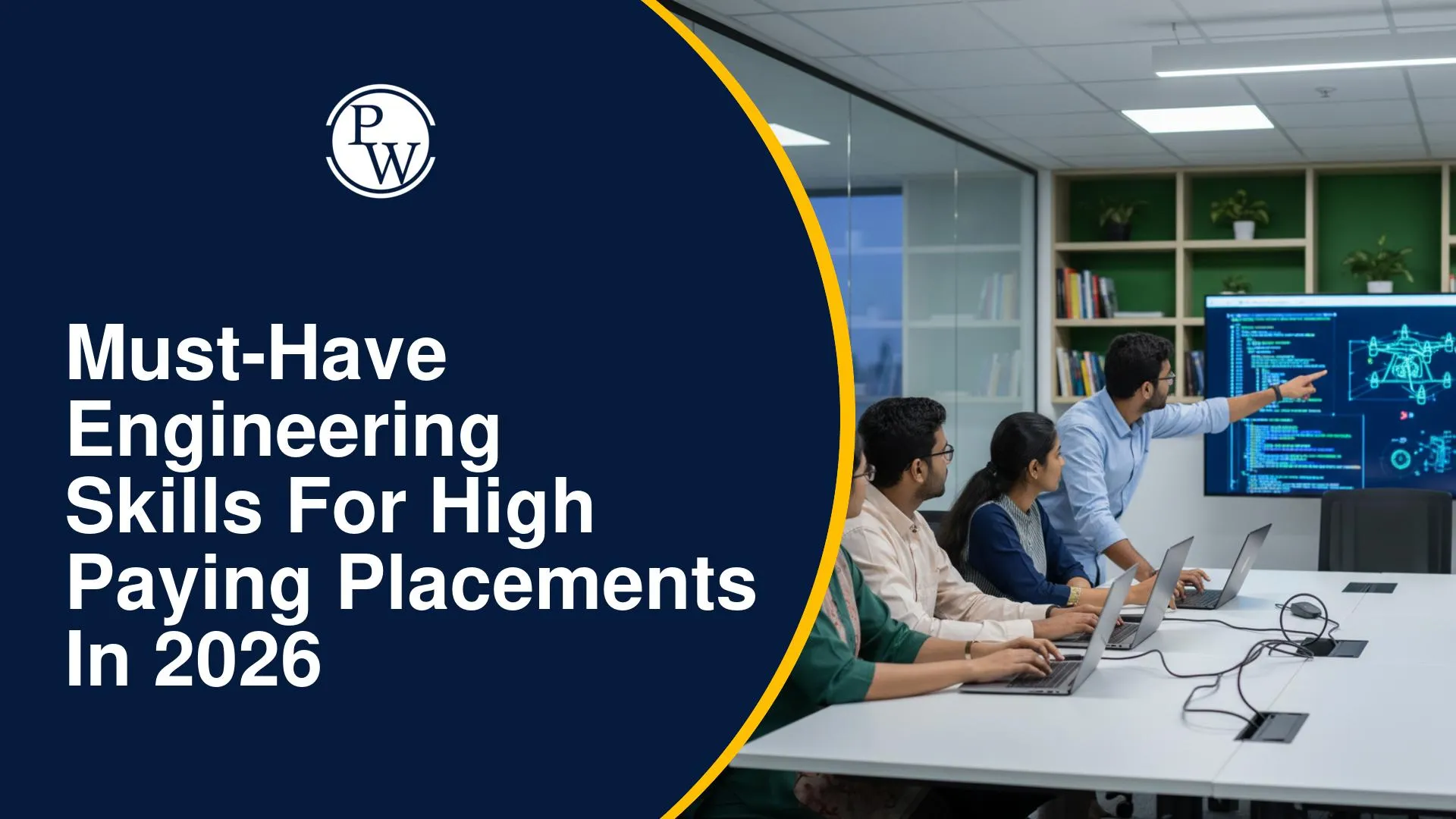
The engineering landscape is evolving rapidly, making continuous upskilling essential for professionals. Traditional degrees alone no longer guarantee career success, as industries increasingly rely on AI, automation, and data-driven solutions.
Engineers must now develop a combination of technical expertise, digital literacy, and strong communication skills to solve real-world problems, collaborate effectively, and adapt to new technologies. Mastery of AI, Generative AI, Data Analytics, Programming, Automation, and emerging technologies such as IoT and Cybersecurity is critical. By embracing practical skills alongside theoretical knowledge, engineers can innovate, remain competitive, and secure high-paying placements in an ever-changing professional environment.
Why Engineers Need New Skills?
Engineers, traditionally known for their versatility, must embrace new skills due to significant transformations:
-
AI is Transforming Every Industry: Artificial intelligence is revolutionizing operations, requiring engineers to leverage AI for increased efficiency.
-
Automation is Replacing Repetitive Tasks: AI is automating jobs involving repetitive, fixed patterns. This necessitates engineers to focus on tasks requiring human creativity and subjective input, which AI cannot replicate.
-
Companies Now Hire for Skills, Not Just Degrees: The industry prioritizes practical skills and problem-solving abilities over mere academic qualifications to address real company challenges.
-
Engineers need a comprehensive blend of technical, digital, and communication skills to meet current job requirements. The future demands professionals who can learn, adapt, and innovate, moving beyond comfort with existing methods.
Skill 1: AI and Generative AI (GenAI)
AI and Generative AI (GenAI) are crucial skills for every engineer's resume, demonstrating capability in modern technological advancements.
-
Applications: It is used extensively across various sectors including design, coding, manufacturing, healthcare, and research.
-
Benefit: This skill significantly increases productivity in diverse fields.
-
Key Learning Areas:
-
ChatGPT usage
-
AI tools
-
Prompt engineering
-
Machine learning basics (including classification, regression, and loss functions)
Skill 2: Data Analytics
Data Analytics is essential because all engineering fields generate vast amounts of data, which serves as a critical resource.
-
Context: Data is the new oil, powering operations and decision-making worldwide.
-
Benefits:
-
Enables better decision making by analyzing data and identifying patterns.
-
There is industry demand across all branches, including healthcare, computer science, data science, manufacturing, and mining.
-
Tools to Learn:
-
Excel: For efficient data handling.
-
Python: For tackling real-world data challenges.
-
Power BI: A popular data visualization tool.
-
Tableau: An alternative tool for data visualization.
-
SQL (Structured Query Language): For querying data and performing analysis.
-
Process: Data is vital for performing EDA (Exploratory Data Analysis), from which valuable insights can be derived.
-
Significance: Data analytics is the starting step to enter the field of data science.
Skill 3: Programming and Automation
Programming and Automation are fundamental for communicating with machines and significantly enhancing efficiency.
-
Recommended Programming Languages:
-
Python: The most accessible and in-demand language, forming the basis for most machine learning models and libraries.
-
C++: Important for competitive coding and games development.
-
MATLAB: A powerful tool for design and various other tasks.
-
Java: Widely used for enterprise software development, known for its Object-Oriented Programming (OOP) capabilities.
-
Applications:
-
Robotics: Combines computer science and electronics.
-
Simulations: Depicting real-world scenarios without conducting actual physical experiments.
-
Automation: Replacing repetitive tasks with processes that run without human intervention, leading to increased efficiency and allowing human roles to shift towards creativity and higher-level problem-solving.
-
AI Development and Deployment: Essential for building and implementing AI solutions to improve existing processes.
Skill 4: Digital Design and Simulation
Digital Design and Simulation are highly relevant across various engineering branches, though often emphasized in electronics and mechanical engineering. The industry now prefers virtual testing before physical testing.
|
Feature |
Physical Testing |
Virtual Testing
|
|---|---|---|
|
Setup |
Requires extensive setup and arrangements. |
Utilizes software and computational models. |
|
Efficiency |
Not time-efficient, money-efficient, or cost-effective. |
Provides early insights into feasibility, saving time and money. |
|
Validation |
Direct validation through real-world experiments. |
Allows initial validation and testing of designs before physical commitment. |
-
Tools: AutoCAD, SolidWorks, ANSYS, CATIA, MATLAB Simulink.
Skill 5: Communication and Presentation Skills
Technical knowledge alone is not enough for effective contribution. Communication and Presentation Skills are vital for engineers working in collaborative environments.
-
Components:
-
Public Speaking: The ability to clearly convey ideas and explain thoughts to an audience, including maintaining presence of mind and appropriate body language.
-
Presentation Skills: Involves creating, editing, and formatting slides, delivering effectively, and presenting professionally.
-
Report Writing: Proficiency in various written forms, such as emails and blogs.
-
Team Collaboration: The capacity to work effectively with others on projects as part of a team.
Engineering Branch-wise Important Skills
While many skills are universally applicable, certain engineering degrees offer an advantage in specific areas:
-
Mechanical Engineering: CAD (Computer-Aided Design), CAM (Computer-Aided Manufacturing), Robotics, Industry 4.0.
-
Civil Engineering: BIM (Building Information Modeling), Staad.Pro, Project Management.
-
Electrical Engineering: EV Technology (Electric Vehicles), Power Systems, MATLAB.
-
Electronics Engineering: VLSI design (Very Large Scale Integration), Embedded Systems, IoT (Internet of Things), which is critical for bringing automation to manufacturing.
-
Computer Science: AI, Cloud Computing (a vast domain with numerous opportunities), Cybersecurity (in high demand due to increasing cybercrimes).
Future Focus of Emerging Technologies
These technologies represent key areas for future focus and career growth for engineers:
-
Artificial Intelligence
-
Robotics
-
IoT (Internet of Things)
-
Electric Vehicles (EV)
-
Cybersecurity
-
Digital Twin Technology
-
Renewable Energy
Semiconductor Industry (currently experiencing high demand)