








Gujarat Board HSC Exam Pattern 2027: Subject-Wise Pattern, Duration and Marking Scheme
The GSHSEB HSC Exam Pattern 2027 explains the examination structure, subject-wise question types, marks distribution, exam duration and marking scheme for Gujarat Board Class 12 students. The pattern may vary between Science and General streams and across subjects. Students should refer to the latest GSEB subject-wise blueprints to understand the paper structure and prepare accordingly.
 Aditi Tiwari312 Oct, 2026

The Gujarat Secondary and Higher Secondary Education Board (GSEB), also known as GSHSEB, conducts the Class 12 Higher Secondary Certificate (HSC) examinations for Science and General stream students. Understanding the GSEB HSC Exam Pattern 2027 helps students identify the question paper structure, marks distribution and subject-wise assessment requirements.
Students preparing for the Gujarat Board examinations can explore the GSHSEB Hub for board-related updates and academic resources.
| Particulars | Details |
|---|---|
| Board | Gujarat Secondary and Higher Secondary Education Board (GSHSEB) |
| Examination | GSEB HSC Examination 2027 |
| Class | 12 |
| Streams | Science and General |
| Exam mode | Offline, subject to the official examination instructions |
| Exam duration | Check the latest subject-wise blueprint and official timetable |
| Subjects | As prescribed for the respective stream |
| Question types | May include objective and descriptive questions, depending on the subject |
| Total marks | As specified in the subject-wise blueprint |
| Marking scheme | As prescribed in the official subject-wise blueprint |
Note: The final GSEB HSC Exam Pattern 2027 should be confirmed using the official blueprint for the 2026–27 academic session.
For more information about board examinations, students can visit the GSHSEB exams page for relevant exam resources and updates.
HSC Science Exam Pattern 2027 Download PDF
Do you need help with your homework or preparing for exams?
Study without using the internet
GSEB HSC Science Exam Pattern 2027: Subject-Wise Details
Science stream students should review the blueprint for each subject separately. The subject-wise pattern helps students understand the paper structure, marks allocation and types of questions they may encounter.
Along with the exam pattern, students should review the GSEB HSC syllabus to identify the prescribed topics and organise subject-wise revision.
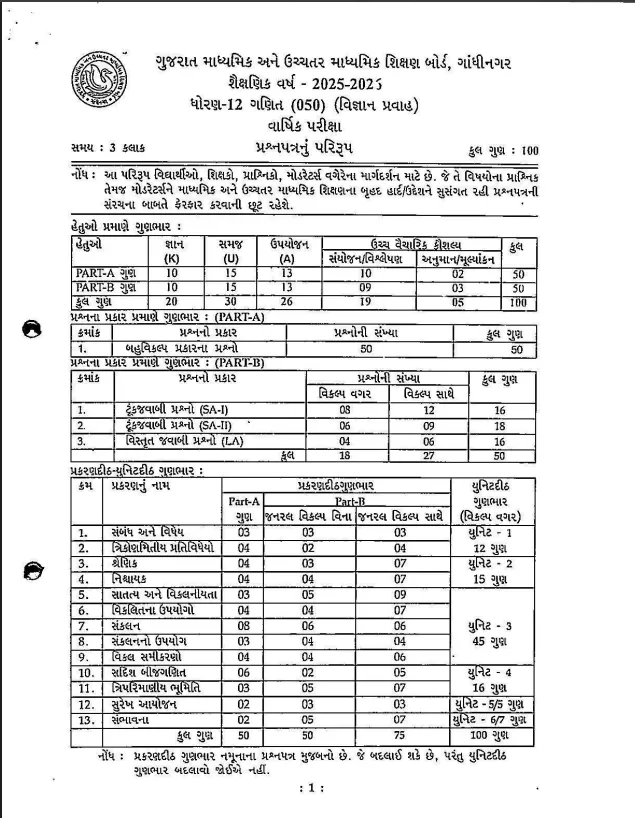
GSEB HSC Mathematics Exam Pattern 2027
The GSEB HSC Mathematics exam pattern outlines how the question paper is structured and how marks are distributed across the subject. Students should review the Mathematics blueprint to understand the question format and the marks assigned to different sections or topics.
Screenshot placement for the editor: Insert a cropped screenshot of the Mathematics paper-pattern table from the Science stream blueprint PDF.
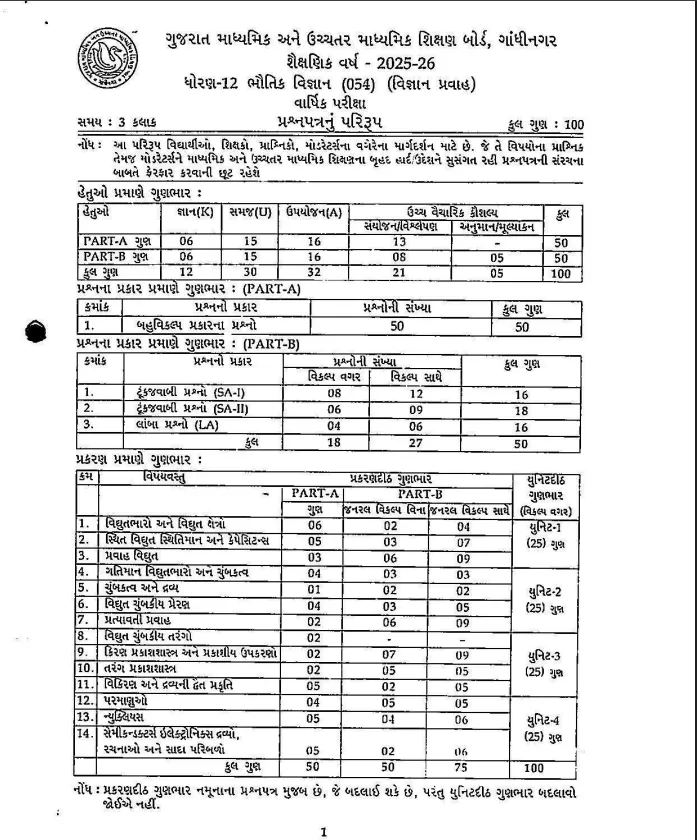
GSEB HSC Physics Exam Pattern 2027
The GSEB HSC Physics exam pattern helps students understand the structure of the Physics paper and the distribution of marks across its questions. Students should refer to the latest Physics blueprint for details about question formats, chapter-wise weightage and marks allocation.
Screenshot placement for the editor: Insert the Physics paper-pattern table from the Science stream blueprint PDF after verifying the subject heading and page number.
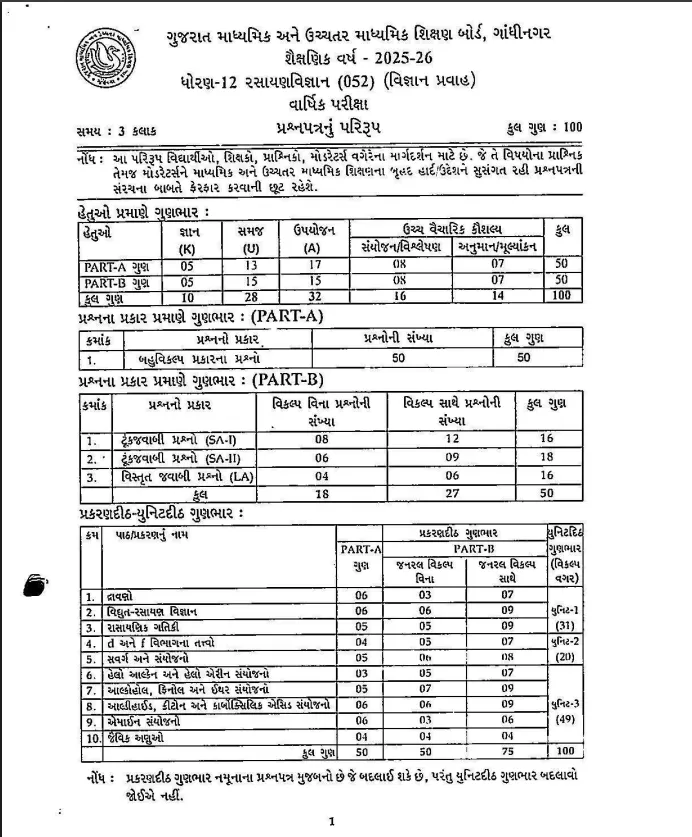
GSEB HSC Chemistry Exam Pattern 2027
The GSEB HSC Chemistry exam pattern provides information about the question paper structure and the distribution of marks. Students should use the Chemistry blueprint to identify the question formats and understand how the subject is assessed.
Screenshot placement for the editor: Insert a cropped screenshot of the Chemistry paper-pattern table.
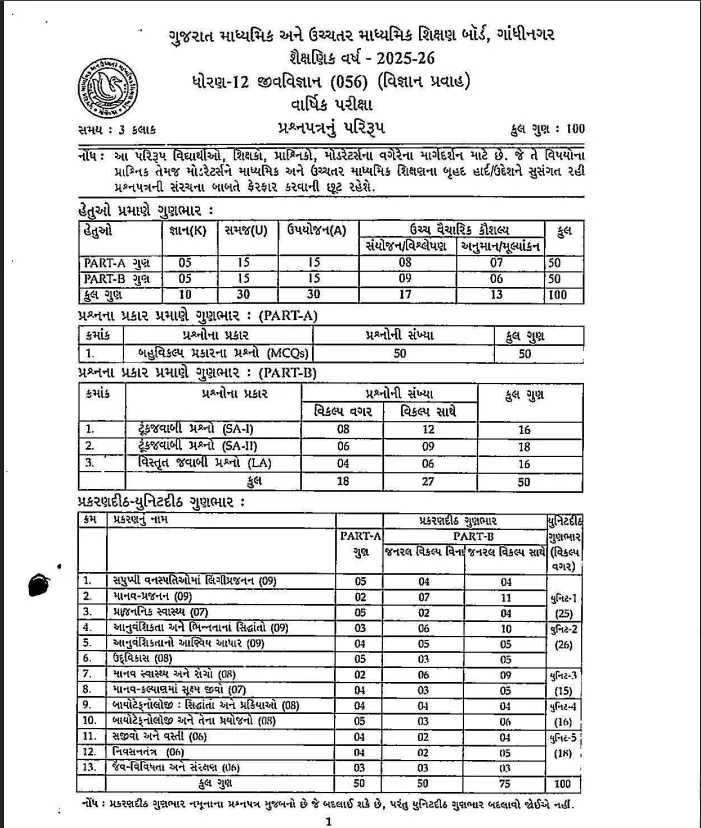
GSEB HSC Biology Exam Pattern 2027
The GSEB HSC Biology exam pattern helps students understand the structure of the Biology question paper and its marks distribution. Students should review the latest blueprint to identify the question types and the weightage assigned to different topics.
Screenshot placement for the editor: Insert the Biology paper-pattern table from the Science stream blueprint after verifying the relevant page.
GSEB HSC Exam Pattern 2027: Question Types
The types of questions in the GSEB HSC examination depend on the subject and its prescribed blueprint. Students should check the latest subject-wise document to identify the question formats used in their papers.
The blueprint may specify details such as:
-
Objective-type questions, where applicable.
-
Short-answer questions.
-
Descriptive or long-answer questions.
-
Marks assigned to individual questions or sections.
-
Subject-wise weightage, where provided.
Students should not assume that every subject follows the same division of objective and descriptive questions. The relevant blueprint should be used to confirm the exact structure.
GSEB HSC Exam Pattern 2027: Marking Scheme
The GSEB HSC marking scheme explains how marks are allocated to questions and sections in each subject. Students should review the latest blueprint to understand the marks assigned to different question types.
Before the examination, students should verify:
-
The maximum marks for each subject.
-
The marks assigned to individual questions.
-
The distribution of marks across sections.
-
Any subject-specific assessment instructions.
-
Whether any negative marking applies to the relevant paper.
The applicable marking scheme should be confirmed from the latest official subject-wise blueprint rather than assumed to be identical across all subjects.
Students should refer to the latest GSHSEB Class 12 notification for official updates and instructions relevant to the HSC examination.
How to Prepare According to the GSEB HSC Exam Pattern 2027 with PW
Students can use the exam pattern and subject-wise blueprints to organise their preparation more effectively.
-
Review the latest blueprint: Check the paper structure and marks distribution for each subject.
-
Prioritise important topics: Use the officially prescribed syllabus and any available subject-wise weightage.
-
Practise different question types: Solve objective, short-answer and descriptive questions wherever they apply.
-
Solve previous-year question papers: Practise available papers to become familiar with the examination format.
-
Take timed mock tests: Practise completing papers within the prescribed duration.
-
Revise regularly: Revisit difficult concepts and review mistakes made during practice.
-
Students should also check the Gujarat Board SSC and HSC Exam Dates 2027 to plan their revision schedule according to the announced examination dates.
FAQs on GSEB HSC Exam Pattern 2027
Where can I check the GSEB HSC Exam Pattern 2027?
Is the GSEB HSC exam pattern the same for Science and General streams?
What types of questions are included in the GSEB HSC examination?
How can I check the marks distribution for a GSEB HSC subject?
Does the GSEB HSC examination have negative marking?


Have questions about your prep?
Our experts can answer all your questions



 Live & recorded classes available at easeDashboard for progress trackingLakhs of practice questions

