






How to Tailor a Resume to a Job Description With PW Gyaan-E
Tailor your resume by studying the job description, identifying important skills and requirements, and highlighting relevant experience and achievements. Keep every claim accurate rather than simply copying keywords. With PW Gyaan-E, you can also build practical career skills for your job search.
 Gunika Shah8 Sept, 2026
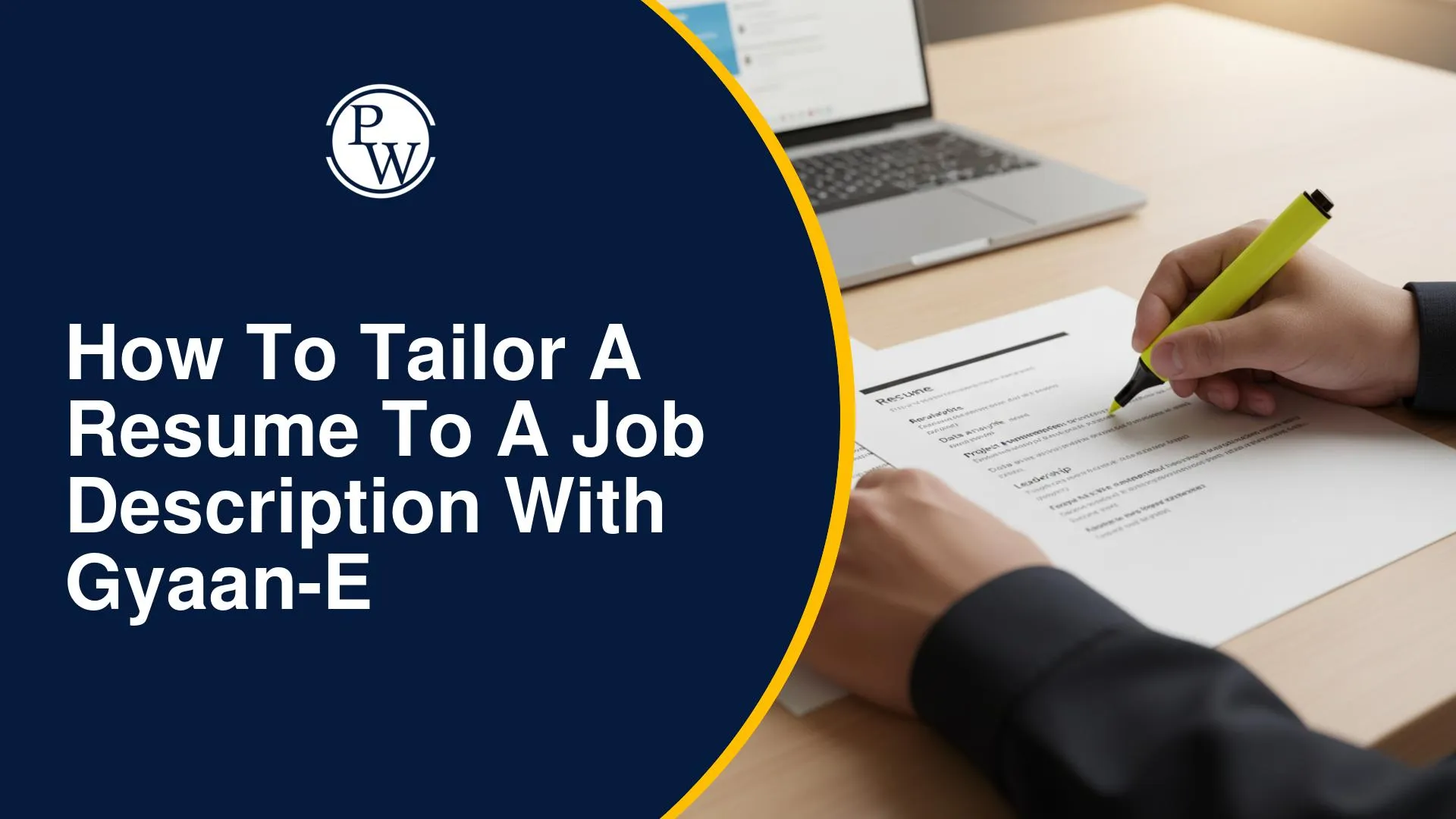
Sending the same resume for every job may be convenient, but different roles often prioritise different skills, responsibilities, and experience. Tailoring your resume means adjusting the relevant parts so that a recruiter can quickly see how your background connects with the position you are applying for.
You do not need to rewrite your entire resume for every application. Instead, compare it with the job description, identify the most relevant requirements, and bring matching skills and achievements into focus. PW Gyaan-E's career-focused learning can also help you work on practical job-search skills and prepare more confidently for opportunities.
What Does It Mean to Tailor a Resume?
Tailoring a resume means adapting it for a specific job opportunity rather than submitting exactly the same document everywhere.
Suppose one role focuses heavily on Excel, reporting, and data analysis, while another prioritises communication, client handling, and presentation skills. Even if you have experience in all these areas, the information you emphasise should depend on the role.
The goal is not to change your actual experience. It is to make the most relevant parts easier for the recruiter to notice.
Why Should You Tailor Your Resume to the Job Description?
A job description tells you what an employer is looking for. It may include required skills, preferred qualifications, responsibilities, tools, and experience.
Comparing these requirements with your resume can help you:
-
Prioritise experience that is directly relevant to the role.
-
Identify skills that deserve more visibility.
-
Remove or shorten details that add little value for that particular application.
-
Use terminology that accurately reflects both your experience and the role.
-
Present your qualifications in a way that is easier to review.
LinkedIn's Resume Tips feature similarly focuses on helping users tailor a resume for a particular job by providing insights and suggestions before they export the updated resume.
How to Tailor a Resume to a Job Description
You can follow a simple process each time you apply for a role.
1. Read the Complete Job Description
Do not apply based only on the job title. Read the responsibilities, qualifications, preferred experience, and skills carefully.
Look for details that appear particularly important, such as:
-
Required technical skills
-
Software or tools
-
Years or type of experience
-
Educational requirements
-
Communication or interpersonal skills
-
Major responsibilities
-
Industry-specific knowledge
This gives you a clearer picture of what should receive attention in your resume.
2. Identify Important Keywords
Job descriptions often use specific words to describe skills and responsibilities.
For example, a marketing role might mention:
Content strategy, SEO, Google Analytics, campaign management, reporting, and social media.
If you genuinely have these skills, use appropriate terminology when describing your experience.
However, do not add a skill simply because it appears in the job description. Your resume should remain an accurate representation of what you can do.
3. Update Your Resume Summary
If your resume includes a professional summary, adjust it to highlight experience relevant to the position.
For example, a generic summary such as:
“Marketing professional with experience across multiple digital channels.”
could become more specific for an SEO-focused role:
“Digital marketing professional with experience in SEO, content optimisation, keyword research, and performance reporting.”
The second version immediately brings the relevant experience into focus.
4. Prioritise Relevant Skills
Your skills section does not need to give every ability equal importance.
If a job asks for Excel, Power BI, reporting, and data analysis, and you have those skills, make them easy to find. Less relevant skills can appear later or be removed when they do not strengthen the application.
Think of the skills section as a quick snapshot of why your background matches the role.
5. Rewrite Experience Around Relevant Work
You do not need to change your job history. Instead, review the bullet points under each position and decide which responsibilities and achievements are most useful for the application.
For example:
Generic:
“Worked on different marketing activities for the company.”
More specific:
“Created SEO-focused content and reviewed keyword performance to support organic search campaigns.”
The second statement tells the recruiter more about what you actually did and connects more clearly with an SEO-related role.
6. Focus on Achievements Where Possible
Responsibilities explain what you were expected to do. Achievements show what happened because of your work.
Instead of writing:
“Prepared weekly sales reports.”
you could write:
“Prepared weekly sales reports covering regional performance and key sales trends.”
If you have an accurate number or measurable result, you can make the point even stronger. Do not invent percentages, revenue figures, or other metrics simply to make a bullet sound impressive.
7. Check Whether Your Resume Matches the Role
Once you have edited the resume, compare it with the job description again.
Ask yourself:
-
Have I included my relevant skills?
-
Are the most useful experiences easy to find?
-
Have I used appropriate terminology from the role?
-
Is any important qualification missing from my resume?
-
Have I included anything that I cannot confidently explain in an interview?
This final comparison can catch gaps before you submit the application.
8. Proofread Before Applying
Tailoring several resumes can sometimes introduce small errors. You might accidentally leave the wrong job title, company reference, or outdated sentence in a version.
Before submitting, check:
-
Spelling and grammar
-
Dates and job titles
-
Contact details
-
Formatting consistency
-
Skills and qualifications
-
File name
Also confirm that you are uploading the correct version for that particular application.
What Should You Avoid When Tailoring a Resume?
Tailoring should make your relevant experience clearer, not make your resume inaccurate.
Avoid:
-
Copying the complete job description into your resume.
-
Adding skills you do not actually have.
-
Stuffing keywords unnaturally into every section.
-
Inventing achievements or numbers.
-
Changing your job title to something inaccurate.
-
Removing important context just to make your experience appear like a perfect match.
-
Making the resume so long that the most relevant information becomes difficult to find.
A tailored resume should still sound like your experience, not a rewritten version of the vacancy.
Can AI Help You Tailor Your Resume?
AI can be useful as an editing assistant when you provide your resume and the job description. For example, you can ask it to identify overlapping skills, point out relevant experience that deserves more attention, or suggest clearer wording for a bullet point.
However, review every suggestion before adding it. AI should not introduce skills, responsibilities, achievements, or numbers that are not supported by your actual experience.
Your final resume should be something you can confidently explain during an interview.
How Can PW Gyaan-E Help You Strengthen Your Job Preparation?
A tailored resume is one part of your job search. You may also need to work on how you present your skills, prepare for interviews, communicate professionally, and approach different stages of the hiring process.
With PW Gyaan-E's Resume: Get Shortlisted Faster Course, you can develop practical career knowledge that can support your preparation.
-
Improve your resume approach: Understand how to present relevant skills and experience more effectively.
-
Prepare for job opportunities: Build practical knowledge that can support different stages of your job search.
-
Present yourself professionally: Work on the career skills needed to communicate your strengths more clearly.
-
Apply with greater clarity: Understand what employers are asking for and prepare your application accordingly.
Rather than treating your resume as a document you create once, you can learn how to adapt it as your skills, experience, and career goals develop.
Tailoring your resume to a job description can help you highlight the skills and experience most relevant to the role. Focus on accurate keywords, relevant achievements, and clear examples while avoiding exaggerated or unsupported claims. Along with resume preparation, PW Gyaan-E’s Resume: Get Shortlisted Faster Course can help you build practical job-search skills and present your profile more effectively.
Tailoring a Resume to a Job Description FAQ
1. Should I tailor my resume for every job?
2. Should I use keywords from the job description in my resume?
3. Do I need to rewrite my entire resume for each job?
4. Can I use AI to tailor my resume?

Get Free Counselling Today
and Clear up all your Doubts
 Live & recorded classes available at easeDashboard for progress trackingLakhs of practice questions

