








Chemistry Hydrocarbons JEE Syllabus
 Avisha Das15 Jun, 2026
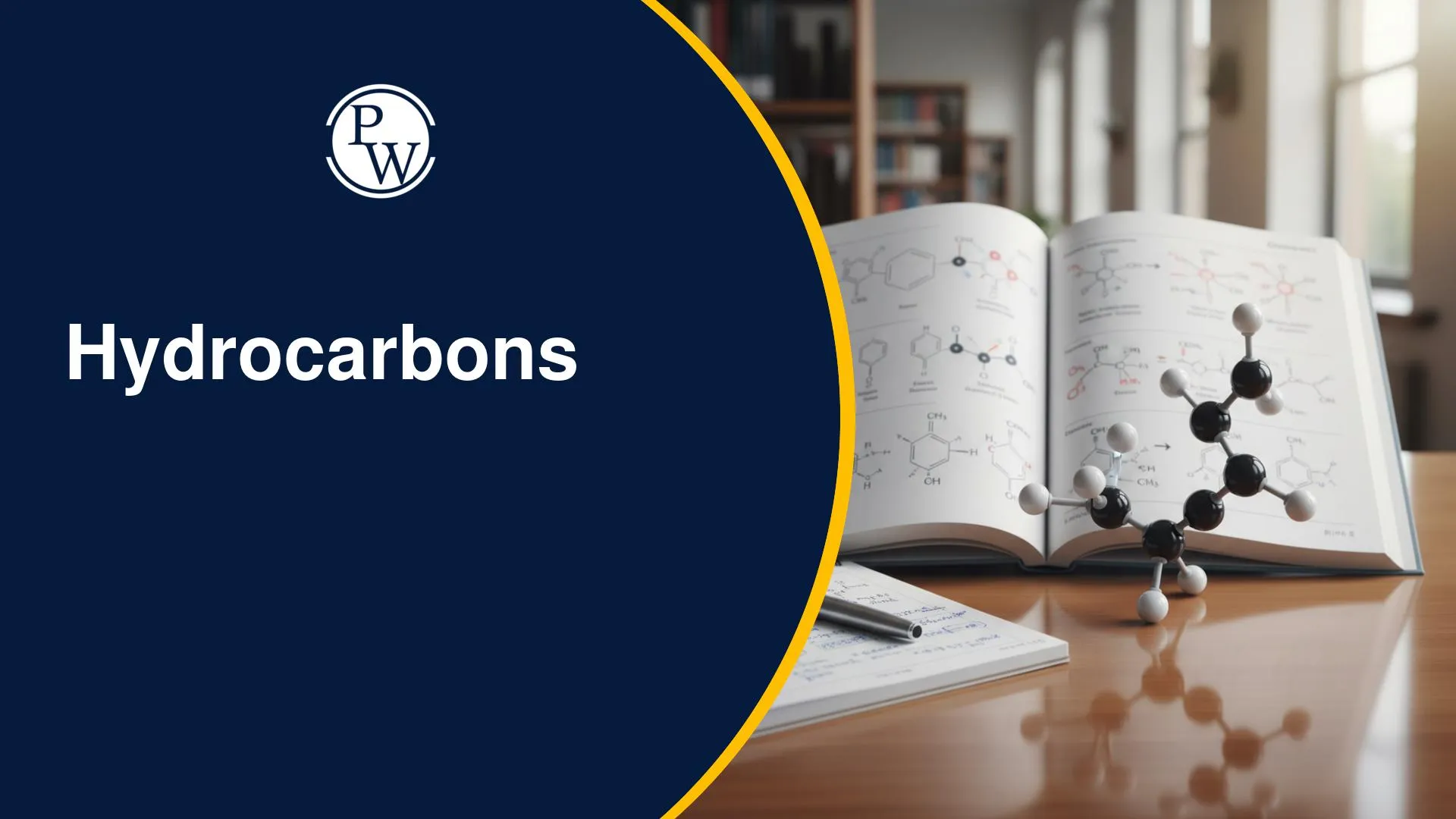
If organic chemistry is a language, Hydrocarbons are its alphabet. Every complex structure you see later in organic chemistry is built from the same carbon–hydrogen framework introduced here. What makes this chapter interesting is that even small changes in bonding completely change how a molecule behaves.
Single, double, and triple bonds are not just structural differences; they change geometry, electron density, hybridisation, and stability together. This is why Hydrocarbons are often used in JEE to test whether a student understands why a reaction happens instead of only remembering it.
Classification of Hydrocarbons
Hydrocarbons are organic compounds made only of carbon and hydrogen atoms. They are classified based on the type of bonding between carbon atoms, which directly controls their chemical behaviour.
Main types:
-
Alkanes: Saturated Hydrocarbons containing only single covalent bonds between carbon atoms.
-
Alkenes: Unsaturated Hydrocarbons containing at least one carbon–carbon double bond.
-
Alkynes: Unsaturated Hydrocarbons containing at least one carbon–carbon triple bond.
-
Aromatic hydrocarbons: Cyclic compounds with delocalised pi electron systems showing extra stability.
Structural classification includes:
-
Open chain hydrocarbons: Straight or branched carbon chains
-
Cyclic hydrocarbons: Carbon atoms arranged in a ring structure
-
Saturated hydrocarbons: Contain only single bonds
-
Unsaturated hydrocarbons: Contain double or triple bonds
General formula patterns:
-
Alkanes: CₙH₂ₙ₊₂
-
Alkenes: CₙH₂ₙ
-
Alkynes: CₙH₂ₙ₋₂
These formulas help determine the level of unsaturation in a molecule.
Alkanes: Structure and Reactions
Alkanes are saturated Hydrocarbons in which each carbon atom forms four single bonds. They are relatively less reactive because all bonds are strong sigma bonds with no weak pi bonds.
Key structural points:
-
Hybridisation: sp³, meaning one s and three p orbitals combine to form four equivalent bonds
-
Geometry: Tetrahedral arrangement of atoms around carbon
-
Bond angle: 109.5°, which minimises repulsion between electron pairs
Halogenation of Alkanes
Halogenation is a substitution reaction in which a hydrogen atom in an alkane is replaced by a halogen atom in the presence of UV light or heat.
General reaction:
CH₄ + Cl₂ → CH₃Cl + HCl (hv)
Free radical mechanism: A reaction mechanism involving highly reactive species called free radicals, which contain unpaired electrons.
Steps:
-
Initiation: Formation of free radicals by breaking the Cl₂ bond
-
Propagation: Chain reaction continues with radical formation and product formation
-
Termination: Two radicals combine to form a stable molecule
Reactivity trend of halogens:
F₂ > Cl₂ > Br₂ > I₂
More reactive halogens form radicals more easily but are less selective.
Alkenes: Structure, Stability, and Reactions
Alkenes are unsaturated Hydrocarbons containing a carbon–carbon double bond made of one sigma and one pi bond. The pi bond is weaker and more exposed, making alkenes more reactive.
Key structure:
-
Hybridisation: sp², meaning one s and two p orbitals form three sigma bonds
-
Geometry: Trigonal planar arrangement
-
Bond angle: 120°, due to planar structure
Stability of Alkenes
Alkene stability depends on the number of alkyl groups attached to the double bond.
More substituted alkenes are more stable because of hyperconjugation and inductive effects.
Stability order:
tetrasubstituted > trisubstituted > disubstituted > monosubstituted
Heat of Hydrogenation
Heat of hydrogenation is the energy released when one mole of an unsaturated compound is completely hydrogenated.
Approx reference:
Ethene hydrogenation ≈ 120 kJ/mol
More stable alkenes release less heat during hydrogenation.
Addition Reactions
Addition reactions are reactions in which atoms add across a multiple bond by breaking the pi bond and forming new sigma bonds.
Important reactions:
-
Hydrogenation: Addition of hydrogen in the presence of Ni/Pt catalyst
-
Halogenation: Addition of halogens, often seen by decolourisation of bromine water
-
Hydrohalogenation: Addition of HX across a double bond
Markovnikov rule:
In addition to HX, hydrogen attaches to the carbon already having more hydrogen atoms.
Exception:
HBr in the presence of peroxide follows the anti-Markovnikov rule due to a free radical mechanism.
Alkynes: Structure and Reactivity
Alkynes are unsaturated Hydrocarbons containing a carbon–carbon triple bond made of one sigma and two pi bonds. They are linear in shape and highly reactive in addition reactions.
Key structure:
-
Hybridisation: sp, formed by mixing one s and one p orbital
-
Geometry: Linear arrangement
-
Bond angle: 180°
Acidity of Alkynes
Acidity refers to the ability to donate a proton (H⁺). Terminal alkynes are weakly acidic due to the high s-character in sp hybridisation.
Acidity trend:
alkyne > alkene > alkane
Example reaction:
2RC≡CH + 2Na → 2RC≡C⁻Na⁺ + H₂↑
Aromatic Hydrocarbons
Aromatic Hydrocarbons are special cyclic compounds that show extra stability due to delocalisation of pi electrons over the ring.
Key features:
-
Benzene formula: C₆H₆
-
Planar hexagonal structure with equal bond lengths
-
Resonance stabilisation: spreading of electrons over the entire ring increases stability
Aromaticity condition:
4n + 2 π electrons (Hückel rule)
For benzene:
n = 1 → 6 π electrons
The resonance energy of benzene ≈ is 150 kJ/mol, which explains its unusual stability.
Electrophilic Substitution Reactions
An electrophilic substitution reaction is one in which an electrophile replaces a hydrogen atom in an aromatic ring.
Important reactions:
-
Nitration (formation of nitrobenzene using HNO₃/H₂SO₄)
-
Halogenation (requires FeCl₃ or FeBr₃ as catalyst)
-
Sulfonation
-
Friedel–Crafts reactions using AlCl₃
Directing effects:
-
Electron-donating groups activate the ring and direct substitution to the ortho and para positions
-
Electron-withdrawing groups deactivate the ring and direct substitution to the meta position
Isomerism in Hydrocarbons
Isomerism is the phenomenon in which compounds have the same molecular formula but different structural arrangements.
Types:
-
Chain isomerism: Difference in carbon skeleton arrangement
-
Position isomerism: Difference in the position of a functional group or multiple bond
-
Geometrical isomerism: Restricted rotation around the double bond leads to cis-trans forms
Condition for geometrical isomerism:
Each carbon of a double bond must have two different substituents.
Reaction and Mechanism Understanding
Organic reactions in Hydrocarbons are best understood through stepwise mechanisms rather than memorisation.
Main types:
-
Free radical substitution in alkanes
-
Electrophilic addition in alkenes and alkynes
-
Electrophilic substitution in aromatic compounds
Carbocation stability order:
3° > 2° > 1° > CH₃⁺
Stability and Energy Considerations
Stability in Hydrocarbons is often explained using energy changes during reactions.
Important concepts:
-
Heat of hydrogenation helps compare alkene stability
-
More substituted alkenes are thermodynamically more stable
-
Benzene shows resonance stabilisation energy (~150 kJ/mol)
-
Hyperconjugation stabilises carbocations and alkenes by electron donation
Hydrocarbons connect structure, bonding, and reactivity into a single framework that explains how organic molecules behave. Understanding definitions, stability trends, and reaction mechanisms makes later organic chapters easier and builds the core thinking required for JEE chemistry.
Hydrocarbons JEE Syllabus FAQs
Why are Hydrocarbons important for JEE?
Which topics are most important in Hydrocarbons?
How should I prepare Hydrocarbons for JEE?


Have questions about your prep?
Our experts can answer all your questions


 Live & recorded classes available at easeDashboard for progress trackingLakhs of practice questions

