JEE Main Chemistry Syllabus PDF with Chapter-wise Weightage 2026

JEE Main Chemistry Syllabus with Chapter-wise Weightage 2026: The JEE Main Chemistry Syllabus 2026 provides a balanced mix of Physical, Organic, and Inorganic Chemistry, helping aspirants build strong conceptual understanding and analytical skills. The syllabus ensures coverage of essential themes such as atomic structure, bonding, thermodynamics, reaction mechanisms, and periodic properties. As Chemistry often contributes significantly to improving overall percentile, knowing topic-wise weightage helps students plan smarter, focus on scoring chapters, and revise efficiently. However, the official syllabus for JEE Main 2026 has not yet been released on the NTA website. Students can refer to the previous year’s syllabus provided here to begin effective preparation.
Also Read: JEE Main Chapter-wise Weightage 2026 for Physics, Chemistry, Maths
Physical Chemistry Syllabus for JEE Main 2026
Physical Chemistry forms the foundation of numerical and conceptual problem-solving in JEE Main. Students must focus on formulas, graphs, theory, and application-based questions, as this section contributes significantly to the exam. Concepts from basic atomic structure to kinetics and electrochemistry frequently appear in both January and April sessions.
JEE Main Syllabus of Physical Chemistry
Some Basic Concepts in Chemistry
Matter and its nature; Dalton’s atomic theory; Concept of atom, molecule, element, compound; Laws of chemical combination; Atomic & molecular masses; Mole concept, molar mass; Percentage composition; Empirical & molecular formulae; Chemical equations & stoichiometry
Atomic Structure
Nature of electromagnetic radiation; Photoelectric effect; Hydrogen atom spectrum; Bohr model: postulates, energy & radius relations, limitations; Dual nature of matter, de Broglie relationship; Heisenberg uncertainty principle; Quantum mechanical model of atom; Atomic orbitals (1s, 2s); Quantum numbers (principal, angular, magnetic, spin); Shapes of s, p, d orbitals; Electron filling rules: Aufbau, Pauli, Hund; Electronic configuration and stability of half/full-filled orbitals
Chemical Bonding and Molecular Structure
Kossel-Lewis approach: ionic & covalent bonds; Ionic bonding: formation, factors, lattice enthalpy; Covalent bonding: electronegativity, Fajan’s rule, dipole moment; VSEPR theory & molecular shapes; Valence Bond Theory: hybridization, resonance; Molecular Orbital Theory: LCAO, bonding & antibonding orbitals, sigma & pi bonds, bond order, bond length, bond energy; Metallic bonding & hydrogen bonding
Chemical Thermodynamics
Fundamentals: system, surroundings, extensive & intensive properties, state functions, entropy; First law of thermodynamics: work, heat, internal energy, enthalpy, heat capacity; Hess’s law & enthalpies: bond dissociation, combustion, formation, atomization, sublimation, phase transition, hydration, ionization, solution; Second law: spontaneity, ΔS, ΔG, ΔG°, equilibrium constant
Solutions
Concentration terms: molality, molarity, mole fraction, percentage (by volume & mass); Vapour pressure, Raoult’s Law (ideal & non-ideal); Colligative properties: relative lowering of vapour pressure, depression of freezing point, elevation of boiling point, osmotic pressure; Determination of molecular mass using colligative properties; Van’t Hoff factor and its significance
Equilibrium
Concept of dynamic equilibrium; Physical equilibria: solid-liquid, liquid-gas, gas-gas, solid-gas; Henry's Law; Chemical equilibrium: law of chemical equilibrium, equilibrium constants (Kp, Kc), ΔG & ΔG°, factors affecting equilibrium, Le Chatelier’s principle; Ionic equilibrium: weak & strong electrolytes, acid-base concepts (Arrhenius, Bronsted-Lowry, Lewis), ionization constants, pH scale, common ion effect, hydrolysis of salts, solubility products, buffer solutions
Redox Reactions and Electrochemistry
Concepts of oxidation & reduction, redox reactions, oxidation number, rules for assigning oxidation number, balancing redox reactions; Electrolytic & metallic conduction, conductance in solutions, molar conductivity, Kohlrausch’s law; Electrochemical cells: electrolytic & Galvanic cells, electrodes, electrode potential, emf, Nernst equation, relation of cell potential & Gibbs energy; Dry cells, lead accumulator, fuel cells
Chemical Kinetics
Rate of chemical reaction, factors affecting rate (concentration, temperature, pressure, catalyst); Elementary & complex reactions, order & molecularity; Rate law & rate constant; Differential & integral forms of zero & first-order reactions, half-life; Effect of temperature, Arrhenius theory, activation energy, collision theory (bimolecular gaseous reactions)
Inorganic Chemistry Syllabus for JEE Main 2026
Classification of Elements & Periodicity in Properties
Modern periodic law, periodic table, s, p, d, f block elements, periodic trends: atomic & ionic radii, ionization enthalpy, electron gain enthalpy, valence, oxidation states, chemical reactivity
p-Block Elements
Groups 13–18: electronic configuration, trends in physical & chemical properties, unique behaviour of first element in each group
d- & f-Block Elements
Transition Elements: general introduction, electronic configuration, occurrence, properties (physical, ionization enthalpy, oxidation states, colour, magnetism, catalytic behaviour, complex formation, interstitial compounds, alloys), preparation, properties & uses of K₂Cr₂O₇ and KMnO₄; Inner Transition Elements: Lanthanoids (electronic configuration, oxidation states, lanthanoid contraction), Actinoids (electronic configuration, oxidation states)
Coordination Compounds
Introduction: Werner’s theory, ligands, coordination number, denticity, chelation, IUPAC nomenclature, isomerism; Bonding: Valence bond theory, basic Crystal Field Theory, colour & magnetic properties, importance in qualitative analysis, metal extraction, biological systems
Organic Chemistry
Purification & Characterisation of Organic Compounds
Crystallization, sublimation, distillation, differential extraction, chromatography; Detection of N, S, P, halogens; Quantitative analysis (C, H, N, halogens, S, P); Calculation of empirical & molecular formulae
Some Basic Principles of Organic Chemistry
Tetravalency of carbon, hybridization, functional group classification, homologous series, isomerism (structural & stereoisomerism), nomenclature (trivial & IUPAC); Covalent bond fission, free radicals, carbocations, carbanions, electrophiles & nucleophiles; Electronic displacement: inductive, electromeric, resonance, hyperconjugation; Common reactions: substitution, addition, elimination, rearrangement
Hydrocarbons
Alkanes: conformations, halogenation; Alkenes: geometrical isomerism, electrophilic addition, polymerization; Alkynes: acidic character, addition & polymerization; Aromatics: benzene structure, aromaticity, electrophilic substitution, Friedel-Crafts alkylation & acylation, directive influence
Organic Compounds Containing Halogens
Preparation, properties, reactions, C–X bond nature, substitution mechanisms; Uses & environmental effects (chloroform, iodoform, freons, DDT
Organic Compounds Containing Oxygen
Alcohols: identification, dehydration mechanism; Phenols: acidic nature, electrophilic substitution, Reimer-Tiemann reaction; Ethers: structure; Aldehydes & Ketones: nucleophilic addition, reactivity, reactions (Grignard, oxidation, reduction, Cannizzaro, Aldol, Haloform), chemical tests; Carboxylic acids: acidic strength & factors
Organic Compounds Containing Nitrogen
Amines: nomenclature, classification, identification, basic character; Diazonium salts: importance in synthetic organic chemistry
Biomolecules
Carbohydrates: classification, monosaccharides (glucose, fructose), oligosaccharides (sucrose, lactose, maltose); Proteins: amino acids, peptide bonds, polypeptides, protein structure (primary–quaternary), denaturation, enzymes; Vitamins: classification & functions; Nucleic acids: DNA & RNA constitution, functions; Hormones: general introduction
Principles Related to Practical Chemistry
Detection of extra elements (N, S, halogens) & functional groups (hydroxyl, carbonyl, carboxyl, amino); Preparation of inorganic compounds (Mohr’s salt, potash alum) & organic compounds (Acetanilide, p-nitroacetanilide, aniline yellow, iodoform); Titrimetric exercises: acids, bases, oxalic acid vs KMnO₄, Mohr’s salt vs KMnO₄; Qualitative salt analysis: cations (Pb²⁺, Cu²⁺, Al³⁺, Fe³⁺, Zn²⁺, Ni²⁺, Ca²⁺, Ba²⁺, Mg²⁺, NH₄⁺), anions (CO₃²⁻, S²⁻, SO₄²⁻, NO₃⁻, NO₂⁻, Cl⁻, Br⁻, I⁻); Experiments: enthalpy of CuSO₄ solution, enthalpy of neutralization, lyophilic/lyophobic sols, kinetic study of iodide & hydrogen peroxide reaction
JEE Main Chemistry Syllabus Official PDF
The JEE Main Chemistry Syllabus 2026 offers a well-structured blend of Physical, Organic, and Inorganic Chemistry, ensuring students develop strong conceptual clarity and problem-solving ability. Since the official 2026 syllabus is yet to be released, candidates can rely on the previous year’s syllabus given here to start their preparation effectively.
JEE Main Chemistry Syllabus Official PDF: Click Here
Chapter-wise Weightage in Chemistry for JEE Main 2026
The table below presents the estimated number of questions and chapter-wise weightage for the Chemistry section in JEE Main. This analysis is derived from previous years’ papers and helps aspirants identify high-priority topics for smarter and more effective preparation.
|
Chapter |
Total Questions |
Weightage |
|
Carboxylic Acids & Their Derivatives |
1 |
3.3% |
|
Transition Elements & Coordination Compounds |
3 |
9.9% |
|
Stereochemistry |
1 |
3.3% |
|
Solid-State & Surface Chemistry |
2 |
6.6% |
|
Chemical Bonding |
2 |
6.6% |
|
Aromatic Compounds |
1 |
3.3% |
|
Mole Concept |
1 |
3.3% |
|
Redox Reactions |
1 |
3.3% |
|
Nuclear & Environmental Chemistry |
2 |
6.6% |
|
Periodic Table |
3 |
9.9% |
|
Electrochemistry |
1 |
3.3% |
|
Chemical Kinetics |
1 |
3.3% |
|
Hydrocarbon |
1 |
3.3% |
|
Chemical & Ionic Equilibrium |
2 |
6.6% |
|
Atomic Structure |
2 |
6.6% |
|
General Organic Chemistry |
1 |
3.3% |
|
Thermodynamics & Gaseous State |
2 |
6.6% |
|
Solution & Colligative Properties |
1 |
3.3% |
|
Alkyl Halides |
1 |
3.3% |
|
Carbohydrates, Amino Acids & Polymers |
1 |
3.3% |
Chapter-wise Weightage in Chemistry for JEE Main 2026 via graph
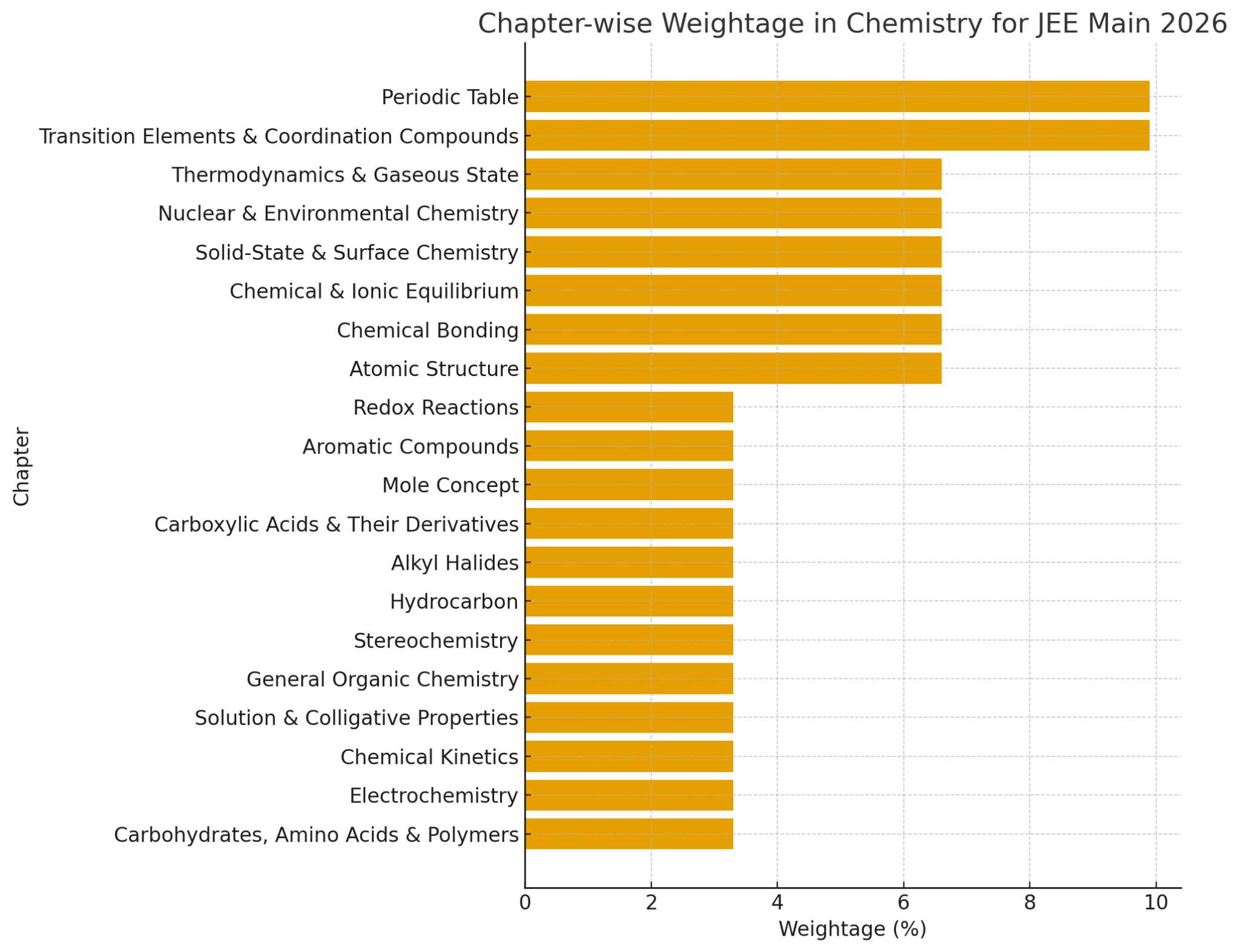
Here’s the chart showing chapter-wise weightage in Chemistry for JEE Main 2026.
You can see that:
-
Periodic Table and Transition Elements & Coordination Compounds have the highest weightage at 9.9% each.
-
Topics like Thermodynamics, Nuclear Chemistry, Chemical Bonding, and Equilibrium follow closely at 6.6% each.
-
Most other chapters carry around 3.3% weightage.
JEE Main Physics Syllabus with Chapter-wise Weightage 2026 FAQs
How should beginners start preparing for JEE Main Physics?
Why is chapter-wise weightage important?
Which chapters had the highest weightage in 2025?
Does the weightage change every year?


Have questions about your prep?
Our experts can answer all your questions