







LED Full Form, Light Emitting Diode, LED IN JEE Main Physics Syllabus 2024
LED Full Form : LED stands for Light Emitting Diode. A Light Emitting Diode is a semiconductor light source that offers many benefits. It is a PN Junction diode where the N region is negatively doped, and the P region is positively doped.
 Shrivastav9 Dec, 2023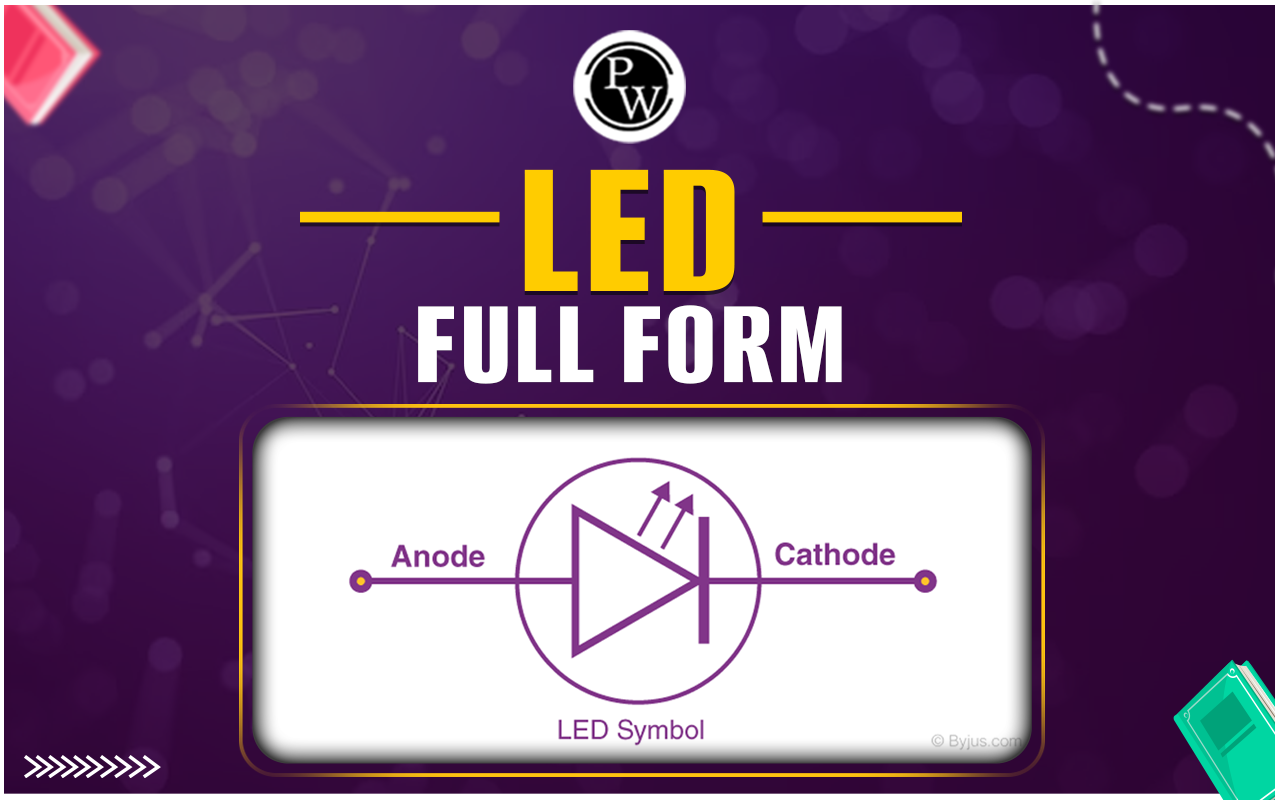
LED Full Form : The LED Full Form is Light Emitting Diode, an important concept in JEE Main Physics Syllabus 2024 . It is a small light bulb that glows when electricity passes through it. The LED devices are energy efficient, durable, and versatile in nature. These light bulbs produce a lesser amount of carbon, which makes them a conventional source of energy.
LEDs can help reduce global warming and the greenhouse effect as they can replace other carbon-emitting lights. The LED is generally used for testing in remotes, watches, radios, etc.What is a Light Emitting Diode (LED)?
What is a Light Emitting Diode (LED)? : A light-emitting diode is a semiconductor device that glows when electricity is passed through it. LED works by releasing energy in the form of photons, which work on the basis of the electron-hole concept, where electrons combine with electron-hole to produce energy in the form of photons. The LEDs are used for various purposes in remotes, street lights, indicator lights, TVs, etc. LEDs are now a part of our daily lives. It is being used everywhere. There are many benefits to using LED lights.Benefits of Using LED Lights
A Light Emitting Diode is a semiconductor light source that offers many benefits. Check out some of the best benefits of using LED lights.- It is a semiconductor device that glows when electricity is passed through it to produce light.
- LEDs support sustainability as they do not contain mercury, which is a hazardous material. It helps reduce bad carbon emissions, which contribute to greenhouse and global warming effects.
- It is an energy-efficient light source. It consumes less electricity as compared to the traditional lights used before.
- LED lights last long and also have low maintenance.
- The LED lights can be dimmed, which provides flexibility in controlling light levels.
- It is environmentally friendly.
- There is a wide range of colour options available in LED Lights.
- The LED bulbs are recyclable and easy to maintain.
Working of LED
LED is a semiconductor material that is based on a phenomenon called electroluminescence. When light of sufficient frequency falls on the semiconductor material, it emits an electron, which then combines with the holes. It works on the P-N junction. The N region is a negatively doped region (electron-rich) and the P-type is a positively doped (electron-deficient) region. Electrons and holes combine at the PN junction, which releases photon light particles.- The LED is a semiconductor that works on a phenomenon called electroluminescence.
- It is a PN Junction diode where the N region is negatively doped, and the P region is positively doped.
- The electron-hole pair formation occurs at the P-N junction when a voltage of sufficient energy passes. When connected to a power source, the electrons from the N side move to the P-type region. Also, the holes from the P-type region move toward the N-type region. The electrons and holes combine to form a P-N junction.
- When an electron combines with the hole, it loses energy in the form of energy packets called Photons.
Difference Between LEDs and CFLs
Difference Between LEDs and CFLs : The CFL stands for Compact Fluorescent Light bulbs. When current passes through the tube, light is produced by the reactions between gases. The UV light produced is absorbed by the fluorescent material to produce glow. The mercury used in the CFLs is harmful. Also, the lifespan of CFLs is low as compared to LEDs. The average life span of a CFL bulb is 8000 hours, and the average life span of an LED bulb is 50,000 hours. LEDs are also better than incandescent bulbs, as they heat the filament to produce the glow, which consumes a lot of energy. Also, the average lifespan of an incandescent bulb is very low, at only 1,200 hours. It is the oldest form of bulb.LED Full Form : FAQs
Q1. What is the full form of LED?
Ans: The LED stands for Light Emitting Diode.
Q2. What is a light-emitting diode?
Ans: A light-emitting diode is a semiconductor device that glows when electricity is passed through it. LED works by releasing energy in the form of photons, which work on the basis of the electron-hole concept, where electrons combine with electron-hole to produce energy in the form of photons.
Q3. What are the uses of LED lights?
Ans: LED lights are used in many technologies such as signals, remotes, TVs, displays, etc.
Q4. What are the main advantages of using LED lights?
Ans: The LED lights are energy efficient, environment friendly, and have a long lifespan.




🔥 Trending Blogs


Check out these Related Articles







Join 15 Million students on the app today!
 Live & recorded classes available at easeDashboard for progress trackingMillions of practice questions at your fingertips


Free Learning Resources
PW Books
Notes (Class 10-12)
PW Study Materials
Notes (Class 6-9)
Ncert Solutions
Govt Exams
Our Other Websites
Class 6th to 12th Online Courses
Govt Job Exams Courses
UPSC Coaching
Defence Exam Coaching
Gate Exam Coaching
Other Exams
Know about Physics Wallah
Physics Wallah is an Indian edtech platform that provides accessible & comprehensive learning experiences to students from Class 6th to postgraduate level. We also provide extensive NCERT solutions, sample paper, NEET, JEE Mains, BITSAT previous year papers & more such resources to students. Physics Wallah also caters to over 3.5 million registered students and over 78 lakh+ Youtube subscribers with 4.8 rating on its app.
We Stand Out because
We provide students with intensive courses with India’s qualified & experienced faculties & mentors. PW strives to make the learning experience comprehensive and accessible for students of all sections of society. We believe in empowering every single student who couldn't dream of a good career in engineering and medical field earlier.
Our Key Focus Areas
Physics Wallah's main focus is to make the learning experience as economical as possible for all students. With our affordable courses like Lakshya, Udaan and Arjuna and many others, we have been able to provide a platform for lakhs of aspirants. From providing Chemistry, Maths, Physics formula to giving e-books of eminent authors like RD Sharma, RS Aggarwal and Lakhmir Singh, PW focuses on every single student's need for preparation.
What Makes Us Different
Physics Wallah strives to develop a comprehensive pedagogical structure for students, where they get a state-of-the-art learning experience with study material and resources. Apart from catering students preparing for JEE Mains and NEET, PW also provides study material for each state board like Uttar Pradesh, Bihar, and others
Copyright © 2026 Physicswallah Limited All rights reserved.