








Mathematics Applications of Derivatives JEE Mind Maps by Physics Wallah
 Avisha Das22 Jun, 2026
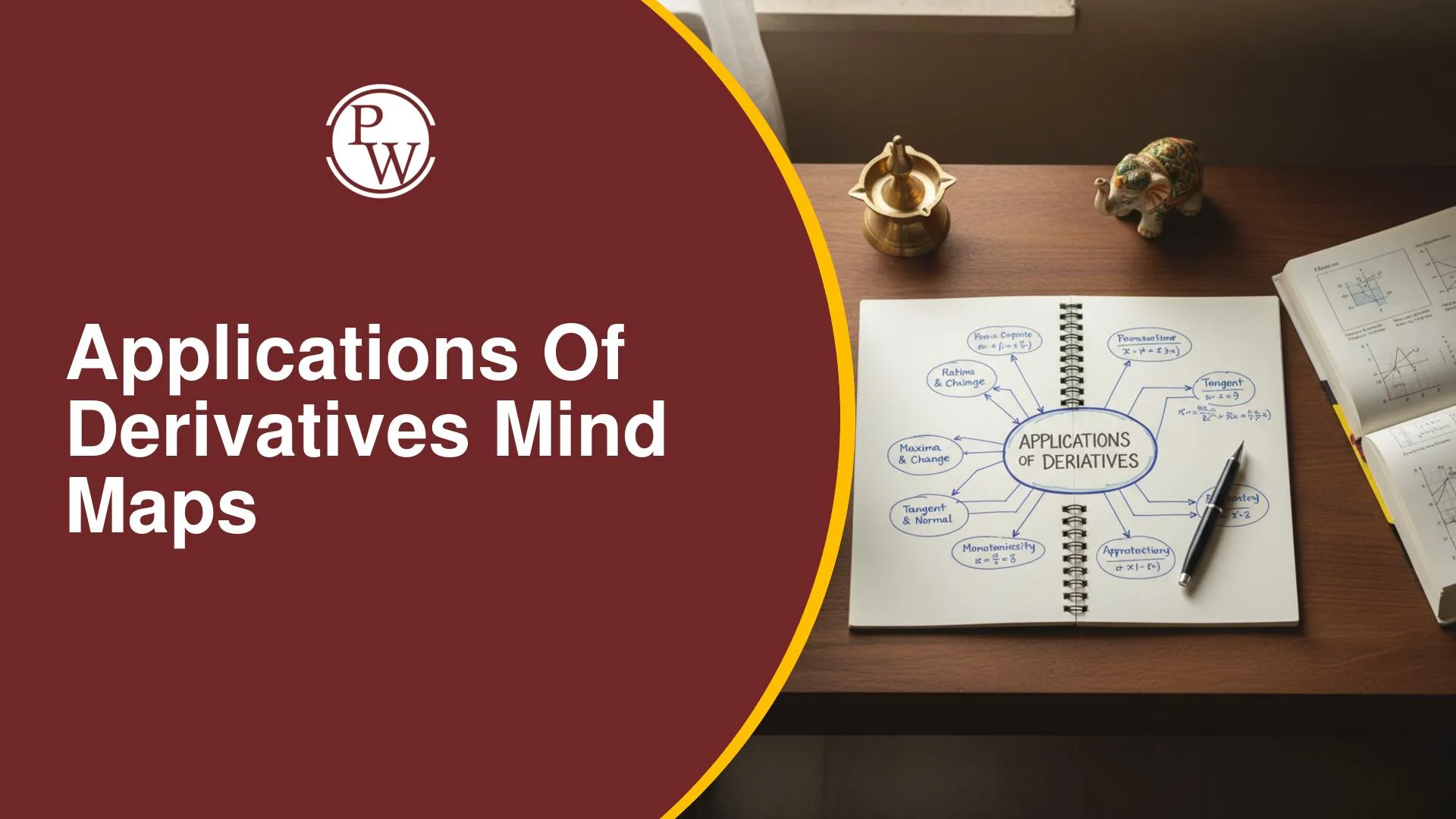
Many mathematical questions are not about finding the derivative itself but about understanding what that derivative reveals about a function. Applications of Derivatives use this idea to study how curves behave, where they reach extreme values, and how mathematical models can be analysed using rates of change.
The chapter combines algebraic techniques with graphical interpretation, making it an important part of JEE Mathematics. Since different concepts are often tested together, regular revision becomes essential. Physics Wallah provides Applications of Derivatives JEE mind maps that help you review important methods, graphical ideas, and standard applications through a visual learning resource.
Applications of Derivatives JEE Mind Maps PDF
Applications of Derivatives combines several concepts that are often used together while solving questions. Revising them in a connected format helps improve understanding and reduces confusion during examinations.
Download the Applications of Derivatives JEE mind maps PDF below and use it to strengthen your preparation during regular study and final revision.
Applications of Derivatives JEE Mind Maps PDF
Why Use PW Applications of Derivatives JEE Mind Maps?
The chapter focuses on applying mathematical concepts rather than simply using formulas. A visual revision tool helps you understand different applications and their relationships.
1. Makes Graph Interpretation Easier
Mind Maps help you revise the behaviour of functions and understand how derivatives are used to study curves.
2. Improves Optimisation Skills
Maximum and minimum value problems involve several steps. A visual overview helps you remember the standard approach for solving them.
3. Helps You Connect Different Concepts
Tangents, normals, rate of change, and monotonicity are closely related ideas that become easier to revise together.
4. Supports Better Analytical Thinking
The chapter develops logical problem-solving abilities, and regular visual revision helps strengthen this skill.
5. Useful Before Practice Sessions
A quick review of important concepts allows you to approach application-based JEE questions with greater confidence.
Applications of Derivatives Mind Maps FAQs
Why are maxima and minima important in Applications of Derivatives?
What should I focus on while revising tangents and normals?
How can these mind maps help in JEE preparation?





Have questions about your prep?
Our experts can answer all your questions
 Live & recorded classes available at easeDashboard for progress trackingLakhs of practice questions

