







Physics Optics JEE Syllabus
 Aarti .11 Jun, 2026
Optics helps explain many everyday observations, from seeing objects clearly through spectacles to observing distant planets with telescopes. It focuses on the behaviour of light and the various ways in which it interacts with different materials. Some concepts deal with light travelling in straight lines and forming images, while others explain light as a wave capable of producing fascinating effects such as interference and diffraction.
Since Optics includes both conceptual and numerical questions, a balanced understanding of formulas, image formation, and wave behaviour is useful for JEE preparation.
Light, Refraction and Refractive Index
One of the first ideas you study is how light changes direction when it moves from one medium to another. This phenomenon is known as refraction and is responsible for many common observations, such as the apparent bending of a pencil placed in water.
The behaviour of light inside a medium depends on its refractive index: n = c/v
where c represents the speed of light in vacuum and v represents its speed in the medium. Understanding refractive index helps in analysing lenses, prisms, and several optical devices.
Lenses and Image Formation
A significant part of Optics focuses on understanding how images are formed using lenses. Convex and concave lenses bend light differently and produce images with varying positions, sizes, and characteristics.
Questions often involve locating images and determining whether they are real, virtual, magnified, or diminished.
Some important formulas include:
-
Lens Formula: 1/f = 1/v − 1/u
-
Magnification: m = v/u
-
Power of Lens: P = 1/f
These relations are widely used in numerical problems and should be practised regularly.
Combination of Lenses
Many Optical Instruments use multiple lenses rather than a single lens. When lenses are placed together, their combined effect can be calculated using simple relations.
For lenses in contact: 1/f = 1/f₁ + 1/f₂ + ...
Similarly, the total power is obtained by adding the powers of individual lenses.
Questions from this area generally focus on effective focal length and overall optical power.
Refraction Through a Prism
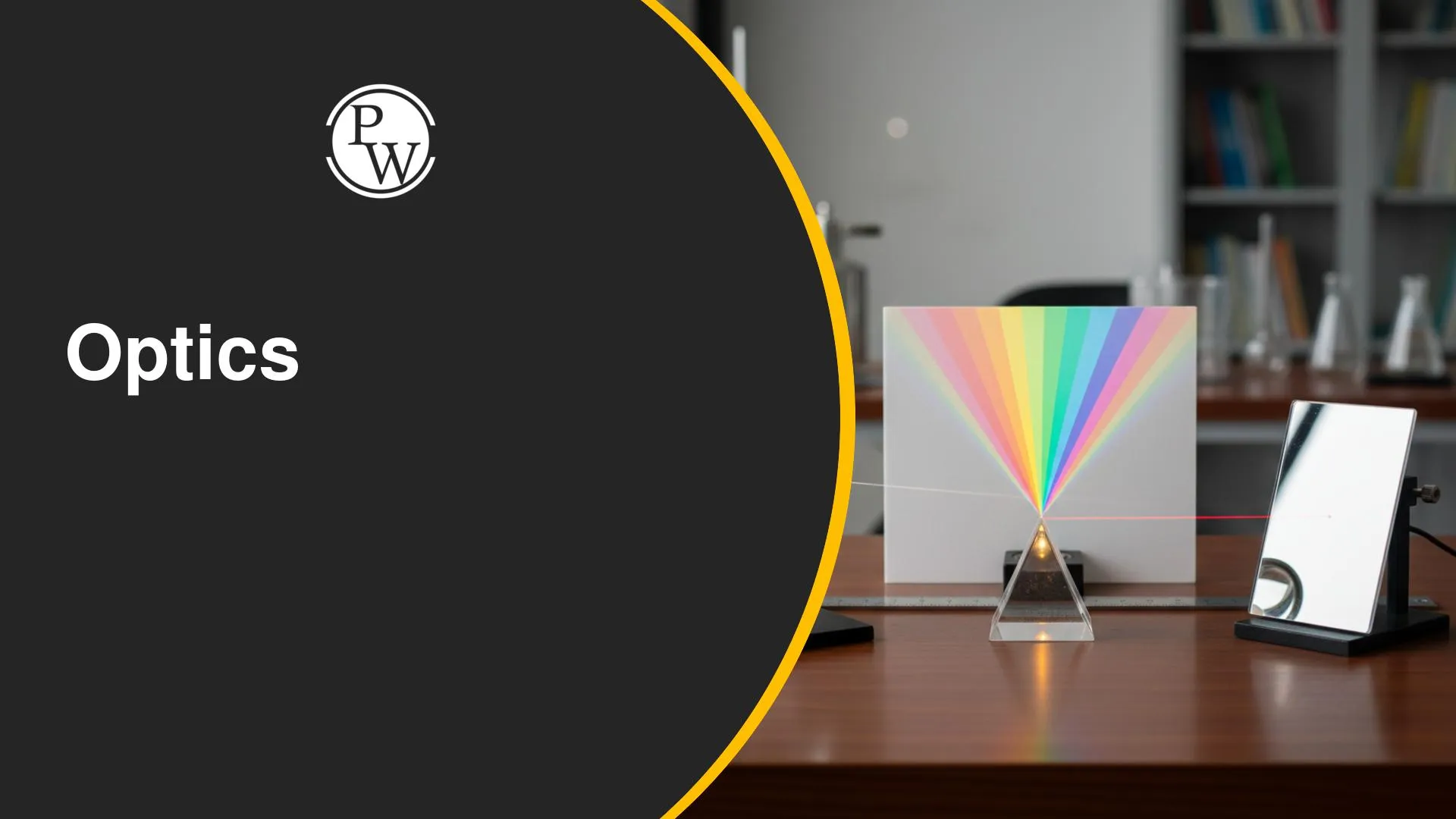
A Prism provides another important application of refraction. As light passes through the prism, it bends and undergoes deviation.
You learn how the angle of the prism and the refractive index influence the path of light. Prism-related concepts are also important for understanding dispersion, where white light splits into its constituent colours.
Numerical questions often involve deviation and minimum deviation conditions.
Optical Instruments
Optical Instruments are devices designed to improve vision and observation. Understanding their working principles is more important than memorising lengthy derivations.
-
Simple Microscope
-
Compound Microscope
-
Astronomical Telescope
Understanding Light as a Wave
While Ray Optics explains image formation successfully, some optical phenomena require a wave description of light.
This approach introduces the concept of wavefronts and explains how light propagates through space. Huygens' Principle plays an important role in understanding the behaviour of wavefronts and serves as the basis for several wave Optics concepts.
Interference of Light
Interference occurs when two coherent light waves overlap. Depending on their phase relationship, they can reinforce or cancel each other.
This produces alternate bright and dark regions known as interference fringes.
Young's Double Slit Experiment is one of the most important experiments in Physics because it demonstrates the wave nature of light.
A commonly used relation is: β = λD/d
, where β is fringe width, λ is wavelength, D is the distance of the screen from the slits, and d is the slit separation.
Questions involving fringe width and path difference are frequently asked in examinations.
Diffraction of Light
Diffraction refers to the bending and spreading of light when it encounters an obstacle or passes through a narrow opening.
This phenomenon shows that light does not always travel strictly in straight lines. It becomes particularly noticeable when the dimensions of the obstacle or opening are comparable to the wavelength of light.
For JEE, understanding the concept and distinguishing diffraction from interference is usually more important than extensive calculations.
Polarisation of Light
Polarisation is another important phenomenon that highlights the transverse nature of light waves.
In polarised light, vibrations are restricted to a specific direction. This concept has practical applications in sunglasses, photography, LCDs,, and various scientific instruments.
Questions often focus on the significance of polarisation and its role in proving that light is a transverse wave.
Optics provides a deeper understanding of how light behaves in different situations, from forming images through lenses to producing wave phenomena such as interference and diffraction. The concepts studied in this topic form the basis of many technologies used in daily life, including cameras, microscopes, telescopes, and optical communication systems. A clear understanding of image formation, refraction, and wave Optics concepts can help build confidence and improve performance in JEE Physics.
Physics Optics Syllabus FAQs
How should you prepare for your Optics for JEE?
Is Optics considered a difficult topic?
Which topics are most important in Optics for JEE?
What type of questions are commonly asked in Optics?
Are numerical questions important in Optics?









Get Free Counselling Today
and Clear up all your Doubts
 Live & recorded classes available at easeDashboard for progress trackingLakhs of practice questions

