








Physics Kinetic Theory of Gases and Thermodynamics JEE Mind Maps by Physics Wallah
 Avisha Das19 Jun, 2026
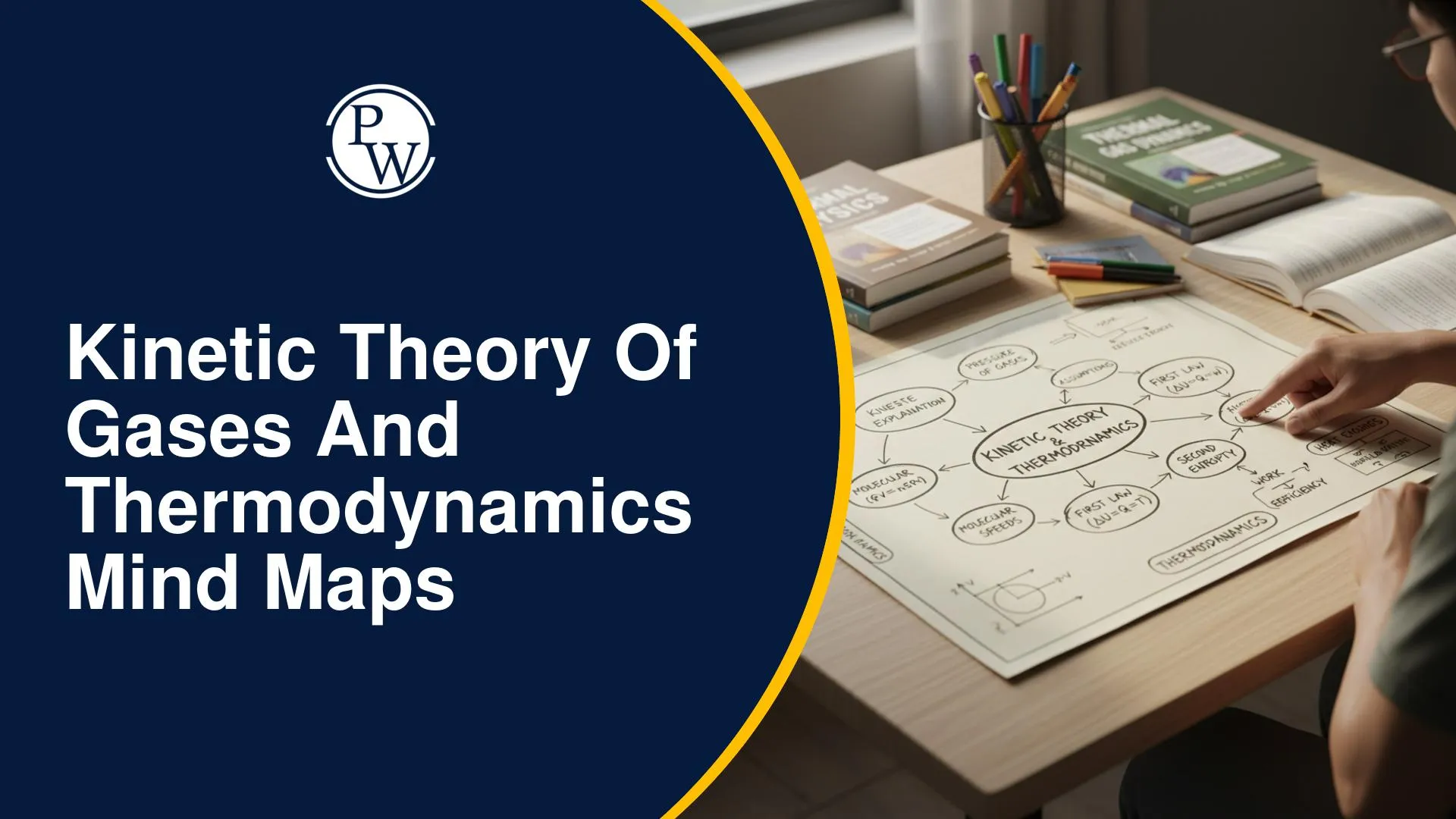
A gas inside a container may appear calm and uniform, but at the microscopic level, billions of particles are moving continuously and colliding with one another. The Kinetic Theory of Gases helps explain how this invisible motion gives rise to measurable properties such as pressure, temperature, and volume.
Thermodynamics takes this understanding a step further by studying how energy moves between systems and how heat is converted into work. Together, these topics form the foundation for understanding engines, refrigerators, atmospheric processes, and many natural phenomena. Physics Wallah provides Kinetic Theory of Gases and Thermodynamics JEE mind maps that help you bring together the key ideas of the topic in a visual format, making revision more efficient and concept-driven.
Kinetic Theory of Gases and Thermodynamics JEE Mind Maps PDF
The topic combines physical reasoning, mathematical relationships, and real-world applications. Revising the major concepts through a visual resource helps you understand how different principles are connected and applied in problem-solving.
Download the Kinetic Theory of Gases and Thermodynamics JEE mind maps PDF below and use it to strengthen your preparation before practice sessions and examinations.
Kinetic Theory of Gases and Thermodynamics JEE Mind Maps PDF
Why Use PW Kinetic Theory of Gases and Thermodynamics JEE Mind Maps?
The chapter Kinetic Theory of Gases and Thermodynamics requires you to move between particle-level explanations and large-scale physical behaviour. PW mind maps help simplify these transitions and improve conceptual understanding.
1. Helps You Connect Microscopic and Macroscopic Concepts
The PW mind maps make it easier to understand how molecular motion influences observable quantities such as pressure, temperature, and volume.
2. Supports Better Understanding of Physical Processes
Many questions involve analysing changes occurring within a system. Visual revision helps you track these processes more effectively.
3. Encourages Conceptual Learning Over Memorisation
The topic is built around a few fundamental principles. Mind maps help you focus on understanding these ideas rather than memorising isolated facts.
4. Helps Organise Multiple Related Concepts
Gas behaviour, energy transfer, and thermodynamic laws are closely connected. A visual overview helps you revise these ideas together.
5. Useful for Mixed Concept Questions in JEE
Questions often combine different parts of the topic. Mind maps help you recognise these connections and approach problems with greater confidence.
Kinetic Theory of Gases and Thermodynamics JEE Mind Maps FAQS
Why is the Kinetic Theory of Gases important in Physics?
What is the significance of the laws of thermodynamics?
Does Physics Wallah provide other resources for this topic?





Have questions about your prep?
Our experts can answer all your questions
 Live & recorded classes available at easeDashboard for progress trackingLakhs of practice questions

