








Physics Motion in a Plane JEE Mind Maps by Physics Wallah
 Avisha Das19 Jun, 2026
In the real world, objects rarely move along perfectly straight paths. A football kicked into the air, a bird flying across the sky, or a swimmer crossing a flowing river all move in more than one direction at the same time. Understanding such motion requires tools that go beyond simple one-dimensional kinematics.
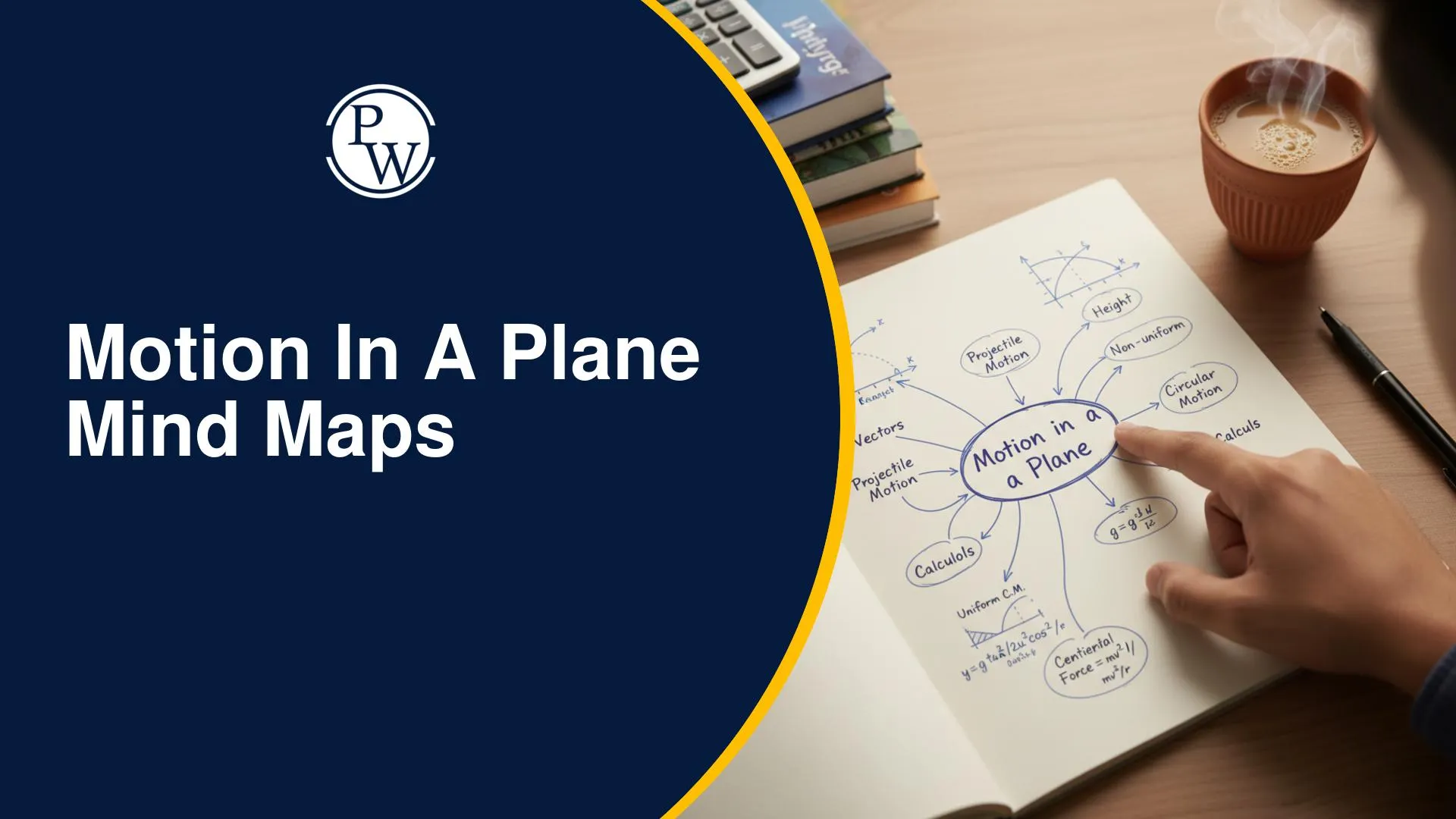
Motion in a Plane introduces vector-based thinking and shows how complex motion can be broken into simpler components. This approach makes it possible to study trajectories, analyse relative movement, and solve a wide variety of Physics problems. Physics Wallah provides Motion in a Plane JEE mind maps that help you connect graphical ideas, vector concepts, and problem-solving techniques through a concise visual revision resource.
Motion in a Plane JEE Mind Maps PDF
Motion in a Plane combines geometry, trigonometry, and Physics concepts in a way that requires both understanding and application. Revising the major topics together helps you develop a clearer picture of how motion behaves in two dimensions.
Download the Motion in a Plane JEE Mind Maps PDF below and use it to strengthen your preparation before practice sessions and examinations.
Motion in a Plane JEE Mind Maps PDF
Why Use PW Motion in a Plane JEE mind maps?
The chapter introduces several new ways of thinking about motion. Mind maps help organise these ideas and make them easier to apply in different situations.
1. Helps You Visualise Motion in Two Dimensions
Understanding movement along horizontal and vertical directions becomes easier when concepts are presented through connected visual summaries.
2. Makes Vector Concepts More Intuitive
Mind maps help you understand vector addition, resolution, and representation without treating them as isolated mathematical operations.
3. Strengthens Projectile Motion Analysis
Key ideas related to trajectory, range, and time of flight can be revised together, helping you approach projectile questions more confidently.
4. Connects Mathematics with Physical Motion
The chapter relies heavily on geometry and trigonometry, and visual revision helps you see how these mathematical tools are applied in Physics.
5. Develops Better Problem Interpretation Skills
Many questions require you to identify motion components correctly before beginning calculations. Mind maps help build this analytical approach.
Motion in a Plane JEE Mind Maps FAQs
Why are vectors important in Motion in a Plane?
What makes projectile motion different from straight-line motion?
How does relative motion help in solving Physics problems?





Have questions about your prep?
Our experts can answer all your questions
 Live & recorded classes available at easeDashboard for progress trackingLakhs of practice questions

