








Physics Work, Energy and Power JEE Mind Maps by Physics Wallah
 Avisha Das19 Jun, 2026
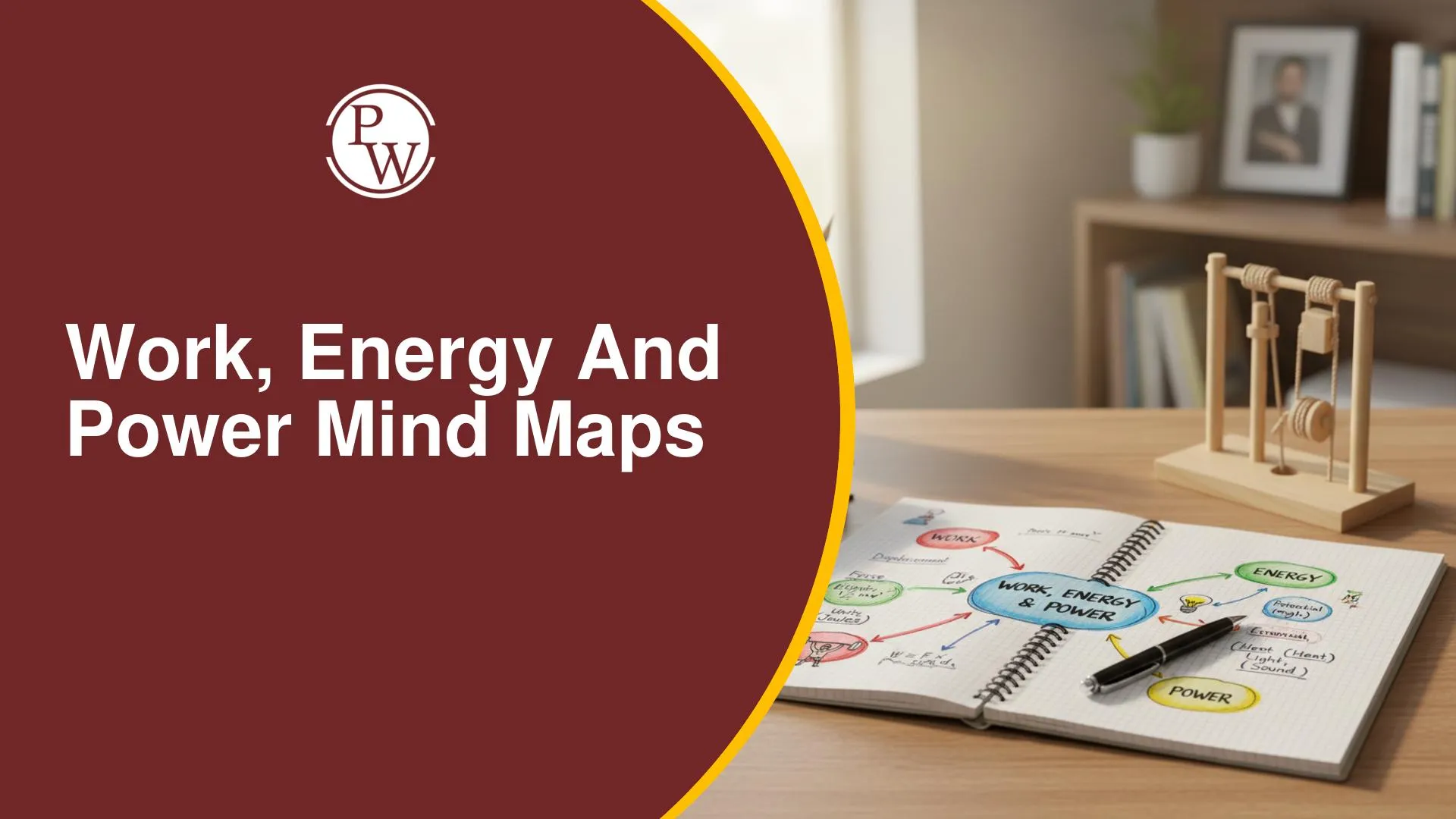
Not every Physics problem requires tracking every force acting on an object. In many situations, understanding how energy is transferred, stored, or transformed provides a much faster route to the solution. This is what makes Work, Energy, and Power one of the most practical and widely applied topics in mechanics.
From moving vehicles and falling objects to springs and collisions, energy concepts appear across a wide range of physical systems. The topic deepens your understanding of how motion and energy are connected, helping you solve problems more efficiently. Physics Wallah provides JEE mind maps on Work, Energy, and Power that bring together key concepts, energy relationships, and problem-solving approaches in a visual format for effective revision.
Work, Energy, and Power JEE Mind Maps PDF
Work, Energy and Power contains several interconnected ideas that are often tested together in JEE questions. Revising them through a visual resource helps you understand the bigger picture and apply concepts more confidently.
Download the Work, Energy, and Power JEE mind maps PDF below and use it to support your preparation during practice sessions and final revision.
Work, energy and Power JEE Mind Maps PDF
Why Use PW Work, Energy, and Power JEE Mind Maps?
Work, Energy and Power focuses on understanding how physical systems evolve rather than simply calculating forces. The PW mind maps help organise these relationships in a meaningful way.
1. Helps You Track Energy Transformations
PW mind maps make it easier to understand how energy changes from one form to another in different physical situations.
2. Connects Multiple Mechanics Concepts
The topic links motion, forces, and energy together. Visual revision helps you see how these ideas influence one another.
3. Simplifies Conservation Principles
Energy conservation is one of the most important tools in mechanics. Mind maps help you identify situations where this principle can be applied effectively.
4. Enhances Problem-Solving Efficiency
Many questions can be solved more quickly through energy methods than through detailed force analysis. Visual revision helps reinforce this approach.
5. Supports Advanced Mechanics Preparation
The concepts learned here continue to appear in rotational motion, oscillations, and several other Physics topics, making regular revision particularly valuable.
Work, Energy, and Power JEE Mind Maps FAQs
Why is the work-energy theorem important in JEE Physics?
When should I use the conservation of mechanical energy principle?
Does Physics Wallah provide other resources for this topic?





Have questions about your prep?
Our experts can answer all your questions
 Live & recorded classes available at easeDashboard for progress trackingLakhs of practice questions

