







Chemistry Purification and Characterisation of Organic Compounds JEE Syllabus
 Avisha Das1 Jul, 2026
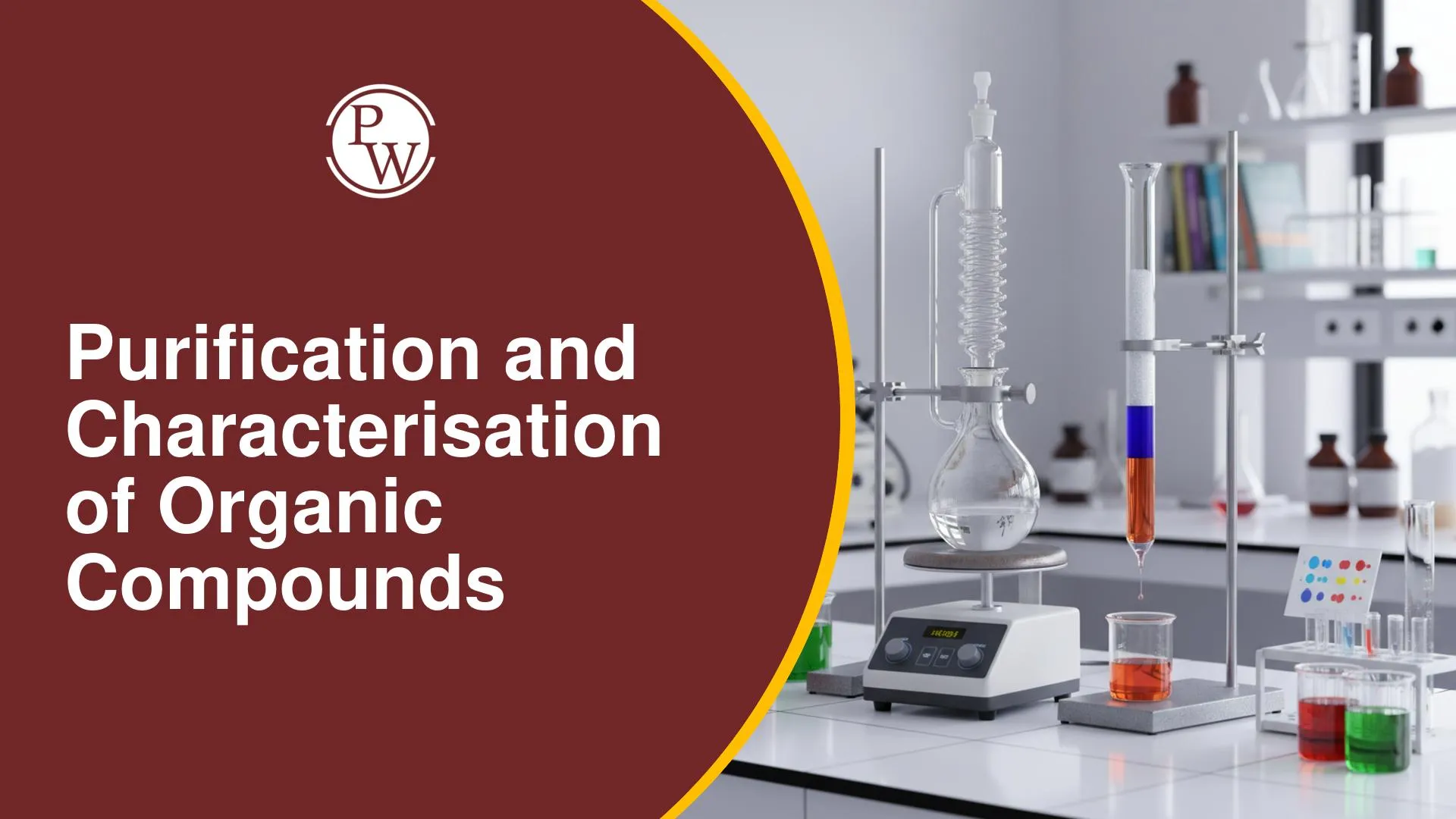
Organic Compounds obtained from chemical reactions are rarely pure. They often contain unreacted reactants, by-products, or other impurities that must be removed before the compound can be identified or used. The Purification and Characterisation of Organic Compounds chapter explains the methods used to purify organic substances and determine their composition and purity.
Knowing what is covered in this chapter helps you plan your preparation and focus on the most important concepts. Topics such as purification techniques, qualitative and quantitative analysis, empirical and molecular formulae, and molecular mass determination build the foundation for many Organic Chemistry concepts and are frequently tested in JEE.
Purification of Organic Compounds
Organic compounds are purified by choosing a method based on differences in physical properties such as boiling point, solubility, volatility, or sublimation temperature. Selecting the correct technique is important because each method works best for a specific type of impurity or compound.
Sublimation
Sublimation is used for solids that change directly from solid to vapour without passing through the liquid state.
Examples
-
Camphor
-
Naphthalene
-
Benzoic acid
Principle
One component sublimes while non-volatile impurities remain behind.
Crystallisation
Crystallisation is the most commonly used method for purifying solid organic compounds. It separates impurities because pure crystals form while most impurities remain dissolved in the solvent.
Properties of an ideal solvent
-
Dissolves the compound completely at high temperature.
-
Dissolves very little compound at low temperatures.
-
Does not react chemically with the compound.
-
Allows impurities to remain either completely soluble or completely insoluble.
Steps
-
Dissolve the impure sample in a minimum quantity of hot solvent.
-
Filter the hot solution if required.
-
Cool the solution slowly.
-
Collect the crystals by filtration.
-
Wash and dry the crystals.
Distillation
Distillation separates liquids on the basis of differences in their boiling points. It is also used to separate volatile liquids from non-volatile impurities.
Types
Simple Distillation
-
Used when the boiling point difference is greater than about 25 K.
-
Separates a volatile liquid from non-volatile impurities.
Fractional Distillation
-
Used for miscible liquids having close boiling points.
-
A fractionating column provides repeated condensation and vaporisation.
Steam Distillation
-
Used for high-boiling compounds that are steam volatile.
-
Prevents decomposition by lowering the effective boiling temperature.
Examples include essential oils and aromatic compounds.
Differential Extraction
Differential extraction separates compounds based on their different solubilities in two immiscible liquids.
Common solvent pair:
-
Water
-
Ether
The compound distributes itself between the two solvents according to its solubility.
Chromatography
Chromatography separates components because different substances move at different rates through a stationary phase under the influence of a mobile phase.
Principle
Separation occurs due to differences in adsorption or partition between the stationary and mobile phases.
Types
-
Paper chromatography
-
Thin Layer Chromatography (TLC)
-
Column chromatography
-
Gas chromatography
Retention Factor (Rf)
Rf = (Distance travelled by solute) ÷ (Distance travelled by solvent front)
Important Points
-
0 < Rf < 1
-
A characteristic of a compound under fixed experimental conditions.
-
Used for identification and purity testing.
Qualitative Analysis of Organic Compounds
Qualitative analysis identifies the elements present in an organic compound. The most commonly detected elements are carbon, hydrogen, nitrogen, sulphur, and halogens using characteristic chemical reactions.
Detection of Carbon and Hydrogen
Organic compounds are heated with copper(II) oxide.
Reactions
C + 2CuO → CO₂ + 2Cu
2H + CuO → H₂O + Cu
Observation
-
CO₂ turns lime water milky.
-
H₂O changes anhydrous copper sulphate from white to blue.
Lassaigne's Test
The organic compound is fused with sodium so that covalently bonded elements are converted into water-soluble ionic compounds.
Formation of sodium extract
Na + C + N → NaCN
2Na + S → Na₂S
Na + X → NaX
(X = Cl, Br, I)
Nitrogen Test
NaCN + FeSO₄ → Na₄[Fe(CN)₆]
On oxidation and acidification:
Fe₄[Fe(CN)₆]₃
Observation
Prussian blue colour confirms the presence of nitrogen.
Sulphur Test
Na₂S + Pb(CH₃COO)₂ → PbS↓ + 2CH₃COONa
Observation
A black precipitate of PbS confirms sulphur.
Halogen Test
NaX + AgNO₃ → AgX↓
Observation
-
AgCl → White precipitate
-
AgBr → Pale yellow precipitate
-
AgI → Yellow precipitate
Quantitative Analysis
Quantitative analysis determines the percentage composition of different elements present in an organic compound. These calculations are frequently asked in numerical problems.
Elements estimated
-
Carbon
-
Hydrogen
-
Nitrogen
-
Sulphur
-
Halogens
-
Oxygen
Carbon and Hydrogen Estimation
Estimated by combustion analysis.
%C = (12 × Mass of CO₂ × 100) ÷ (44 × Mass of sample)
%H = (2 × Mass of H₂O × 100) ÷ (18 × Mass of sample)
Nitrogen Estimation
Dumas Method
-
Based on the volume of nitrogen gas evolved.
Kjeldahl Method
-
Nitrogen is converted into ammonium sulphate.
-
Ammonia is liberated and estimated by titration.
-
Not applicable to nitro, azo, and diazo compounds.
Sulphur Estimation
Sulphur is converted into sulphate ions.
SO₄²⁻ + BaCl₂ → BaSO₄↓
The mass of BaSO₄ obtained is used to calculate the sulphur content.
Halogen Estimation
Carius Method
An organic compound is heated with fuming nitric acid.
AgNO₃ + X⁻ → AgX↓
The mass of AgCl, AgBr, or AgI is used for halogen estimation.
Empirical and Molecular Formula
Empirical and molecular formulae help determine the composition of an organic compound. Numerical questions based on these concepts are common in examinations.
Empirical Formula
Represents the simplest whole-number ratio of atoms.
Example:
C₆H₁₂O₆ → CH₂O
Molecular Formula
Represents the actual number of atoms present in one molecule.
Relationship:
Molecular Formula = (Empirical Formula) × n
where
n = Molar Mass ÷ Empirical Formula Mass
Molecular Mass Determination
Determining molecular mass helps identify unknown compounds and establish their molecular formula. Different experimental methods are used depending on the nature of the compound.
Victor Meyer Method
Used for volatile organic compounds.
The method is based on the volume of air displaced by the vapour of the compound.
Uses the ideal gas equation:
PV = nRT
to calculate molar mass.
Purification and Characterisation of Organic Compounds connects theoretical Organic Chemistry with practical laboratory techniques. Understanding the principles behind purification, elemental analysis, and molecular mass determination makes it easier to approach later Organic Chemistry chapters with confidence. A strong grasp of these concepts also helps solve application-based and numerical questions efficiently in JEE.
Purification and Characterisation of Organic Compounds JEE Syllabus FAQs
Why is the Purification and Characterisation of Organic Compounds important for JEE?
Which purification methods are most important?
Which reactions should I remember from this chapter?
Does Physics Wallah provide preparation resources for this chapter?







 Live & recorded classes available at easeDashboard for progress trackingLakhs of practice questions


