







Chemistry Redox Reactions and Electrochemistry JEE Syllabus
 Avisha Das4 Jul, 2026
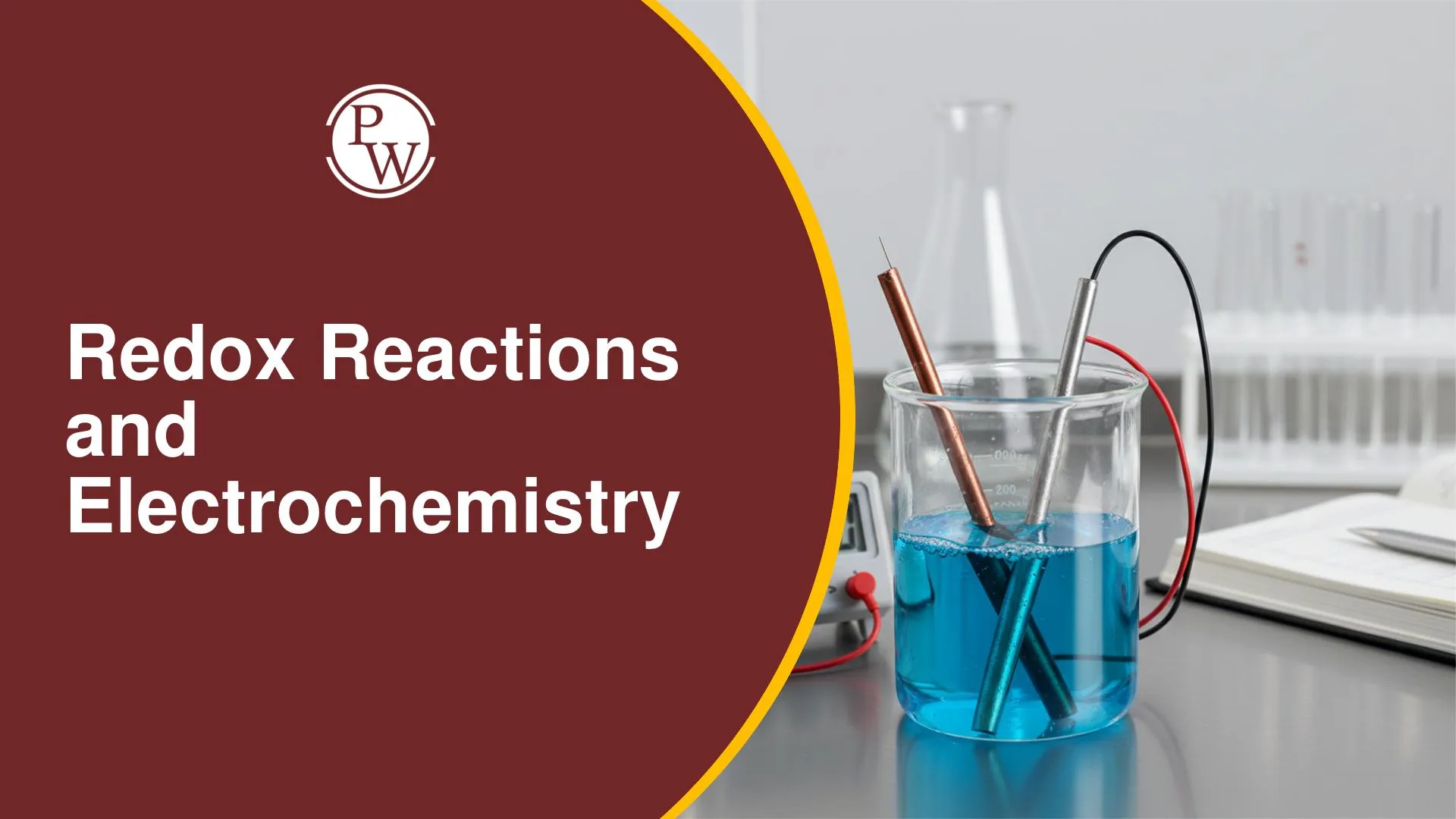
Why does a piece of iron slowly rust while a battery can power a device for hours? How can a chemical reaction produce electricity, and why is electricity able to drive chemical changes in return? Redox Reactions and Electrochemistry answers these questions by following the movement of electrons during chemical processes.
Knowing what Redox Reactions and Electrochemistry include before starting the chapter can make revision more focused. The chapter connects oxidation and reduction, balancing redox equations, electrochemical cells, electrode potential, conductance, electrolysis, and batteries into one flow of ideas. Understanding these major topics and how they relate to each other helps you approach both conceptual questions and numerical problems with greater confidence.
Redox Reactions and Oxidation Number
Many chemical reactions involve the transfer of electrons from one substance to another. Such reactions are known as redox reactions because oxidation and reduction always occur together.
Electron Transfer and Oxidation Number Concepts
According to the electronic concept:
-
Oxidation is the loss of electrons.
-
Reduction is the gain of electrons.
Example:
Zn → Zn²⁺ + 2e⁻
Cu²⁺ + 2e⁻ → Cu
In the above reaction:
-
Zinc is oxidized.
-
Copper ions are reduced.
The concept of oxidation number helps track the movement of electrons in a chemical reaction.
Some important rules for assigning oxidation numbers are:
-
Free elements have oxidation number zero.
-
The oxidation number of a monoatomic ion equals its charge.
-
Oxygen usually has an oxidation number of -2.
-
Hydrogen usually has an oxidation number of +1.
-
The sum of oxidation numbers in a neutral compound is zero.
-
The sum of oxidation numbers in an ion equals its overall charge.
Important types of redox reactions include:
Combination Reactions
A + B → AB
Decomposition Reactions
AB → A + B
Displacement Reactions
A + BC → AC + B
Disproportionation Reactions
The same element undergoes both oxidation and reduction.
Example:
2H₂O₂ → 2H₂O + O₂
Comproportionation Reactions
Two oxidation states of the same element combine to form an intermediate oxidation state.
Oxidizing agents gain electrons and are themselves reduced.
Reducing agents lose electrons and are themselves oxidized.
Balancing Redox Reactions
Complex redox equations often require systematic methods for balancing both atoms and charges.
Oxidation Number and Ion Electron Methods
Two standard methods are commonly used.
Oxidation Number Method
The steps involve:
-
Assign oxidation numbers.
-
Identify oxidation and reduction.
-
Calculate electron gain and loss.
-
Equalize electron transfer.
-
Balance remaining atoms.
-
Verify overall charge balance.
Ion Electron Method
This method is especially useful for reactions occurring in acidic or basic media.
General procedure:
-
Write oxidation and reduction half reactions.
-
Balance atoms except H and O.
-
Balance oxygen using H₂O.
-
Balance hydrogen using H⁺.
-
Balance charges using electrons.
-
Multiply half reactions to equalize electrons.
-
Add the balanced half reactions.
For reactions in basic medium:
H⁺ ions are neutralized by adding OH⁻ ions to both sides.
Balancing redox equations is an important skill because many electrochemistry problems begin with correctly balanced reactions.
Electrochemical Cells and Cell Potential
Certain redox reactions can be arranged in such a way that the transfer of electrons produces electrical energy. Devices based on this principle are called electrochemical cells.
Galvanic Cells and Electrode Potentials
A galvanic or voltaic cell converts chemical energy into electrical energy through a spontaneous redox reaction.
A typical example is the Daniell cell:
Zn | Zn²⁺ || Cu²⁺ | Cu
The main components are:
Anode
-
Oxidation occurs.
-
Negative electrode.
Zn → Zn²⁺ + 2e⁻
Cathode
-
Reduction occurs.
-
Positive electrode.
Cu²⁺ + 2e⁻ → Cu
Electrons always flow from anode to cathode through the external circuit.
Salt bridge functions:
-
Maintains electrical neutrality.
-
Completes the circuit.
-
Prevents direct mixing of solutions.
The standard cell potential is:
E°cell = E°cathode - E°anode
Conditions for a spontaneous reaction:
E°cell > 0
The relationship between free energy and cell potential is:
ΔG = -nFEcell
Under standard conditions:
ΔG° = -nFE°cell
where:
-
n = number of electrons transferred
-
F = Faraday constant
The equilibrium constant is related to cell potential by:
ΔG° = -RT ln K
These relationships connect electrochemistry with chemical thermodynamics.
Nernst Equation and Chemical Equilibrium
The potential of an electrochemical cell changes when the concentrations of reactants and products change. The Nernst equation provides a mathematical relationship between cell potential and concentration.
Concentration Effects and Equilibrium Constants
The Nernst equation for a general electrochemical cell is:
Ecell = E°cell - (RT/nF) ln Q
At 298 K, this equation becomes:
Ecell = E°cell - (0.0591/n) log Q
where:
-
Ecell = cell potential under given conditions
-
E°cell = standard cell potential
-
n = number of electrons transferred
-
Q = reaction quotient
For a metal-metal ion electrode:
Mⁿ⁺ + ne⁻ ⇌ M
The electrode potential is:
E = E° - (0.0591/n) log (1/[Mⁿ⁺])
At equilibrium:
Ecell = 0
Therefore,
E°cell = (0.0591/n) log K
The Nernst equation is widely used for:
-
Calculating electrode potentials.
-
Determining equilibrium constants.
-
Finding ionic concentrations.
-
Predicting the direction of redox reactions.
Conductance of Electrolytic Solutions
Electrolytes conduct electricity because they produce mobile ions when dissolved in water or melted. The movement of these ions under an electric field gives rise to electrical conductance.
Conductivity, Molar Conductivity, and Kohlrausch's Law
Electrical resistance is given by:
R = V/I
Conductance is the reciprocal of resistance:
G = 1/R
The specific conductance or conductivity is represented by:
κ = l/RA
where:
-
l = distance between electrodes
-
A = cross-sectional area
Molar conductivity is defined as:
Λm = κ × (1000/M)
where M is the molarity of the solution.
Important observations:
-
For strong electrolytes, molar conductivity increases slightly with dilution.
-
For weak electrolytes, molar conductivity increases sharply with dilution because ionization increases.
According to Kohlrausch's Law of Independent Migration of Ions:
At infinite dilution, each ion contributes independently to the total molar conductivity.
Λ°m = λ°+ + λ°-
Applications of Kohlrausch's Law include:
-
Determination of weak electrolyte conductivity.
-
Calculation of the solubility of sparingly soluble salts.
-
Determination of dissociation constants.
The degree of dissociation of a weak electrolyte is:
α = Λm/Λ°m
This concept is closely related to ionic equilibrium.
Electrolysis and Faraday's Laws
Electrolysis is the process in which electrical energy is used to bring about a non-spontaneous chemical reaction.
Electrolytic Cells and Quantitative Laws
An electrolytic cell converts electrical energy into chemical energy.
In an electrolytic cell:
-
Anode is positive.
-
Cathode is negative.
-
Oxidation occurs at the anode.
-
Reduction occurs at the cathode.
The products of electrolysis depend on:
-
Nature of electrolyte.
-
Nature of electrodes.
-
Magnitude of current.
-
Duration of electrolysis.
Faraday's First Law of Electrolysis
The mass of substance deposited or liberated is directly proportional to the quantity of electricity passed.
m ∝ Q
Since,
Q = It
Therefore,
m = ZIt
where:
-
m = mass deposited
-
Z = electrochemical equivalent
-
I = current
-
t = time
Faraday's Second Law of Electrolysis
When the same quantity of electricity passes through different electrolytes, the masses of substances liberated are proportional to their equivalent masses.
m₁/m₂ = E₁/E₂
One Faraday of electricity:
1F = 96500 C
One Faraday deposits one gram equivalent of a substance.
These laws are frequently used in JEE numerical problems involving electrolysis.
Batteries, Fuel Cells, and Corrosion
Electrochemical principles are widely applied in devices that store or generate electricity and in understanding the deterioration of metals.
Practical Applications of Electrochemistry
A battery is a combination of one or more electrochemical cells that converts chemical energy into electrical energy.
Primary Cells
These cannot be recharged after use.
Example:
-
Dry cell.
Secondary Cells
These can be recharged by passing an electric current.
Examples:
-
Lead storage battery.
-
Nickel-cadmium battery.
-
Lithium-ion battery.
A fuel cell continuously converts the energy of a fuel and an oxidizing agent into electricity.
The hydrogen oxygen fuel cell operates through the reaction:
2H₂ + O₂ → 2H₂O
Fuel cells are known for:
-
High efficiency.
-
Continuous operation.
-
Lower environmental pollution.
Another important application of electrochemistry is corrosion.
Corrosion is the gradual deterioration of a metal due to chemical or electrochemical reactions with the environment.
Rusting of iron is a common example.
Factors affecting corrosion:
-
Presence of moisture.
-
Presence of oxygen.
-
Electrolytes.
-
Impurities in metal.
Methods for preventing corrosion:
-
Painting.
-
Galvanization.
-
Alloy formation.
-
Cathodic protection.
-
Electroplating.
Understanding corrosion helps explain many industrial and engineering applications of electrochemistry.
Redox Reactions and Electrochemistry JEE Syllabus FAQs
1. Why are Redox Reactions and Electrochemistry important for JEE?
2. Which formulas should you remember from this chapter?
3. What is the difference between a galvanic cell and an electrolytic cell?







 Live & recorded classes available at easeDashboard for progress trackingLakhs of practice questions


