







Mathematics Sets, Relations and Functions JEE Syllabus

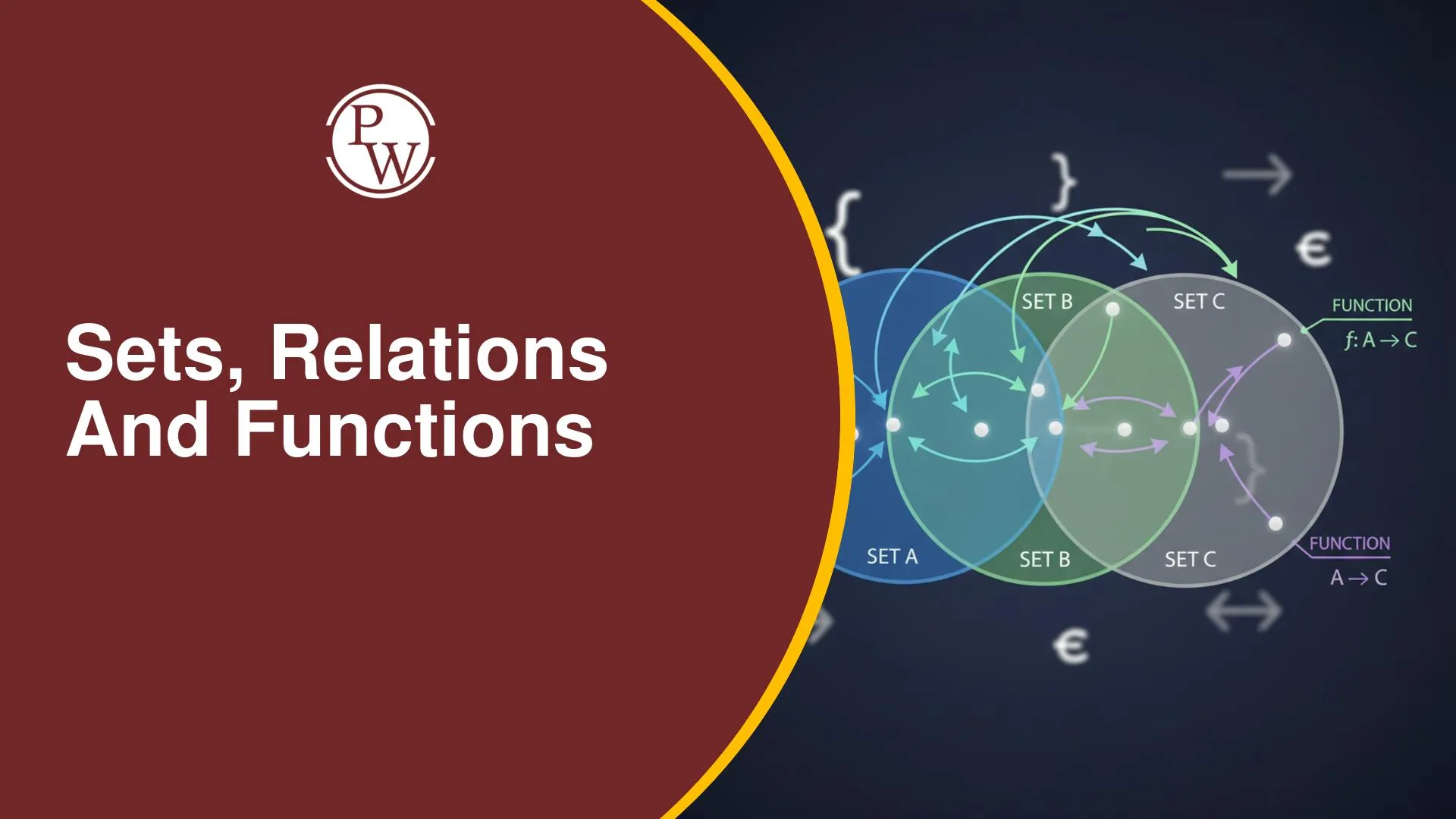
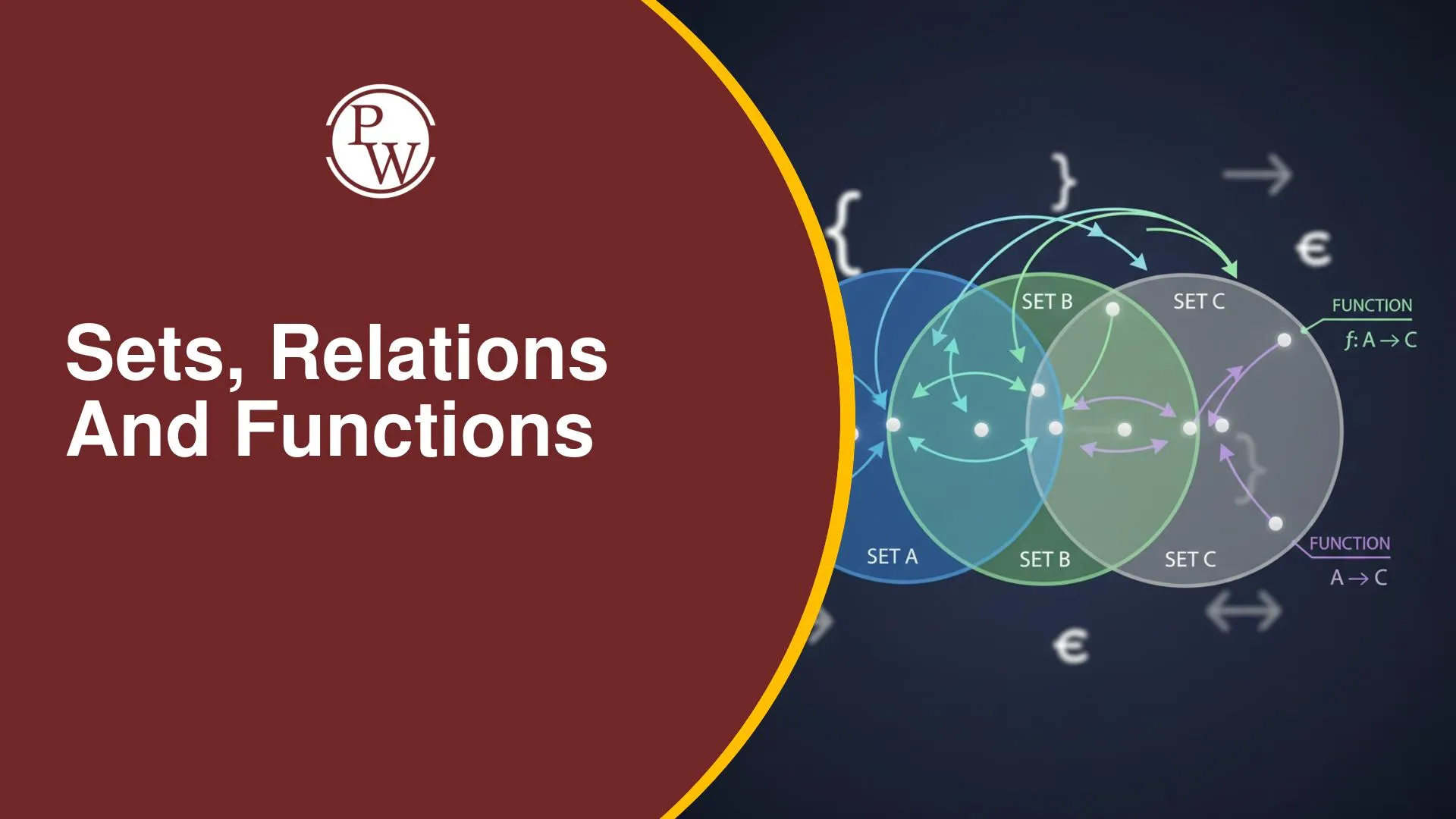
Sets, Relations and Functions introduces some of the most important concepts in mathematics. The chapter begins with sets, which are well-defined collections of objects used to organise and describe mathematical information. It then explores how sets can be represented, classified, and connected through operations such as union, intersection, and complement.
Building on these ideas, the chapter explains Cartesian products and relations, which establish connections between elements of different sets. It further introduces functions, a special type of relation that assigns exactly one output to each input. You also learn about domain, range, codomain, special functions, and operations on real-valued functions.
Sets
Sets are well-defined collections of distinct objects. The idea of a set helps in organising mathematical objects in a clear way, where membership of elements is always unambiguous.
Representation of Sets
Sets can be expressed in different forms depending on how information is given.
-
Roster Form: Elements are listed inside braces, e.g., {1, 2, 3}
-
Set-Builder Form: Elements are described using a property, e.g., { : x satisfies a condition}
These representations are interchangeable and used based on convenience in solving problems.
Types of Sets
Sets are classified based on the number and nature of elements they contain.
-
Empty Set: A set containing no elements, denoted by ∅
-
Finite Set: A set with a fixed number of elements
-
Infinite Set: A set with unlimited elements
-
Equal Sets: Two sets A and B are equal if they contain the same elements (A = B)
Subsets and Universal Set
A set A is a subset of B if every element of A is also an element of B.
A ⊂ B ⇔ x ∈ A ⇒ x ∈ B
Special cases:
-
Every set is a subset of itself: A ⊂ A
-
The empty set is a subset of every set: ∅ ⊂ A
The universal set (U) is the set of all elements under consideration in a given context.
Venn Diagrams and Set Operations
Venn diagrams provide a visual representation of sets and their relationships.
Union of Sets
A ∪ B = {x : x ∈ A or x ∈ B}
Intersection of Sets
A ∩ B = {x : x ∈ A and x ∈ B}
Complement of a Set
A′ = {x : x ∈ U and x ∉ A}
These operations are used to combine, compare, and analyse sets in logical and quantitative problems.
Cartesian Product of Sets
The Cartesian product of two sets forms ordered pairs from their elements.
A × B = {(a, b) : a ∈ A, b ∈ B}
If n(A) = m and n(B) = n, then:
n(A × B) = m × n
Key point: Order in pairs matters, so (a, b) ≠ (b, a).
Relations
A Relation is any subset of a Cartesian product that defines a connection between elements of two sets.
R ⊆ A × B
Domain, Range and Codomain
-
Domain: Set of all first components of ordered pairs
-
Range: Set of all second components
-
Codomain: Target set containing all possible outputs
Range is always a subset of the codomain:
Range ⊆ Codomain
Functions
A Function is a special type of relation in which every element of the domain has exactly one image in the codomain.
f: A → B such that each a ∈ A is associated with exactly one b ∈ B.
If f(a) = b:
-
b is called the image of a
-
a is called the pre-image of b
A relation fails to be a function if any input has either no output or more than one output.
Special Functions
Identity Function
f(x) = x
Constant Function
f(x) = c
Polynomial Function
f(x) = a₀ + a₁x + a₂x² + … + aₙxⁿ, where exponents are non-negative integers
These functions are frequently used as basic building blocks in algebra and calculus.
Algebra of Real Functions
Let f and g be real-valued functions.
-
Addition: (f + g)(x) = f(x) + g(x)
-
Subtraction: (f − g)(x) = f(x) − g(x)
-
Multiplication: (fg)(x) = f(x)g(x)
-
Scalar Multiplication: (αf)(x) = αf(x)
-
Division: (f/g)(x) = f(x)/g(x), g(x) ≠ 0
These operations allow the construction of new functions from existing ones.
Sets, Relations and Functions FAQs
What is a set in mathematics?
What are the two methods of representing a set?
What is an empty set?









Get Free Counselling Today
and Clear up all your Doubts
 Live & recorded classes available at easeDashboard for progress trackingLakhs of practice questions

