







Chemistry States of Matter: Gases and Liquids JEE PYQs with Solutions by PW
 Avisha Das14 Aug, 2026
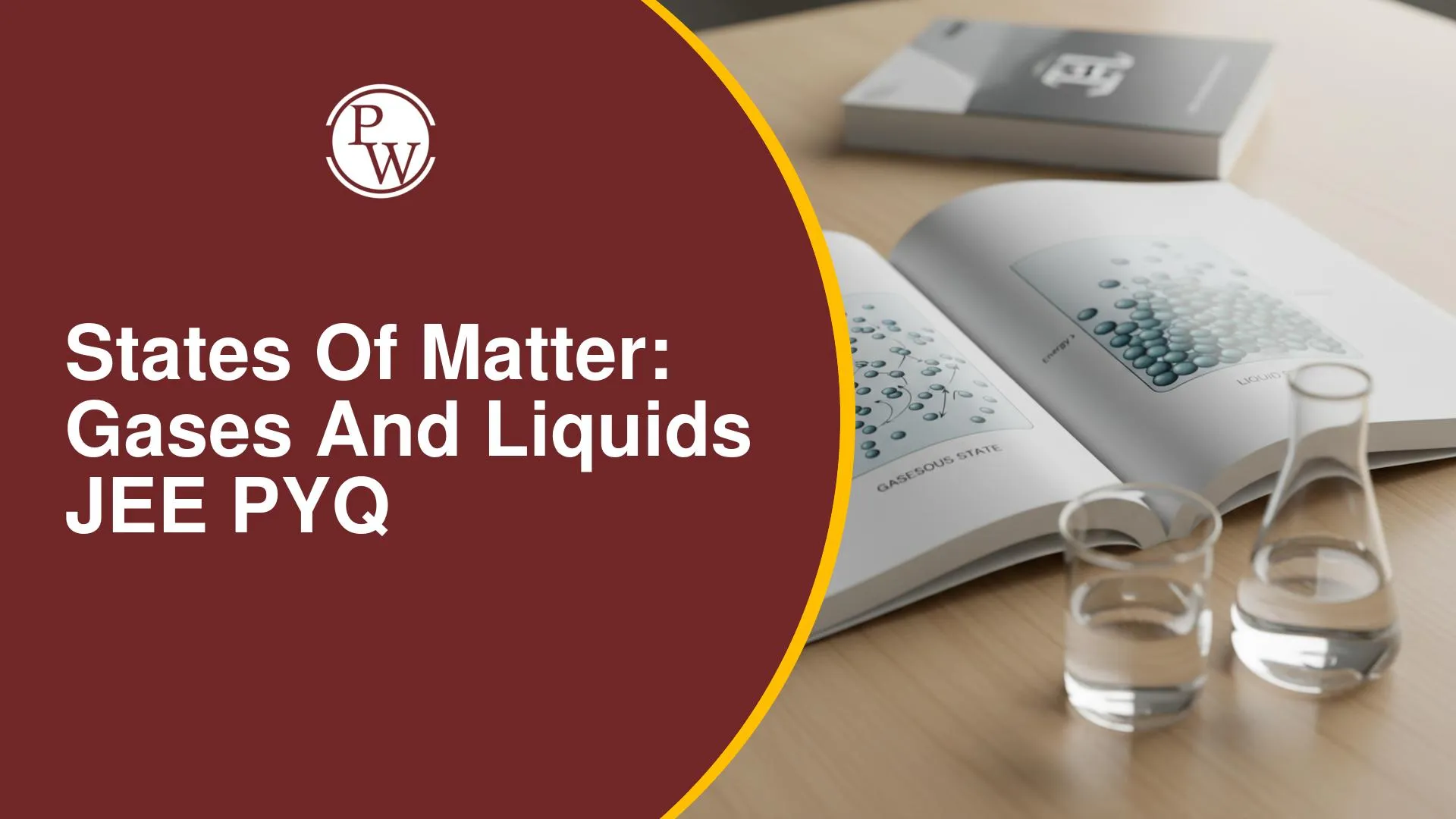
Pressure, temperature, and volume are closely linked to gases, whereas properties such as vapour pressure and surface tension depend on particle interactions. JEE uses these relationships to frame questions that test both calculation and conceptual understanding. For many students, the challenge is moving from memorising gas laws to applying them across changing conditions.
The States of Matter: Gases and Liquids JEE PYQs by PW includes previous-year questions from JEE Advanced, with solutions. Solving these questions gives you direct practice with the chapter's actual question formats and helps you understand how its concepts are used at different levels of the exam.
States of Matter: Gases and Liquids JEE PYQ PDF
Practise the chapter using the previous-year questions in the PDF, and check the solutions only after completing each question on your own.
States of Matter: Gases and Liquids JEE PYQ PDF
Why Solve the PW States of Matter: Gases and Liquids JEE PYQs?
PYQs help you revise the chapter while giving you a clearer idea of how its concepts and calculations appear in JEE. Use them to balance concept practice with exam-focused preparation.
1. Understand the JEE Question Pattern
See how gas and liquid properties are tested through numerical, conceptual, comparison-based, and statement-type questions.
2. Apply Real-Gas Concepts in JEE Advanced-Level Questions
Practise questions that go beyond ideal gas assumptions and test how intermolecular forces, pressure, temperature, and volume influence real-gas behaviour in more analytical JEE Advanced problems.
3. Improve Speed in Numerical Questions
Timed practice with gas-law problems can help you become faster at setting up equations and working through calculations during the exam.
4. Practise Gas-Law Relationships
Solve problems involving Boyle's law, Charles' law, Avogadro's law, the ideal gas equation, and combined changes in pressure, volume, and temperature.
5. Strengthen Concepts of Liquid Properties
Work with questions involving vapour pressure, surface tension, viscosity, and intermolecular forces to understand how these properties are tested.
States of Matter: Gases and Liquids JEE PYQs give you practical exposure to the calculations and concepts used to test this chapter in the exam. Practising questions from JEE Advanced can help you become more comfortable with changing conditions, gas-law applications, and liquid-state problems.
Also check
States of Matter Gases and Liquids JEE PYQ FAQs
Q. What topics are covered in States of Matter: Gases and Liquids JEE PYQs?
Q. Are solutions available with the PYQs?
Q. Is this chapter mainly numerical for JEE?
Q. What should I revise before solving these PYQs?








Get Free Counselling Today
and Clear up all your Doubts
 Live & recorded classes available at easeDashboard for progress trackingLakhs of practice questions

