







Physics Thermal Physics JEE Syllabus
 Chetali Baghel6 Jul, 2026
Have you ever noticed that railway tracks have small gaps between them or wondered why a hot cup of tea gradually becomes cold? Have you thought about how refrigerators keep food cold or why gases expand when heated? Thermal Physics helps you understand the science behind these everyday observations.
Thermal Physics is an important part of JEE Physics because it explains how heat is transferred, how materials behave when their temperature changes, and how gases respond under different conditions. You study concepts such as thermal expansion, calorimetry, heat transfer, kinetic theory of gases, and thermodynamics. Since the chapter contains both conceptual and numerical topics, regular revision and practice can help you solve questions quickly and accurately in JEE Main and JEE Advanced.
Temperature and Thermal Equilibrium
Temperature determines the direction in which heat flows. Heat always flows from a body at a higher temperature to a body at a lower temperature until both bodies attain thermal equilibrium.
Thermal equilibrium is based on the Zeroth Law of Thermodynamics, which states that if two bodies are separately in thermal equilibrium with a third body, they are also in thermal equilibrium with each other.
This principle forms the basis of temperature measurement and thermometer calibration.
Specific Heat Capacity
Specific heat capacity represents the amount of heat required to raise the temperature of a unit mass of a substance by one degree.
The relation is:
Q = mcΔT
where:
Q = heat supplied
m = mass
c = specific heat capacity
ΔT = temperature change
Water possesses a high specific heat capacity, which explains why coastal regions experience comparatively moderate temperatures.
Heat Capacity
Heat capacity refers to the amount of heat required to increase the temperature of an entire body by one degree.
It is represented as:
C = Q/ΔT
Heat capacity depends upon the mass of the substance, whereas specific heat capacity is an intrinsic property of the material.
Latent Heat
Latent heat is the heat absorbed or released during a change of state without any temperature change.
You should revise:
Q = mL
Where L represents latent heat.
Examples include the melting of ice and the evaporation of water.
Questions involving phase changes frequently appear in examinations.
Calorimetry
Calorimetry deals with the measurement of heat exchanged between bodies.
The principle of calorimetry states:
Heat lost = Heat gained
This concept is commonly applied in problems involving mixtures, heating and cooling.
Thermal Conductivity
Thermal conductivity describes the ability of a substance to conduct heat.
Copper, silver and aluminium are good conductors of heat, whereas wood, rubber and glass act as thermal insulators.
This concept explains why cooking utensils are made from metals while handles are often made from insulating materials.
Thermal Expansion
Have you ever noticed railway tracks containing small gaps between adjacent rails? These gaps are provided because materials expand when heated. Thermal expansion refers to the increase in dimensions of a substance due to an increase in temperature.
Linear Expansion
Linear expansion refers to the increase in length of a solid when its temperature rises.
The relation is:
ΔL = αLΔT
where:
α = coefficient of linear expansion
L = original length
ΔT = rise in temperature
This concept is used in bridges, pipelines and railway tracks.
Area Expansion
Area expansion explains the increase in surface area caused by heating.
It is represented by:
ΔA = βAΔT
where β is the coefficient of area expansion.
Volume Expansion
Volume expansion becomes important for liquids and gases because their volumes change significantly with temperature.
The expression is:
ΔV = γVΔT
Where γ denotes the coefficient of volume expansion.
Coefficient of Expansion
The coefficient of expansion indicates how much a substance expands per unit rise in temperature. Different materials possess different expansion coefficients, which explains why some materials expand more rapidly than others.
Anomalous Expansion of Water
Water behaves differently from most substances.
-
Between 0°C and 4°C, water contracts upon heating and attains maximum density at 4°C.
-
This phenomenon is known as the anomalous expansion of water.
-
It helps aquatic organisms survive during winters because lakes freeze from the top while the water beneath remains liquid.
Heat Transfer
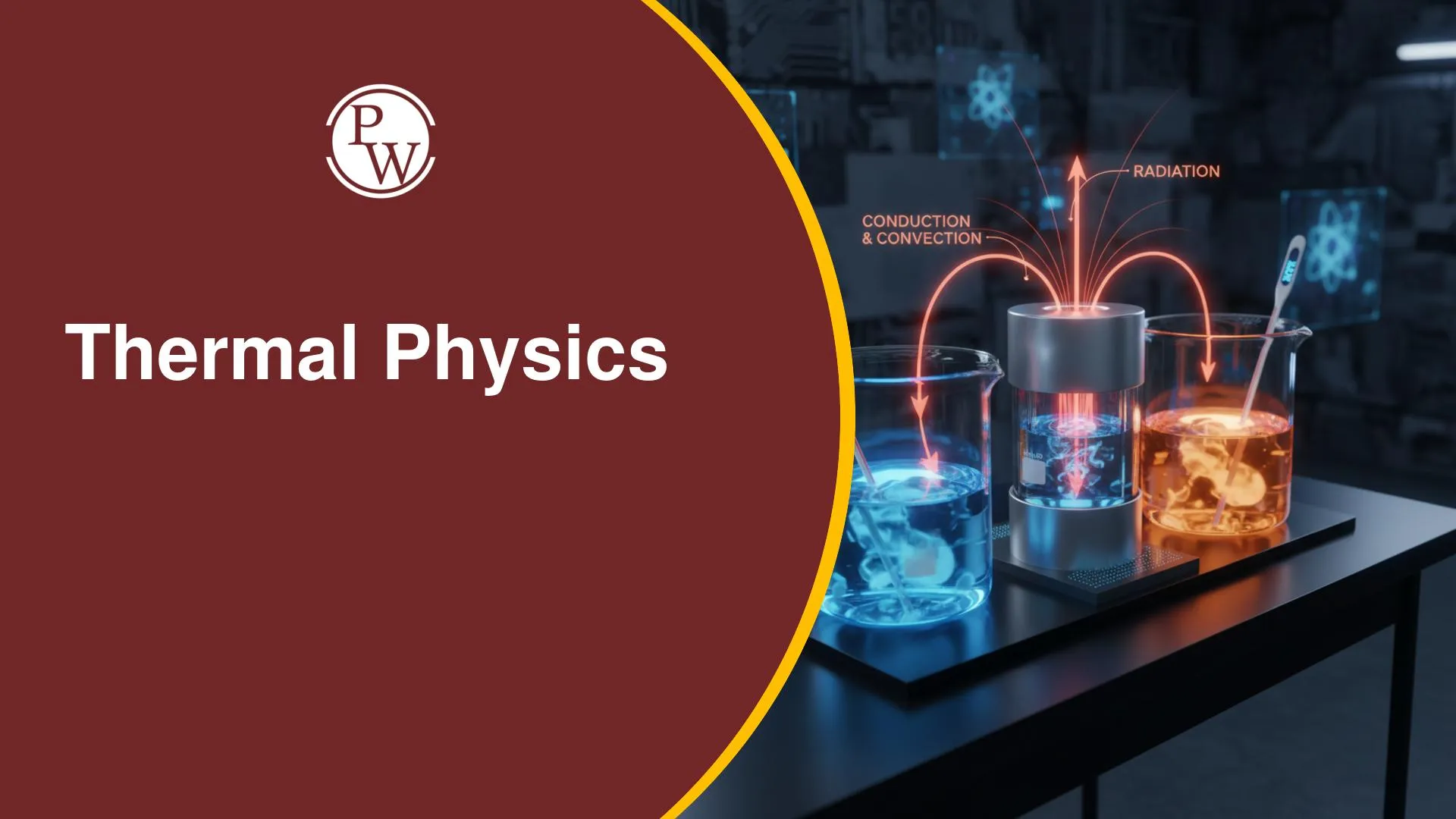
Heat transfer explains how thermal energy moves from one region to another because of temperature differences. Heat transfer occurs through three modes:
|
Mode |
Description |
|
Conduction |
Transfer of heat through direct molecular contact |
|
Convection |
Transfer of heat through the movement of fluids |
|
Radiation |
Transfer of heat through electromagnetic waves |
Conduction
Conduction mainly occurs in solids.
In this process, heat energy is transferred from particle to particle without actual movement of matter.
Examples include:
-
Heating of a metal rod
-
Hot cooking utensils
-
Ironing clothes
Metals conduct heat efficiently because they possess free electrons.
Convection
Convection occurs in liquids and gases.
Heat transfer takes place because warmer portions of the fluid rise while cooler portions move downward.
Examples include:
-
Sea breeze
-
Land breeze
-
Heating water in a vessel
-
Atmospheric circulation
Radiation
Radiation does not require a material medium.
Heat from the Sun reaches the Earth through radiation.
Black surfaces absorb heat more effectively, whereas shiny surfaces reflect heat efficiently.
This explains why solar cookers are generally painted black.
Kinetic Theory of Gases
The kinetic theory explains the behaviour of gases by considering molecular motion. It establishes a connection between microscopic molecular properties and measurable quantities such as pressure and temperature.
Ideal Gas Equation
The ideal gas equation combines Boyle's law, Charles' law and Avogadro's law.
PV = nRT
Questions based on gas mixtures and thermodynamic processes frequently utilise this equation.
Molecular Speeds
Gas molecules move continuously in random directions.
Three important molecular speeds are:
Root mean square speed:
vrms = √(3RT/M)
Average speed:
vavg = √(8RT/πM)
Most probable speed:
vmp = √(2RT/M)
You should remember:
vrms > vavg > vmp
Questions based on the comparison of molecular speeds are commonly asked.
Pressure of Gases
Gas pressure arises because molecules continuously collide with the walls of the container.
Pressure increases when temperature rises because molecular kinetic energy increases.
Degrees of Freedom
Degrees of freedom represent the number of independent ways in which a molecule can store energy.
Monatomic gases possess three degrees of freedom.
Diatomic gases generally possess five degrees of freedom at ordinary temperatures.
Equipartition Theorem
The equipartition theorem states that each degree of freedom contributes:
(1/2)kT
energy per molecule.
This theorem helps determine the internal energy of gases.
Mean Free Path
Mean free path represents the average distance travelled by a gas molecule between successive collisions.
At lower pressures, molecules travel larger distances before colliding.
Root Mean Square Speed
Root-mean-square speed is an important parameter used in numerical questions.
It depends directly upon temperature and inversely upon molecular mass.
Lighter gases generally possess higher RMS speeds.
Thermodynamics
Thermodynamics studies the relationship between heat, work and energy.
It is one of the most important sections in Thermal Physics because questions from this area appear regularly in JEE examinations.
Internal Energy
Internal energy represents the total energy possessed by molecules due to their motion and interactions.
For an ideal gas, internal energy mainly depends on temperature.
Heat Supplied
Heat supplied increases the internal energy of a system or enables the system to perform work.
Its SI unit is the joule.
Work Done by a Gas
When a gas expands, it performs work on the surroundings.
For constant pressure:
W = PΔV
Graphical questions involving P–V diagrams are commonly asked.
Thermodynamic Equilibrium
A system is said to be in thermodynamic equilibrium when thermal, mechanical and chemical equilibrium exist simultaneously.
First Law of Thermodynamics
The first law represents the conservation of energy.
ΔQ = ΔU + ΔW
where:
ΔQ = heat supplied
ΔU = change in internal energy
ΔW = work done
Questions based on sign conventions frequently appear in examinations.
Second Law of Thermodynamics
The second law determines the direction of natural processes.
Heat cannot spontaneously flow from a colder body to a hotter body.
It also explains why no heat engine can achieve 100% efficiency.
Thermodynamic Processes
Various thermodynamic processes are frequently tested in JEE examinations.
|
Process |
Constant Quantity |
|
Isothermal |
Temperature |
|
Adiabatic |
Heat exchange |
|
Isobaric |
Pressure |
|
Isochoric |
Volume |
Isothermal Process
Temperature remains constant.
PV = constant
For ideal gases:
ΔU = 0
Adiabatic Process
No heat exchange occurs.
Q = 0
PVγ = constant
Adiabatic expansion causes cooling, whereas adiabatic compression increases temperature.
Isobaric Process
Pressure remains constant.
Work done:
W = PΔV
Isochoric Process
Volume remains constant.
Since volume does not change:
W = 0
All supplied heat contributes towards increasing internal energy.
Heat Engines and Refrigerators
Heat engines and refrigerators explain how thermal energy is utilised in practical devices.
Carnot Engine
Carnot engine represents an ideal reversible heat engine.
Its efficiency is:
η = 1 − (T₂/T₁)
where:
T₁ = source temperature
T₂ = sink temperature
No practical engine can exceed Carnot efficiency.
Heat Engine Efficiency
Efficiency represents the fraction of heat converted into useful work.
η = W/Q₁
Higher efficiency indicates better performance.
Refrigerators
Refrigerators transfer heat from a colder region to a hotter region with the help of external work.
They operate according to thermodynamic principles.
Heat Pumps
Heat pumps transfer thermal energy to warm a region during colder conditions.
They function similarly to refrigerators but serve a different purpose.
Coefficient of Performance
For refrigerators:
COP = Q₂/W
A higher coefficient of performance indicates greater efficiency.
Thermal Physics is an important chapter that combines conceptual understanding with numerical problem-solving. By developing clarity in thermal expansion, calorimetry, heat transfer, kinetic theory and thermodynamics, you can strengthen your Physics preparation significantly. Since many concepts are interconnected, regular revision and consistent practice can help you make Thermal Physics one of the most dependable scoring areas in JEE Main and JEE Advanced.
Thermal Physics JEE FAQs
Is Thermal Physics important for JEE?
Which topics should you focus on the most?
Are derivations necessary for JEE preparation?
Is NCERT sufficient for Thermal Physics?
How can you revise Thermal Physics effectively?







Get Free Counselling Today
and Clear up all your Doubts
 Live & recorded classes available at easeDashboard for progress trackingLakhs of practice questions

