

Physics Thermodynamics JEE Syllabus
 Avisha Das15 Jun, 2026
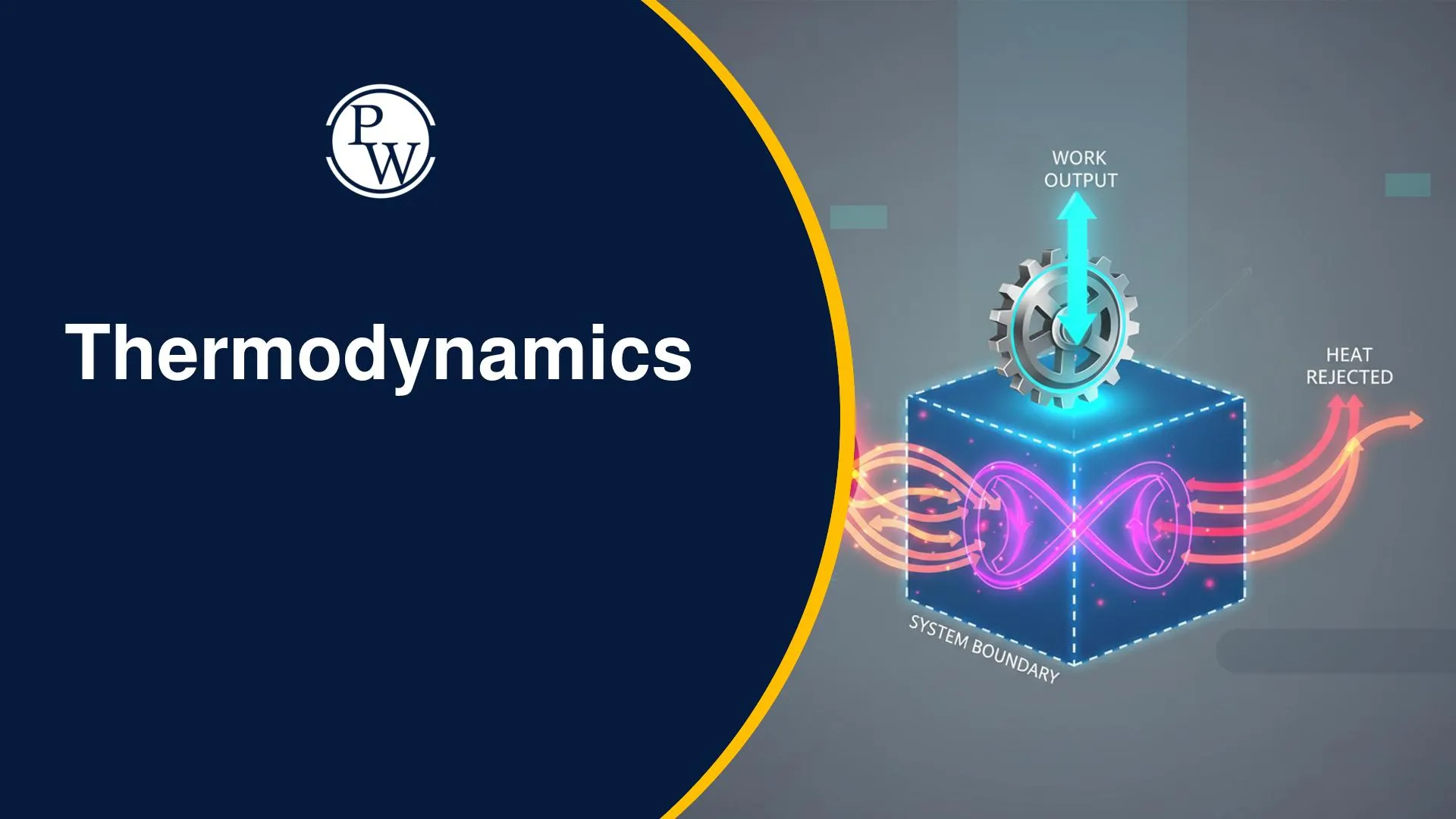
Energy is constantly changing its form around you. Fuel burns to run engines, ice melts into water, and refrigerators keep food cold by transferring heat from one place to another. Thermodynamics is the branch of physics that explains how heat, work, and energy are related and how these transformations take place according to well-defined physical laws.
Before you begin solving numerical problems, it is useful to understand what Thermodynamics includes. Knowing the syllabus helps you map out important topics such as the laws of thermodynamics, internal energy, specific heat capacities, thermodynamic processes, heat engines, and the Carnot cycle. Having a clear overview can make revision easier and help you approach JEE questions with greater confidence.
Thermal Equilibrium and the Zeroth Law of Thermodynamics
Thermodynamics deals with macroscopic concepts like heat, work, internal energy, and temperature. The zeroth law establishes a solid definition for temperature scales by looking at how separate systems reach thermal equilibrium.
Macroscopic State Parameters and Isothermal Constants
A system is in thermal equilibrium if its macroscopic variables (like pressure, volume, and mass) do not change over time when the system is isolated from its surroundings.
The Zeroth Law: If two thermodynamic systems, A and B, are each in thermal equilibrium with a third system C, then A and B are in thermal equilibrium with each other.
The Temperature Postulate: This law implies that a scalar property called Temperature (T) must exist. Systems in thermal equilibrium share the exact same temperature value, which determines the direction of spontaneous heat transfer.
Internal Energy (U) and Heat (Q)
Internal energy is the total energy bound within a system, including the kinetic and potential energies of its individual molecules. Heat measures the transfer of energy across a boundary driven by a difference in temperature.
Microscopic State Variations and Thermal Energy Flows
Internal energy is a state function, meaning its value depends entirely on the system's current state, not on the path taken to reach that state. Heat is a path function that tracks energy transfer.
Internal Energy for Ideal Gases: In an ideal gas, there are no intermolecular forces, so the potential energy is zero. Internal energy depends exclusively on temperature and the gas's degrees of freedom (f):
U = (f/2)nRT
Internal Energy Change (ΔU): For any thermodynamic process involving an ideal gas, the net change in internal energy is:
ΔU = nC_vΔT
(Where C_v = (f/2)R is the molar specific heat capacity at constant volume).
Work Done by a Gas (W)
Work represents the macroscopic energy transferred between a system and its surroundings due to a force causing a displacement. In thermodynamics, this work is typically driven by changes in pressure and volume.
P-V Coordinate Integrals and Path Dependences
Because work depends directly on the sequence of intermediate states a system passes through, it is classified as a path function. Geometrically, it equals the area under a pressure-volume curve.
General Calculus Formulation: For a gas expanding or compressing from an initial volume V_i to a final volume V_f:
W = ∫[V_i to V_f] P dV
Graphical Sign Conventions (Standard Physics Mapping):
Expansion (V_f > V_i): Work is done by the gas on its surroundings (W > 0). The area under the path curve counts as positive.
Compression (V_f < V_i): Work is done on the gas by its surroundings (W < 0). The area under the path curve counts as negative.
Cyclic Processes: On a P-V indicator diagram, a clockwise loop indicates net positive work, while a counterclockwise loop indicates net negative work.
The First Law of Thermodynamics (FLOT)
The first law of thermodynamics is a specific application of the principle of conservation of energy to thermal and mechanical systems.
Conservation Boundaries and State Summaries
The law states that heat energy added to a system is split between increasing the system's internal energy and doing mechanical work on the surroundings.
Mathematical Statement:
ΔQ = ΔU + ΔW
(Using differential notation: dQ = dU + dW = nC_v dT + P dV).
Sign Convention Checklist for JEE:
ΔQ > 0: Heat is absorbed by or supplied to the system.
ΔQ < 0: Heat is released or rejected by the system.
ΔW > 0: Work is done by the gas (expansion).
ΔW < 0: Work is done on the gas (compression).
ΔU > 0: Internal energy increases, causing the temperature to rise (T_f > T_i)
Specific Heat Capacities of Gases
The specific heat capacity of a gas measures the heat energy required to raise the temperature of a unit amount of the substance by one degree. This value changes depending on how pressure or volume is controlled during heating.
Molar Constants and Mayer’s Identity
Gases have two primary molar specific heat capacities: C_p (at constant pressure) and C_v (at constant volume). Their ratio determines how easily a gas changes temperature during adiabatic shifts.
Mayer’s Relation: Explains why C_p is always greater than C_v (heating at constant pressure requires extra energy to perform expansion work):
C_p - C_v = R
Adiabatic Index (γ): The ratio of specific heats, which depends on the molecular structure and degrees of freedom (f):
γ = C_p / C_v = 1 + 2/f
Degrees of Freedom Matrix:
|
Gas Molecular Type |
Degrees of Freedom (f) |
C_v |
C_p |
γ = C_p/C_v |
|
Monoatomic (e.g., He, Ar) |
3 |
(3/2)R |
(5/2)R |
5/3 ≈ 1.67 |
|
Diatomic / Linear Polyatomic (e.g., O₂, N₂) |
5 |
(5/2)R |
(7/2)R |
7/5 = 1.40 |
|
Non-Linear Polyatomic (e.g., H₂O, NH₃) |
6 |
3R |
4R |
4/3 ≈ 1.33 |
Standard Thermodynamic Processes
Thermodynamic processes can be classified into distinct types based on which state variable is held constant during the transformation.
State Variable Constants and Process Multipliers
Each standard process has unique path properties and energy conversion rules under the first law.
Isochoric Process (Constant Volume: V = Constant):
dV = 0 ⇒ W = 0.
First Law: ΔQ = ΔU = nC_vΔT. All added heat directly raises the internal energy.
Isobaric Process (Constant Pressure: P = Constant):
Work Formula: W = P(V_f - V_i) = nRΔT.
First Law: ΔQ = nC_pΔT ⇒ ΔQ = ΔU + ΔW.
Isothermal Process (Constant Temperature: T = Constant):
Governing Equation: PV = Constant (Boyle's Law).
Since ΔT = 0 ⇒ ΔU = 0.
Work Formula:
W = ΔQ = nRT ln(V_f / V_i)
= 2.303 nRT log₁₀(P_i / P_f).
Adiabatic Process (Zero Heat Exchange: ΔQ = 0):
Governing Path Equation:
PV^γ = Constant
⇒ TV^(γ-1) = Constant
⇒ T^γ P^(1-γ) = Constant.
Since ΔQ = 0 ⇒ ΔW = -ΔU.
Work Formula:
W = nR(T_i - T_f)/(γ - 1)
= (P_iV_i - P_fV_f)/(γ - 1).
Heat Engines and the Second Law of Thermodynamics
A heat engine is a device that operates in a cyclic process, absorbing heat from a high-temperature reservoir, converting a fraction of it into mechanical work, and rejecting the remainder to a low-temperature sink.
Efficiency Barriers and Thermal Sink Rejections
The performance of a heat engine is measured by its thermal efficiency (η), which tracks the ratio of net work output to total heat input.
Engine Efficiency Equation:
η = Net Work Done (W) / Heat Absorbed (Q₁)
= (Q₁ - Q₂) / Q₁
= 1 - Q₂/Q₁
(Where Q₁ is heat absorbed from the hot reservoir and Q₂ is heat rejected to the cold sink).
The Second Law of Thermodynamics:
Kelvin-Planck Statement: It is impossible to construct an engine operating in a cycle whose sole effect is to absorb heat from a single reservoir and convert it completely into an equivalent amount of work (η = 100% is physically impossible).
Clausius Statement: It is impossible for a self-acting machine, unaided by any external agency, to transfer heat from a cooler body to a hotter body.
The Carnot Cycle and Reversible Limits
The Carnot engine is an idealised, perfectly reversible thermodynamic cycle that operates at the maximum possible theoretical efficiency allowed by physical laws.
8.1 Isothermal-Adiabatic Quad Sequences
The Carnot cycle consists of four sequential stages: two alternating isothermal stages and two alternating adiabatic stages.
Pressure (P)
^
| A (P1, V1, T1) -> Isothermal Expansion
| \
| \--> B (P2, V2, T1) -> Adiabatic Expansion
| \
| \--> C (P3, V3, T2) -> Isothermal Compression
| /
| /
+----------D (P4, V4, T2) -> Adiabatic Compression
0----------------------------------------------> Volume (V)
The Four Carnot Stages:
Stage A → B: Reversible isothermal expansion at temperature T₁.
Stage B → C: Reversible adiabatic expansion dropping from temperature T₁ to T₂.
Stage C → D: Reversible isothermal compression at temperature T₂.
Stage D → A: Reversible adiabatic compression returning the gas to its initial state.
Maximum Theoretical Efficiency (η_carnot): For any reversible Carnot cycle, heat ratios match absolute temperature ratios (Q₂/Q₁ = T₂/T₁):
η_carnot = 1 - T₂/T₁
Refrigerator Coefficient of Performance (β): A refrigerator operates as a Carnot cycle running in reverse. Its performance index measures heat extraction relative to work input:
β = Heat Extracted From Sink (Q₂) / Work Input (W)
= Q₂ / (Q₁ - Q₂)
= T₂ / (T₁ - T₂)
Thermodynamics explains the relationship between heat, work, and energy, making it an important chapter for JEE Physics. Building a strong command over its laws and numerical applications can help you tackle both conceptual and calculation-based questions effectively.
Thermodynamics JEE Syllabus FAQs
1. Why is Thermodynamics important for JEE Physics?
2. Which topics carry the most weight in Thermodynamics for JEE?
3. Is memorizing formulas enough for Thermodynamics?