Class 10 Maths Chapter 9 Introduction to Trigonometry Most Important Questions By PW
 Ananya Gupta8 May, 2026
Physics Wallah’s Most Important Questions for Class 10 Trigonometry offer an exam-focused way to revise this formula and concept-heavy chapter while moving beyond memorization toward clear logical understanding. Covering core trigonometric ratios, standard angles, and identities that frequently appear in board exams, this set helps you practice what truly matters.
By working through these high-yield problems, you learn to connect geometric relationships with algebraic simplification more effectively. This systematic approach reduces confusion, strengthens your grasp of identities, and improves calculation accuracy. Whether you are simplifying expressions or finding unknown angles, this targeted practice helps turn trigonometry into a reliable scoring area for your upcoming board exams.
PW Most Important Questions for Class 10 Maths Chapter 9 Introduction to Trigonometry
Q.1: A tree breaks due to a storm and the broken part bends so that the top of the tree touches the ground, making an angle of 30° with it. The distance between the foot of the tree to the point where the top touches the ground is 8 m. Find the height of the tree.
Solution:
Using given instructions, draw a figure. Let AC be the broken part of the tree. Angel C = 30 degrees. BC = 8 m To Find: Height of the tree, which is ABQ.2: A tower stands vertically on the ground. From a point on the ground which is 25 m away from the foot of the tower, the angle of elevation of the top of the tower is found to be 45°. Then the height (in meters) of the tower is :
(a) 25 2 (b) 25 3 (c) 25 (d) 12.5
Solution:
Let the height of the tower be H m.
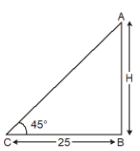
Thus, tan45°= Base/ perpendicular Or H/25 =1 Hence, H = 25m
Q.3: A ladder, leaning against a wall, makes anangle of 60° with the horizontal. If the foot of the ladder is 2.5 m away from the wall, find the length of the ladder. (2016OD)
Solution:
Let AC be the ladder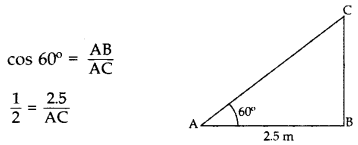 ∴ Length of ladder, AC = 5 m 2.5 m
Q.4: A ladder 15 m long just reaches the top of a vertical wall. If the ladder makes an angle of 60° with the wall, then calculate the height of the wall.
Solution:
∠BAC = 180° – 90° – 60o = 30° sin 30° = BCAC 12=BC15 2BC = 15 BC = 152mQ.4: In the given figure, a tower AB is 20 m high and BC, its shadow on the ground, is 203–√ m long. Find the Sun’s altitude.
Solution:
AB = 20 m, BC = 20 3 –√ m,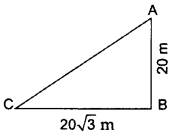 θ = ? In ∆ABC,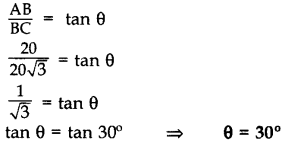
Q.5: The angles of depression of two ships from the top of a light house and on the same side of it are found to be 45° and 30°. If the ships are 200 m apart, find the height of the light house.
Solution:
Let AB be the height of the light house, D and C are two ships and DC = 200 m Let BC = x m, AB = h m In rt. ∆ABC,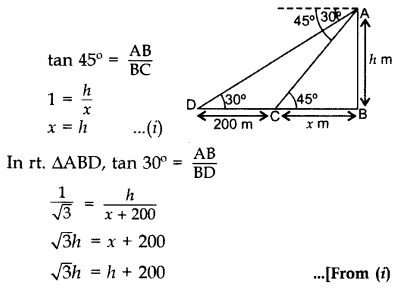
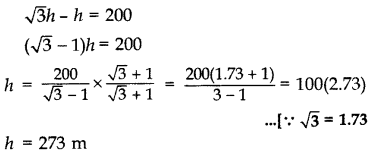 ∴ Height of the light house = 273 m
Q.6: The angle of elevation of the top of a tower is 30°. If the height of the tower is doubled, then the angle of elevation of its top will
(A) also get doubled (B) will get halved (C) will be less than 60 degree (D) None of theseSolution:
According to Question: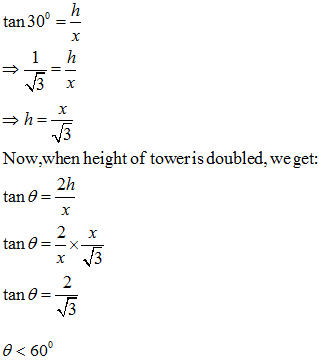
Q.7: If the height of a tower and the distance of the point of observation from its foot,both, are increased by 10%, then the angle of elevation of its top
(A) increases (B) decreases (C) remains unchanged (D) have no relation.Solution:
Since tan θ = h/x Where h is height and x is distance from tower, If both are increased by 10%, then the angle will remain unchanged.Q.8: As observed from the top of a 60 m high light house from the sea-level, the angles of depression of two ships are 30° and 45°. If one ship is exactly behind the other on the same side of the light-house, find the distance between the two ships. (Use 3 –√ = 1.732]
Solution:
Let AB = 60 m be the height of Light-house and C and D be the two ships. In right ∆ABC,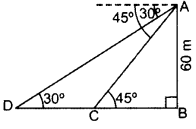
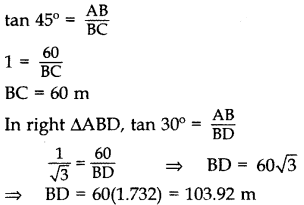 ∴ Distance between the two ships, CD = BD – BC = 103.92 – 60 = 43.92 m
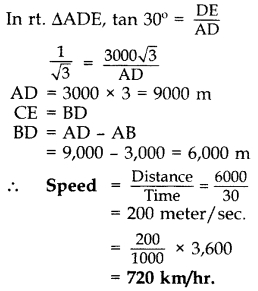
Q.9: The angle of elevation of an aeroplane from a point on the ground is 60°. After a flight of 30 seconds the angle of elevation becomes 30°. If the aeroplane is flying at a constant height of 3000 3 –√ m, find the speed of the aeroplane.
Solution:
Let A be the point on the ground and C be the aeroplane. In rt. ∆ABC,
Q.10: From the top of a 60 m high building, the angles of depression of the top and the bottom of a tower are 45° and 60° respectively. Find the height of the tower. (Take 3 –√ = 1.73] (2014OD)
Solution:
Let AC be the building & DE be the tower.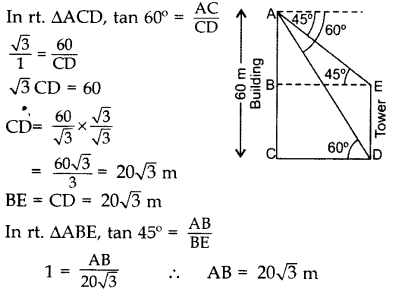 ∴ Height of the tower, DE = BC DE = AC – AB DE = 60 – 20 3 –√ = 20(3 – 3 –√ ) DE = 20(3 – 1.73) = 20(1.27) DE = 25.4 m
Q.11. The angles of depression of the top and bottom of a 50 m high building from the top of a tower are 45° and 60° respectively. Find the height of the tower and the horizontal distance between the tower and the building. [Use 3 –√ = 1.73].
Solution:
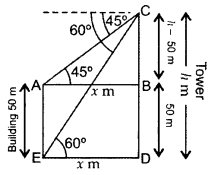 Let AE be the building and CD be the tower. Let height of the tower = h m and, the horizontal distance between tower and building = x m …[Given BD = AE = 50 m ∴ BC = CD – BD = (h – 50) m
 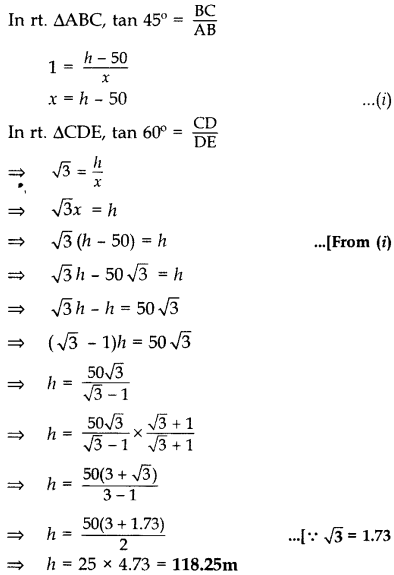 From (i), x = h – 50 = 118.25 – 50 = 68.25 m Height of the tower, h = 118.25 m ∴ Horizontal distance between tower and Building, x = 68.25 m
Q.12: A man standing on the deck of a ship, which is 10 m above water level, observes the angle of elevation of the top of a hill as 60° and the angle of depression of the base of hill as 30°. Find the distance of the hill from the ship and the height of the hill. (2016D)
Solution:
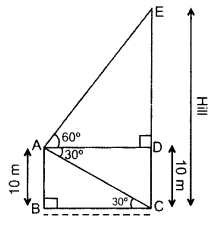 Let the man standing on the deck of a ship be at point A and let CE be the hill. Here BC is the distance of hill from ship and CE be the height of hill. In rt. ∠ABC, tan 30° = A B B C BC = 10 3 –√ m .(i) BC = 10(1.73) = 17.3 m …[:: 3 –√ = 1.73 AD = BC = 10 3 –√ m …(ii) [From (i) In rt. ∆ADE, tan 60° = D E A D ⇒ 3 –√ = D E 10 3 √ … [From (ii) ⇒ DE = 10 3 –√ × 3 –√ = 30 m ∴ CE = CD + DE = 10 + 30 = 40 m Hence, the distance of the hill from the ship is 17.3 m and the height of the hill is 40 m.
Q.13: From the top of a tower 100 m high, a man observes two cars on the opposite sides of the tower with angles of depression 30° and 45° respectively. Find the distance between the cars. (Use 3 –√ = 1.732]
Solution:
Let AB be the tower. In rt. ∆ABC, tan 45° = A B B C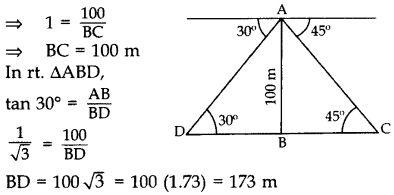 ∴ Distance between the cars, CD = BD + BC = 173 + 100 = 273 m
Q.14: Two poles of equal heights are standing opposite to each other on either side of the road, which is 100 m wide. From a point between them on the road, the angles of elevation of the top of the poles are 60° and 30° respectively. Find the height of the poles.
Solution:
Let AB and DE be the two equal poles and C be the point on BD (road). Let BC = x m Then CD = (100 – x) m Let AB = DE = y m In rt. ∆ABC,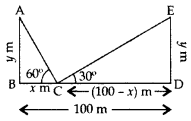
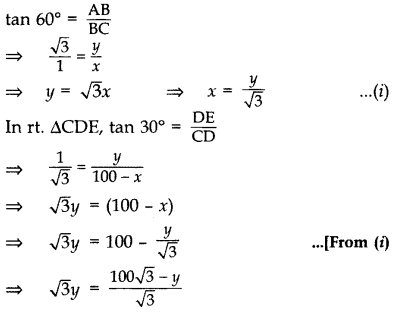 ⇒ 3y = 100 3 –√ – y ⇒ 4y = 100 3 –√ ∴ Height of the poles, y = 100 3 √ 4 = 25 3 –√ m = 25(1.73) = 43.25 m
Q.15: The angle of elevation of the top of a building from the foot of a tower is 30° and the angle of elevation of the top of the tower from the foot of the building is 60°. If the tower is 50 m high, find the height of the building.
Solution:
Let AB = 50 m be the tower and CD be the building. In rt. ∆ABC,