







How to Build Vocabulary for IPMAT 2027 Preparation?
 Aarti .2 Jun, 2026
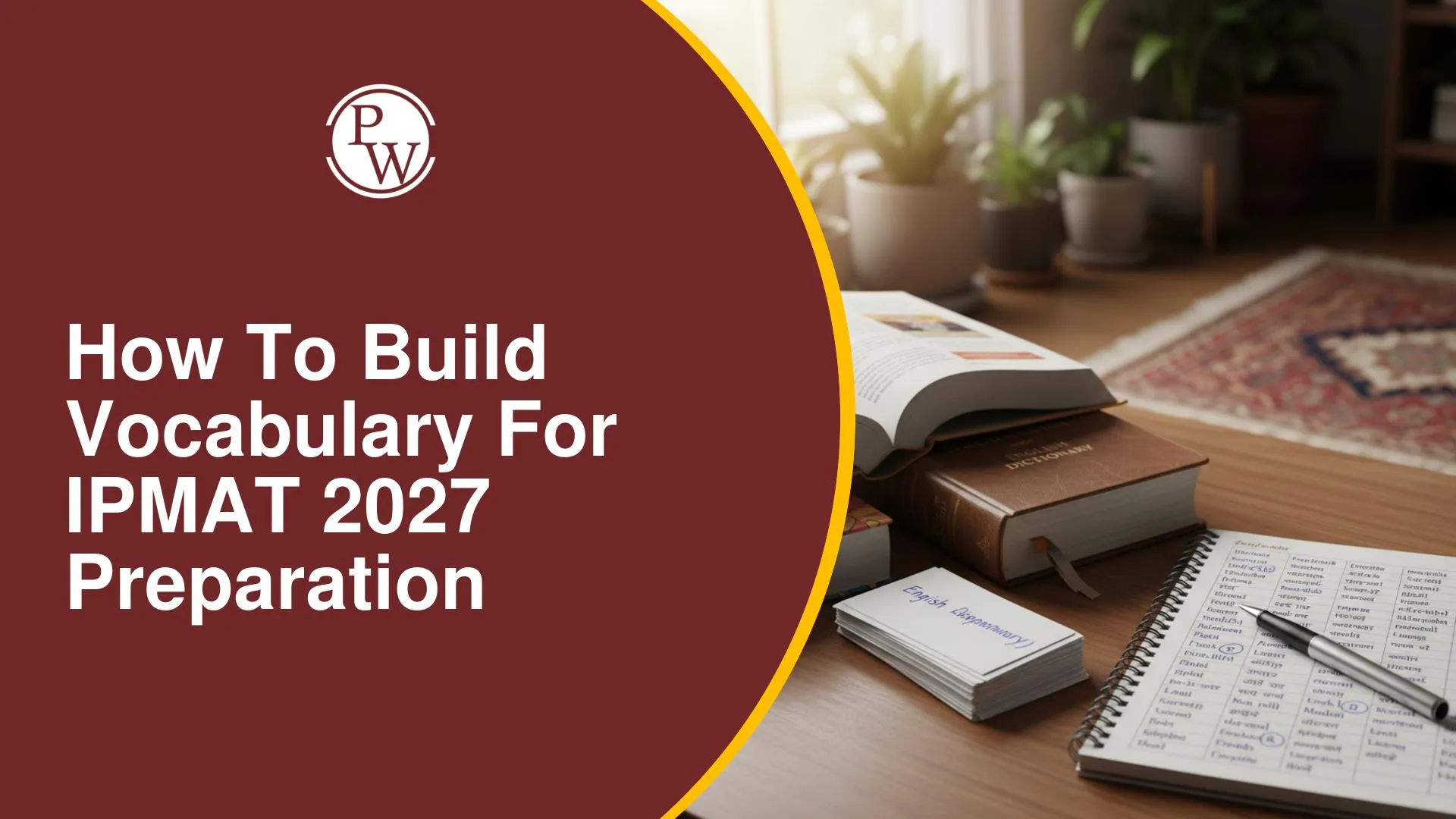
Vocabulary plays a crucial role in IPMAT 2027 preparation, especially in the English section, where candidates are tested on reading comprehension, verbal ability, sentence completion, and word usage. A strong vocabulary not only helps you understand complex passages faster but also improves your accuracy on verbal reasoning questions.
Since vocabulary development is a gradual process, aspirants should focus on consistent learning methods such as root words, flashcards, mnemonics, and regular reading. Check practical strategies and a study plan to help you build a strong vocabulary base for IPMAT 2027 below.
Methods to Build Vocabulary for IPMAT 2027
Effective vocabulary building for IPMAT 2027 involves multiple strategies, such as using root words, flashcards, mnemonics, vocabulary journals, and daily practice. Check below for detailed methods and practical tips to systematically enhance your word bank, improve comprehension, and boost performance in verbal sections of the exam.
The Root Word Approach
Many English words derive from Greek and Latin roots. Learning roots, prefixes, and suffixes enables candidates to logically decode unfamiliar words.
|
Root |
Meaning |
Example Words |
|
VER |
Truth |
Verity, Veracity, Verisimilitude, Aver, Veritable |
|
BEN |
Good |
Benevolent, Benefactor, Beneficiary, Bonafide |
|
MAL |
Bad |
Malicious, Malefactor, Malevolent, Malediction |
|
CRED |
Belief |
Credible, Credence, Credentials, Credulous |
|
PHIL |
Love |
Bibliophile, Philanthropic |
|
MIS |
Hate |
Misanthrope |
|
LOQ/LOC/LOG |
Speech |
Eloquent, Colloquial, Prologue |
Benefits of Root Words:
-
Allows logical deduction of meanings for unfamiliar words.
-
Reduces reliance on rote memorization.
-
Helps remember synonyms and antonyms for competitive exams.
Flashcards for Efficient Retention
Flashcards are a proven method to retain vocabulary effectively:
-
Material: Use thick paper or card stock; cut to the size of a playing card.
-
Front: Word + 2 synonyms + 2 antonyms
-
Back: Example sentence using the word
-
Daily Goal: 5 cards/day (~125 words including synonyms and antonyms)
-
Revision: Review in short bursts (1–2 minutes) whenever possible.
-
Usage: Incorporate these words in writing and speaking for better recall.
Flashcards move words from short-term to long-term memory and improve retention in exam conditions.
Mnemonics & Association Techniques
-
Create mnemonics for tricky words. Example: “Ben is never violent” for Benevolent.
-
Associate words with people, events, or experiences.
-
Helps in quick recall and deeper understanding during exams.
Vocabulary Journal & Learning
-
Maintain a journal to record words, synonyms, antonyms, and sample sentences.
-
Learn all forms of a word: noun, verb, adjective.
-
Review regularly for long-term retention.
Journals ensure words are understood in all contexts.
Daily Consistency
-
Dedicate 10–15 minutes daily for vocabulary practice.
-
Avoid cramming; practice is more effective.
-
Use multiple strategies: root words, flashcards, mnemonics, and journaling.
-
Incorporate learned words in daily discussions or writing exercises.
30-Day Vocabulary Building Plan
Building a strong vocabulary requires practice. Dedicate 10–15 minutes daily to flashcards, root words, mnemonics, and journals. Check below for a 30-day actionable plan to enhance your word bank for IPMAT 2027 systematically.
|
Day |
Activity |
Time |
|
1–5 |
Learn 5 root words/day, create 5 flashcards |
15 min |
|
6–10 |
Review previous cards + add 5 new words |
15 min |
|
11–15 |
Use words in sentences and discussions |
15 min |
|
16–20 |
Create mnemonic aids for 10 tricky words |
15 min |
|
21–25 |
Revise all flashcards, focus on synonyms/antonyms |
15 min |
|
26–30 |
Practice reading comprehension using new words |
15 min |
Why Vocabulary Matters for IPMAT 2027?
A strong vocabulary is essential for IPMAT 2027, as it improves reading comprehension, verbal reasoning, and sentence completion skills. Mastery of words enhances understanding of passages, aids in eliminating wrong options, and boosts overall performance in the English section.
-
Vocabulary is foundational for scoring high in the English section.
-
Strong word knowledge improves reading comprehension and understanding of complex passages.
-
Helps in eliminating wrong answer choices in verbal reasoning questions.
-
Enables interpretation of nuances, idioms, synonyms, and antonyms confidently.
How to Build Vocabulary for IPMAT 2027 Preparation FAQs
Why is vocabulary important for IPMAT 2027?
What is the root word approach?
How do flashcards help?
What is the most important advice for vocabulary?




Get Free Counselling Today
and Clear up all your Doubts
 Live & recorded classes available at easeDashboard for progress trackingLakhs of practice questions

