JKBOSE Class 11 Physics Waves: Wave Motion, Sound, Wave Equations and Speed of Waves


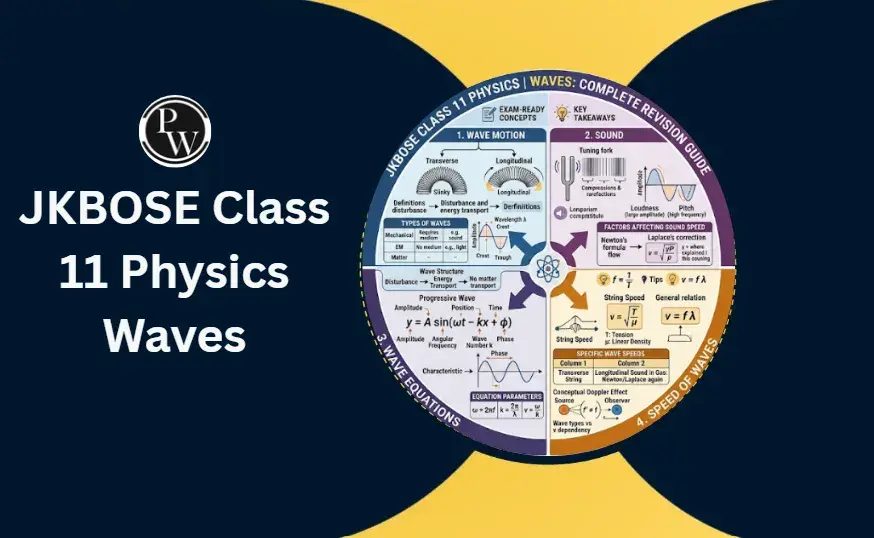
Understanding wave motion is important for learning how energy travels through different media. Students need to understand concepts such as wavelength, frequency, wave velocity, progressive waves and sound propagation to solve related numerical and conceptual questions. Remembering the different wave equations and speed formulas can also be challenging during revision.
This video covers the classification and properties of waves, progressive wave equations, sound waves and the speed of waves in different media. Important definitions, formulas and examples are explained below to help students revise JKBOSE Class 11 Physics Waves.
Students can also refer to the JKBOSE Class 11 Physics Syllabus 2026-27 to check the prescribed chapters, units and examination weightage.
What is a Wave?
A wave is a disturbance that travels with a definite velocity and transfers energy from one point to another without transferring matter.
When a wave travels through a medium, its particles vibrate about their mean positions. However, they do not permanently move along with the wave. Their collective vibrations create the appearance of a travelling disturbance.
For example, when a water wave travels forward, water particles move up and down around their mean positions.
The main characteristics of wave motion are:
-
A wave transfers energy from one place to another.
-
It does not transfer matter permanently.
-
Particles of the medium vibrate about their mean positions.
-
The disturbance travels with a definite velocity.
For chapter-wise revision, students can access the JKBOSE Class 11 Physics Notes PDF and review important definitions, formulas and numerical concepts.
Planning your JKBOSE Class 11 examination preparation? Visit the PW JKBOSE Class 11 Exam page to access class-wise syllabus, exam pattern, model papers, previous year question papers and other preparation resources in one place.
Classification of Waves
Waves are mainly classified into mechanical and electromagnetic waves. Mechanical waves are further divided into longitudinal and transverse waves.
Mechanical and Electromagnetic Waves
-
Mechanical waves require a material medium for propagation. They cannot travel through a vacuum. Sound waves are an example.
-
Electromagnetic waves do not require a material medium and can travel through a vacuum. Light is an example.
|
Feature |
Mechanical Waves |
Electromagnetic Waves |
|
Medium required |
Yes |
No |
|
Travel through vacuum |
No |
Yes |
|
Example |
Sound |
Light |
To understand other fundamental concepts of Physics, students can also explore Class 11 Physics Notes covering topics such as vectors, motion, force and wave motion.
Longitudinal and Transverse Waves
Mechanical waves are further classified according to the direction of particle vibration.
-
Longitudinal Waves: In these waves, particles vibrate parallel to the direction of wave propagation. They consist of compressions and rarefactions. Sound waves are an example.
-
Transverse Waves: In these waves, particles vibrate perpendicular to the direction of wave propagation. Vibrations produced in a guitar string are an example.
The main differences are:
|
Feature |
Longitudinal Waves |
Transverse Waves |
|
Particle vibration |
Parallel to wave direction |
Perpendicular to wave direction |
|
Wave pattern |
Compressions and rarefactions |
Crests and troughs |
|
Example |
Sound waves |
Guitar-string waves |
Water surface waves are discussed as transverse waves, while waves inside water are described as longitudinal waves.
Memory Tip: Longitudinal means vibration along the direction of the wave, whereas transverse means vibration perpendicular to the direction of the wave.
Progressive and Stationary Waves
Waves can also be classified according to their movement through the medium.
-
Progressive Waves: These waves continuously move forward with a definite velocity. They transfer energy from one point to another.
-
Stationary Waves: These waves do not advance through the medium. They remain confined between two boundaries and are formed when two waves travel in opposite directions and superimpose.
The main differences are:
-
Progressive waves move forward through the medium.
-
Stationary waves remain confined between two boundaries.
-
Progressive waves transfer energy through the medium.
-
Stationary waves have a fixed pattern between their boundaries.
Important Terms Related to Waves
Before studying wave equations, students should understand the basic terms associated with wave motion.
-
Crest and Trough
A transverse wave has two important points:
-
Crest: The uppermost point of a wave.
-
Trough: The lowermost point of a wave.
One complete oscillation represents one complete cycle.
-
Wavelength (λ)
Wavelength is the distance travelled by a wave during one complete vibration of a particle of the medium. It is represented by the symbol λ (lambda).
-
Wave Number (k)
Wave number represents the phase change per unit distance along the direction of wave propagation.
Its formula is:
k = 2π/λ
-
Wave Velocity (v)
Wave velocity is the distance travelled by a wave per unit time.
We know that:
Velocity = Distance / Time
For one complete wave, the distance travelled is λ and the time taken is T.
Therefore:
v = λ/T
Since frequency is the inverse of the time period:
f = 1/T
The wave velocity can also be written as:
v = fλ
-
Frequency and Angular Frequency
Frequency is the number of complete oscillations per unit time.
f = 1/T
Angular frequency is represented by ω (omega).
ω = 2π/T
It can also be written as:
ω = 2πf
The important wave quantities and their formulas are:
|
Quantity |
Formula |
|
Wavelength |
λ |
|
Wave number |
k = 2π/λ |
|
Frequency |
f = 1/T |
|
Angular frequency |
ω = 2πf |
|
Wave velocity |
v = fλ |
Equation of a Progressive Wave
The progressive wave equation describes the displacement of a particle at a particular position and time as the wave travels through a medium.
The equation depends on the direction of wave propagation.
-
Wave Travelling in the Positive X-Direction
When a progressive wave travels in the positive x-direction, its equation is:
y = a sin (ωt − kx)
-
Wave Travelling in the Negative X-Direction
When a progressive wave travels in the negative x-direction, its equation is:
y = a sin (ωt + kx)
Here:
-
a: Amplitude of the wave
-
ω: Angular frequency
-
t: Time
-
k: Propagation constant or wave number
-
x: Position coordinate
-
y: Displacement of the particle
The two equations can be compared as follows:
|
Direction of Wave Propagation |
Wave Equation |
|
Positive x-direction |
y = a sin (ωt − kx) |
|
Negative x-direction |
y = a sin (ωt + kx) |
Students should remember the signs used in both equations, as the direction of propagation determines whether the equation contains +kx or −kx.
Sound Waves
Sound waves are produced when particles vibrate and create disturbances that travel through a medium. These disturbances cause the eardrum to vibrate, and the resulting signals reach the brain, producing the sensation of sound.
Sound waves have the following characteristics:
-
They are mechanical waves.
-
They are longitudinal waves.
-
They require a material medium for propagation.
-
They show reflection, refraction and interference.
-
They cannot be polarised because they are longitudinal waves.
Students can also explore NEET Physics Notes for Class 11 to revise important Physics concepts and practise formula-based questions.
Audible Frequency Range
A normal human being can hear sound within a particular frequency range.
The audible frequency range is:
20 Hz to 20,000 Hz (20 kHz)
The speed of sound in air is also mentioned as approximately 332 m/s.
Speed of Waves in Different Media
The speed of a wave depends on the properties of the medium through which it travels. The speed of transverse waves in a stretched string and longitudinal waves in solids, liquids and gases is calculated using different formulas.
-
Speed of Transverse Waves in a Stretched String
When a string is stretched and vibrations are produced in it, transverse waves travel along the string.
The speed of a transverse wave in a stretched string is:
v = √(T/μ)
Where:
-
T: Tension in the string
-
μ: Mass per unit length of the string
The formula can be used to calculate the speed of transverse waves when the tension and mass per unit length are known.
The concept of isothermal and adiabatic processes is also important in thermodynamics. Students can revise these concepts through Class 11 Physics Notes Chapter-wise.
-
Speed of Longitudinal Waves in Solids
For longitudinal waves travelling through a solid, the speed depends on the elasticity and density of the material.
According to Newton's formula:
v = √(E/ρ)
Where:
-
E: Modulus of elasticity
-
ρ: Density of the solid
For a solid in which Young's modulus is considered, the formula becomes:
v = √(Y/ρ)
Here, Y represents Young's modulus of elasticity.
-
Speed of Longitudinal Waves in Liquids
For longitudinal waves travelling through liquids, the bulk modulus of elasticity is used instead of Young's modulus.
The formula is:
v = √(B/ρ)
Where:
-
B: Bulk modulus of elasticity
-
ρ: Density of the liquid
The speed of sound in water at 20°C is approximately 1480 m/s.
-
Speed of Longitudinal Waves in Gases
The speed of sound in gases involves the bulk modulus of elasticity and density. Newton and Laplace explained the behaviour of sound propagation in gases using different assumptions about temperature.
Newton's Isothermal Assumption
Newton considered sound propagation in gases to be an isothermal process.
An isothermal process is one in which temperature remains constant.
The ideal gas equation is:
PV = nRT
For an isothermal process, the temperature remains constant. Therefore, the equation can be differentiated to obtain:
P dV + V dP = 0
Rearranging:
P = −V (dP/dV)
The bulk modulus of elasticity is:
B = −V (dP/dV)
For an isothermal process, the bulk modulus becomes equal to pressure.
Therefore, according to Newton's assumption, the speed of sound in a gas is:
v = √(P/ρ)
Where:
-
P: Pressure of the gas
-
ρ: Density of the gas
JKBOSE Class 11 Physics Waves covers important concepts related to wave motion, wave classification, progressive wave equations, sound and wave velocity in different media. Students should focus on understanding the differences between longitudinal and transverse waves, remembering important wave quantities and practising the speed formulas for stretched strings, solids, liquids and gases.
Revising Physics for your JKBOSE Class 11 examination? Explore the JKBOSE CLASS 11 YouTube Channel to strengthen your understanding and make your examination preparation more focused.
JKBOSE Class 11 Physics Waves FAQs
What is a wave in Physics?
What is the difference between longitudinal and transverse waves?
What is the formula for wave velocity?
What is the equation of a progressive wave travelling in the positive x-direction?