



GK Questions on Incredible India for Class 1 Kids
 Yashasvi Tyagi21 Oct, 2026

Children are naturally curious about the world around them, and learning about India can help them understand their country better. However, remembering state capitals, identifying places on a map and learning about national leaders can be challenging for young learners. Parents can make these topics easier by introducing simple general knowledge questions with familiar examples and colourful pictures.
GK questions on Incredible India by Physics Wallah offer an enjoyable way to build a child’s awareness of the country. With maps, fun facts, short quizzes and regular practice, parents can help children learn about India’s identity, geography and important people without making learning feel like a task.
GK Questions on Incredible India
India is a country with many states, languages, festivals, historical places and cultural traditions. Parents can introduce these topics through simple questions and answers that children can understand and remember.
Fun Facts About India
Begin with interesting facts to spark your child’s curiosity about the country.
Did you know?
-
India is the seventh-largest country in the world by land area.
-
India has the world’s largest population.
-
The national flag of India has three colours: saffron, white and green, with a blue Ashoka Chakra in the centre.
-
The national animal of India is the Bengal tiger.
-
The national bird of India is the Indian peacock.
-
The national flower of India is the lotus.
Parents can use pictures of the Indian flag, tiger, peacock and lotus to help children remember these facts.
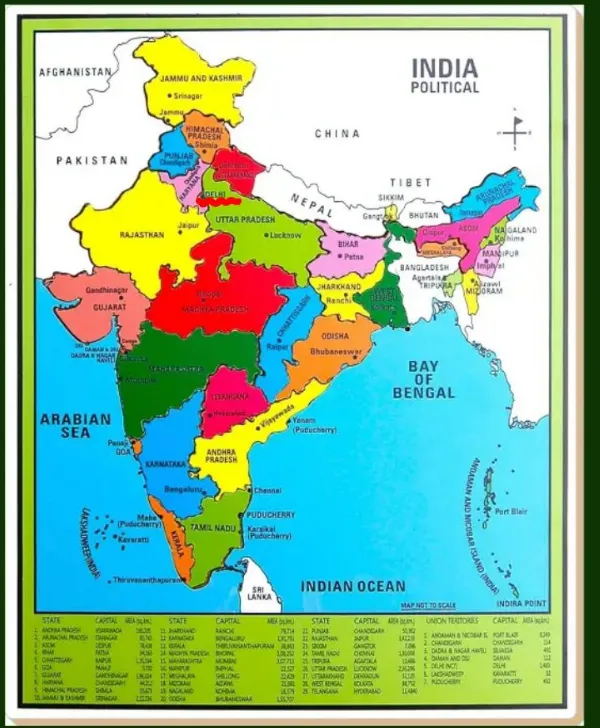
Political Map of India
A political map shows the boundaries of states and Union Territories. It also helps children locate different parts of the country and recognise the places they hear about.
India’s Capital and Official Identity
Introduce your child to a few basic facts about India.
|
Question |
Answer |
|
What is the official name of our country? |
Republic of India |
|
What is the capital of India? |
New Delhi |
|
What is the national flag of India called? |
The Tiranga |
|
What is the currency of India? |
Indian Rupee |
|
What is the national anthem of India? |
Jana Gana Mana |
Parents can explain that a capital city is an important place where the national government carries out its work.
States and Union Territories of India
India has 28 states and 8 Union Territories. States and Union Territories are different types of administrative regions. States have their own elected state governments, while Union Territories are administered under arrangements set by the Union Government; some also have elected legislatures.
The 28 States and Their Capitals
A state capital is the city where important state government offices are located. Learning state-capital pairs helps children become familiar with India’s geography.
|
No. |
State |
Capital |
|
1 |
Andhra Pradesh |
Amaravati |
|
2 |
Arunachal Pradesh |
Itanagar |
|
3 |
Assam |
Dispur |
|
4 |
Bihar |
Patna |
|
5 |
Chhattisgarh |
Raipur |
|
6 |
Goa |
Panaji |
|
7 |
Gujarat |
Gandhinagar |
|
8 |
Haryana |
Chandigarh |
|
9 |
Himachal Pradesh |
Shimla |
|
10 |
Jharkhand |
Ranchi |
|
11 |
Karnataka |
Bengaluru |
|
12 |
Kerala |
Thiruvananthapuram |
|
13 |
Madhya Pradesh |
Bhopal |
|
14 |
Maharashtra |
Mumbai |
|
15 |
Manipur |
Imphal |
|
16 |
Meghalaya |
Shillong |
|
17 |
Mizoram |
Aizawl |
|
18 |
Nagaland |
Kohima |
|
19 |
Odisha |
Bhubaneswar |
|
20 |
Punjab |
Chandigarh |
|
21 |
Rajasthan |
Jaipur |
|
22 |
Sikkim |
Gangtok |
|
23 |
Tamil Nadu |
Chennai |
|
24 |
Telangana |
Hyderabad |
|
25 |
Tripura |
Agartala |
|
26 |
Uttar Pradesh |
Lucknow |
|
27 |
Uttarakhand |
Dehradun |
|
28 |
West Bengal |
Kolkata |
Note for parents: Chandigarh is the shared capital of Punjab and Haryana. Some states also have seasonal or additional capital arrangements, so the table uses the commonly listed capitals for introductory learning.
Map of India and Its Neighbouring Countries
India is located in South Asia. It shares land borders with several countries and has maritime neighbours across the sea.
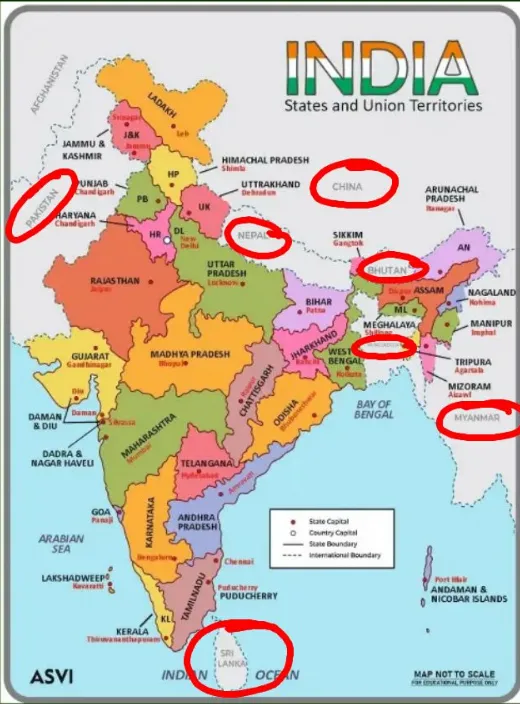
Parents can use the map to point out nearby countries and explain that countries, like states, have their own names and capital cities. Keep the activity simple by introducing one or two countries at a time.
Neighbouring Countries and Their Capitals
Children can learn about nearby countries through short question-and-answer pairs.
|
Country |
Capital |
|
Pakistan |
Islamabad |
|
China |
Beijing |
|
Nepal |
Kathmandu |
|
Bhutan |
Thimphu |
|
Bangladesh |
Dhaka |
|
Myanmar |
Naypyidaw |
|
Sri Lanka |
Sri Jayawardenepura Kotte |
Sri Lanka has Sri Jayawardenepura Kotte as its legislative capital, while Colombo is its major commercial city. It is a nearby maritime neighbour of India rather than a country sharing a land border with India.
Important National Leaders and Ministers of India
Children may hear the names of national leaders during school assemblies, on television or in conversations at home. Simple explanations can help them understand the different roles these people have.
|
Position |
Name |
Simple explanation |
|
President |
Droupadi Murmu |
The constitutional head of India |
|
Prime Minister |
Narendra Modi |
Leads the Union Government |
|
Home Minister |
Amit Shah |
Handles matters related to internal security and home affairs |
|
Defence Minister |
Rajnath Singh |
Leads the Ministry of Defence |
|
External Affairs Minister |
Dr. S. Jaishankar |
Handles India’s relations with other countries |
|
Finance Minister |
Nirmala Sitharaman |
Handles the country’s finances and budget |
*These names and portfolios reflect the official Union Council of Ministers list dated 15 October 2026.
Interactive Rapid-Fire Quiz
Once your child has read the facts, try this short quiz. Encourage them to answer aloud before revealing the answers.
Brain Check! Are You Paying Attention?
-
What is the capital of India?
-
What is the capital of Rajasthan?
-
Which country has Kathmandu as its capital?
-
What is the national animal of India?
-
What is the national bird of India?
-
Which two states share Chandigarh as their capital?
-
What is the capital of Maharashtra?
-
Who is the Prime Minister of India?
-
How many states are there in India?
-
What are the three colours of the Indian national flag?
Answers
-
New Delhi
-
Jaipur
-
Nepal
-
Bengal tiger
-
Indian peacock
-
Punjab and Haryana
-
Mumbai
-
Narendra Modi
-
28
-
Saffron, white and green
Parents can turn this quiz into a fun game by giving children time to think, offering clues when needed and celebrating their efforts.
GK Questions on Incredible India for Class 1 Kids PDF
Parents can use the PDF to help children practise GK questions about India, its states, capitals, neighbouring countries and important national facts.
GK Questions on Incredible India for Class 1 Kids PDF
Study without using the internet
How Can Parents Help Children Learn GK About India?
Parents play an important role in making general knowledge interesting for young children. Instead of asking children to memorise long lists, introduce facts through small activities they can enjoy.
-
Use maps and pictures: Point out India, your home state and New Delhi on a map. Pictures can make unfamiliar names easier to remember.
-
Ask a few questions daily: Practise three to five questions during breakfast, after school or before bedtime.
-
Connect facts with everyday life: If your family visits a new city, talk about the state it belongs to. Festivals, food and local landmarks can also introduce children to India’s diversity.
-
Play matching games: Write state names on one set of cards and capitals on another. Let your child match the pairs.
-
Repeat without pressure: Revisit previously learned questions through short quizzes. Encourage effort and treat mistakes as opportunities to learn.
The goal is to help children become curious about India and comfortable answering simple questions, rather than expecting them to remember every fact immediately.
Learning about Incredible India can help Class 1 children build general knowledge and develop an early interest in their country. Parents can make the process enjoyable by using maps, pictures, simple questions and short quizzes. With regular practice and encouragement, children can gradually become familiar with India’s capital, states, neighbouring countries and national leaders.
GK Questions on Incredible India for Class 1 Kids FAQ
What are some easy GK questions about India for Class 1?
How can parents teach Indian states and capitals to young children?
How many states and Union Territories are there in India?


Have questions about your prep?
Our experts can answer all your questions